Hamilton Graveside Remembrance at Trinity Church (July 14, 2014)

On July 14, 2014, the AHA Society and Trinity Church, hosted a graveside remembrance in honor of the 210th anniversary of Hamilton’s death.  The event flyer states:

July 14th, 210 years ago, was the day of Alexander Hamilton’s funeral, in which a funeral procession led from his brother-in-law John B. Church’s home to Trinity Church, where he was buried. His funeral was one of the most attended funerals in New York City history.

Come join together in remembering Alexander Hamilton on the anniversary of his funeral in the Trinity Churchyard. This special program will include participation by the US Coast Guard, Sector New York, which was founded by Alexander Hamilton, and remarks by Peter Dodge, the President of the New York State Society of the Cincinnati. Mr. Dodge will speak on the history of the Society of the Cincinnati (of which Alexander Hamilton was a member and second President-General), plus the role the Society played in coordinating and leading the 1804 funeral procession for Alexander Hamilton.

The below video, created by Arthur Piccolo, a long-time Hamilton supporter and Chairman of the Bowling Green Association, is a great documentation of the events.

The Trinity Church webcast, containing the full talk by Dr. Joanne Freeman on Alexander Hamilton: Man of Honor is available here.  Dr. Freeman’s talk focused on the importance that Hamilton placed on honor throughout his life, from his childhood in the West Indies, to his conduct during the Revolution, and to the decisions that led to the duel with Aaron Burr.  Freeman has a very interesting perspective on Hamilton and is an engaging speaker, so I encourage you to listen to the whole lecture if you have an hour to spare.

Eliphalet Nott’s “On the Death of Hamilton” and the Condemnation of Dueling

Eliphalet Nott, a notable clergyman in Albany, used the occasion of Hamilton’s death in 1804 to deliver a widely-publicized condemnation of the practice of dueling.  Nott’s sermon was “one of several sermons delivered by prominent preachers at that time, and having for their immediate purpose the breaking up of the custom of dueling.”  William Jennings Bryan also included the sermon in his collection of The World’s Famous Orations, published in 1906, over 100 years after the duel., and it was considered an example of the principles of elocution.

Nott began his sermon with a passionate description of the many facets of Hamilton’s career and personal life that made him worthy of national acclaim.

Would to God my talents were adequate to the occasion. But such as they are, I devoutly proffer them to unfold the nature and counteract the influence of that barbarous custom which, like a resistless torrent, is undermining the foundations of civil government, breaking down the barriers of social happiness, and sweeping away virtue, talents, and domestic felicity in its desolating course. Another and an illustrious character—a father—a general—a statesman—the very man who stood on an eminence and without a rival among sages and heroes, the future hope of his country in danger—this man, yielding to the influence of a custom which deserves our eternal reprobation, has been brought to an untimely end.

The Hero, called from his sequestered retreat, whose first appearance in the field, tho a stripling, conciliated the esteem of Washington, our good old father. Moving by whose side, during all the perils of the Revolution, our young chieftain was a contributor to the veteran’s glory, the guardian of his person, and the copartner of his toils.

The Conqueror, who, sparing of human blood when victory favored, stayed the uplifted arm and nobly said to the vanquished enemy, “Live!”

The Statesman, the correctness of whose principles and the strength of whose mind are inscribed on the records of Congress and on the annals of the council chamber; whose genius impressed itself upon the Constitution of his country; and whose memory the government—illustrious fabric, resting on this basis—will perpetuate while it lasts; and shaken by the violence of party should it fall, which may Heaven avert, his prophetic declarations will be found inscribed on its ruins.

The Counselor, who was at once the pride of the bar and the admiration of the court; whose apprehensions were quick as lightning, and whose development of truth was luminous as its path; whose argument no change of circumstances could embarrass; whose knowledge appeared intuitive; and who, by a single glance, and with as much facility as the eye of the eagle passes over the landscape, surveyed the whole field of controversy; saw in what way truth might be most successfully defended and how error must be approached; and who, without ever stopping, ever hesitating, by a rapid and manly march, led the listening judge and the fascinated juror, step by step, through a delightsome region, brightening as he advanced, till his argument rose to demonstration, and eloquence was rendered useless by conviction; whose talents were employed on the side of righteousness; whose voice, whether in the council chamber, or at the bar of justice, was virtue’s consolation; at whose approach oppressed humanity felt a secret rapture, and the heart of injured innocence leaped for joy.

Where Hamilton was, in whatever sphere he moved, the friendless had a friend, the fatherless a father, and the poor man, tho unable to reward his kindness, found an advocate. It was when the rich oppressed the poor; when the powerful menaced the defenseless; when truth was disregarded or the eternal principles of justice violated—it was on these occasions that he exerted all his strength; it was on these occasions that he sometimes soared so high and shone with a radiance so transcendent, I had almost said, so “heavenly, as filled those around him with awe and gave to him the force and authority of a prophet.”

The Patriot, whose integrity baffled the scrutiny of inquisition; whose manly virtue never shaped itself to circumstances; who, always great, always himself, stood amid the varying tides of party, firm, like the rock which, far from land, lifts its majestic top above the waves and remains unshaken by the storms which agitate the ocean.

The Friend, who knew no guile; whose bosom was transparent and deep; in the bottom of whose heart was rooted every tender and sympathetic virtue; whose various worth opposing parties acknowledged while alive, and on whose tomb they unite, with equal sympathy and grief, to heap their honors.

He then went on to criticize societal institutions for permitting the custom of dueling to continue and used the tragedy of Hamilton’s death to spur his audience to take action to condemn dueling.

But I have said, and I repeat it, there are those whom I can not forgive. I can not forgive that minister at the altar who has hitherto forborne to remonstrate an this subject. I can not forgive that public prosecutor who, entrusted with the duty of avenging his country’s wrongs, has seen those wrongs, and taken no measures to avenge them. I can not forgive that judge upon the bench, or that governor in the chair of state, who has lightly passed over such offenses. I can not forgive the public, in whose opinion the duelist finds a sanctuary. I can not forgive you, my brethren, who till this late hour have been silent while successive murders were committed.

No; I cannot forgive you that you have not in common with the freemen of this State, raised your voice to the powers that be and loudly and explicitly demanded an execution of your laws; demanded this in a manner which, if it did not reach the ear of government, would at least have reached the heavens and pleaded your excuse before the God that filleth them—in whose presence as I stand I should not feel myself innocent of the blood that crieth against us had I been silent. But I have not been silent. Many of you who hear me are my witnesses—the walls of yonder temple, where I have heretofore addressed you, are my witnesses, how freely I have animadverted upon this subject in the presence both of those who have violated the laws and of those whose indispensable duty it is to see the laws executed on those who violate them.

A short time since, and he who is the occasion of our sorrows was the ornament of his country. He stood on an eminence, and glory covered him. From that eminence he has fallen—suddenly, for ever fallen. His intercourse with the living world is now ended; and those who would hereafter find him must seek him in the grave. There, cold and lifeless, is the heart which just now was the seat of friendship. There, dim and sightless, is the eye whose radiant and enlivening orb beamed with intelligence; and there, closed for ever, are those lips on whose persuasive accents we have so often and so lately hung with transport! From the darkness which rests upon his tomb there proceeds, methinks, a light in which it is clearly seen that those gaudy objects which men pursue are only phantoms. In this light, how dimly shines the splendor of victory; how humble appears the majesty of grandeur! The bubble which seemed to have so much solidity has burst; and we again see that all below the sun is vanity.

Nott’s sermon was not alone.  At a Philadelphia meeting, one of the resolutions was that “the clergymen of several denominations, be requested to expatiate, on Sunday next, upon the irreligious and pernicious tendency of a custom, which has deprived our country of one of her best and most valuable citizens.”

Hamilton, Paterson, and Economic Independence

Leonard A. Zax, president of the Hamilton Partnership for Paterson, recently published an article in NorthJersey.com regarding Hamilton’s role in pushing America towards economic independence by building strong support for American innovation.  Zax states:

Fifteen years after the Declaration of Independence and long after the British had surrendered, America remained woefully dependent upon England for all manufactured goods, including military supplies. Hamilton recognized that America could never be free from foreign dominance without economic independence, and as treasury secretary he created an ambitious strategy to achieve it, starting in Paterson.

Hamilton’s plan was to harness the force of the Great Falls, then the most forceful waterfall in America —the British still claimed the lands around Fort Niagara — to power the new industries that would secure our economic future. The Paterson Great Falls are 300 feet wide and 77 feet high and pour up to 2 billion gallons of water into a narrow chasm each day. Hamilton knew the Falls could provide power to mills at a time when there was virtually no manufacturing in the United States.

Paterson became the world’s first planned city of innovation, the Silicon Valley of the American Industrial Revolution. Today, the Great Falls is a living reminder of the birthplace of American industry at a time when manufacturing was the high-tech of the day.

Paterson Great Falls

The Paterson Great Falls National Historical Park website states:

The history of the City of Paterson includes its beginnings as the ambitious project of Hamilton and the Society for Establishing Useful Manufacturers (S.U.M.) in 1792 at the Great Falls, the early development of water power systems for industrial use, and the various types of manufacturing that occurred in the District’s mills into the 20th Century. These included cotton fabrics, railroad locomotives, textile machinery, jute, and silk spinning, weaving, and dyeing, among many others. preserves this important legacy.

Founders Online features many fascinating primary source documents showing Hamilton’s ambitious architecture for this early Silicon Valley hybrid.  These documents make clear how important Hamilton’s farsightedness was to the ultimate success of America’s early industrial revolution.  As Sax suggests, without Hamilton’s economic vision, the United States could have been a nation with independence in name only, dependent on Great Britain to supply all manufactured goods.

  • Prospectus of the Society for Establishing Useful Manufactures
  • Proposals to Contract for the Construction of the Manufacturing Plant of the Society for Establishing Useful Manufactures
  • Draft Minutes of a Meeting of a Committee of the Directors of the Society for Establishing Useful Manufactures

Buzz Building for Miranda’s “Hamilton!”

Following its workshop debut last month, Lin-Manuel Miranda’s Hamilton is receiving major budge in advance of its debut in New York’s Public Theater this winter.

Deadline reports:

With producers hollering huzzahs after the last week’s final workshop presentations of Lin-Manual Miranda‘s Hamilton, the race for next year’s Tony best musical is underway three weeks before this year’s CBS Tonycast. “This was the best workshop of any musical I’ve ever attended,” one mega producer  – who’s not producing the show — told me after seeing Friday’s final outing of the monthlong development and buzz-inciting gig. The Broadway-bound musical formerly known as The Hamilton Mixtape, by the prodigiously talented  Miranda (best known for the four-Tony winning 2008 In The Heights) — will kick off next January at the nonprofit Public Theater. But with enhancement funds from three top Broadway producers — Jeffrey Seller (Rent), Roy Furman (current Tony nominees After Midnight and Mothers and Sons, among many others) and Sander Jacobs (In The Heights) — you can count on a fast Broadway transfer.

Very exciting stuff!  Can’t wait for Hamilton’s debut at the Public Theater (January 20-February 22, 2015)!

The Public Theater’s description states:

From the groundbreaking team behind the Tony Award-winning musical In The Heights comes a wildly inventive new show about the life, death and rhymes of a scrappy young immigrant who forever changed America: Alexander Hamilton. Tony and Grammy Award winner Lin-Manuel Miranda takes the stage as the unlikely founding father determined to make his mark on the new nation as hungry and ambitious as he is. From bastard orphan to Washington’s right hand man, rebel to war hero, a loving husband caught in the country’s first sex scandal, the Treasury head who made an untrusting world believe in the American economy, HAMILTON is an astonishing musical exploration of a political mastermind who was both sinner and saint. George Washington, Eliza Hamilton, Thomas Jefferson and Hamilton’s lifelong friend/foil Aaron Burr all make their mark in this uproarious, heart-filled new musical. Tony Award nominee Thomas Kail directs Lin-Manuel Miranda‘s breathtaking array of music in this bold new show about taking your shot, speaking your mind and turning the world upside down. HAMILTON is produced with the support of Jeffrey Seller, Sander Jacobs, and Jill Furman. 

Hamilton [College] on Hamilton: Voices from Students Past

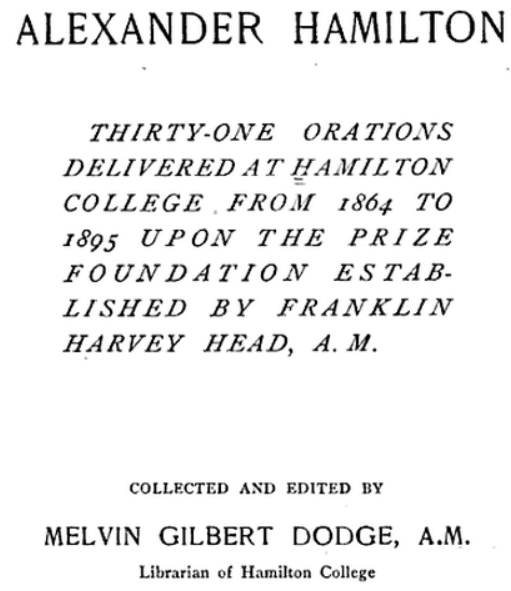
HamCol Book


I came across an interesting collection that I wanted to share.  Franklin Harvey Head, who penned an extremely influential address on the meaning and goals of liberal arts education in the US, sponsored a prize foundation at Hamilton College that awarded the top student orator for each year a prize for preparing and delivering a speech on Alexander Hamilton.  The introduction to the collection states “Mr. Head established the prize called by his name, designating that the subject for this Prize Oration year by year should have reference to the character and career of Alexander Hamilton.”  The introduction also notes:

“No name from the rolls of our struggle for independence and our binding together as a nation awakens more intense interest or opens wider fields for consideration than that of Hamilton.  From the first appearance of the youthful student, to the tragic hour on the heights of Weehawken, the story has the attraction of romance, and in it can be found the kindling of influences potent not only for then but for all time.”

The thirty-one topics include:

  • Hamilton as a Constitutional Statesman
  • The Character and Statesmanship of Hamilton
  • Hamilton as an Expounder of the Constitution
  • The Intellectual Rank of Hamilton among his Contemporaries
  • Hamilton as a Political Prophet
  • The Relations of Hamilton and Burr
  • Our Political Indebtedness to Hamilton
  • Hamilton Compared with His European Contemporaries
  • The Position of Hamilton in American History
  • The Career and Character of Hamilton
  • Alexander Hamilton and Thomas Jefferson
  • The French Revolution and the Political Doctrines of Hamilton
  • Alexander Hamilton and Salmon P. Chase
  • Hamilton and Seward as Political Leaders
  • Alexander Hamilton and Louis Adolphe Thiers
  • The Death of Hamilton
  • The Political Doctrines of Hamilton in the Light of Recent American History
  • Hamilton and the Tariff Question
  • Alexander Hamilton and Benjamin Disraeli
  • The Political Services of Hamilton and Webster
  • The Debt of Our Government to Washington and Hamilton
  • Hamilton and the Presidential Election of 1800
  • The Military Services of Hamilton
  • The Verdict of Experience on Hamilton’s Constitutional Theories
  • Hamilton and the Constitutional Convention of 1787
  • The Influence of “The Federalist”
  • Hamilton, Webster, Seward
  • The Principles that Distinguish Hamilton and Jefferson as Statesmen
  • Alexander Hamilton and John Adams
  • Hamilton as a Lawyer
  • Hamilton and the Code of Honor
  • Hamilton’s Theory of the United States Senate

The collection of thirty-one prize-winning student oration is interesting for several reasons.  First, it offers us a snapshot of what students in the 1864-1895 time period were focused on studying.  Second, the range of topics varies from purely historical discussions of particular aspects of Hamilton’s legacy, to discussions of Hamilton in comparison to contemporary political figures.  I found the essays comparing Hamilton with contemporary politicians (Disraeli, Thiers, etc) extremely interesting.  Those orations offered an insight both into Hamilton and into the political theory of the late 1860s.  Keep in mind that these orations were being delivered for the three decades immediately after the Civil War, when the nation was still reeling.  Little wonder that students would seek lessons from the Constitutional period for guidance during another time of division and crisis.

The full text of the thirty-one orations is available via Google Books and Cornell’s Internet Archive..

Aaron Burr, Part 2

An interesting short film has been making its way across the film circuits.  Aaron Burr, Part 2, is a 9 minute comedic film that purports to retell the story of Hamilton and Burr’s duel from Burr’s perspective.  Much like Gore Vidal’s Burr, the film is filled with inaccuracies, but I think it raises some interesting dialogue points.  I’d be curious to know what It’s Hamiltime readers think.

The Atlantic’s description states:

Complete with iPhones, battle reenactments, and a very snarky first person narration, this short film is a hilarious take on the event that tarnished Burr’s legacy. Aaron Bur, Part 2 comes from director Dana O’Keefe. The film has been showcased in film festivals across the country, including SXSW and the Dallas Film Festival where it received the Jury Prize for best short film.

Film School Rejects states:

Why Watch?Dana O’Keefe and company take up the task of humanizing Aaron Burr, an incredible figure whose memory has been reduced to one label: the man who killed Alexander Hamilton. In this unconventional take on history, Burr is a man out of time, sliding between his pre-Revolutionary days fighting in Canada and a modern day New York City where hip hop hugeness paints his larger-than life with every slow motion step.

It’s tough to say why this works. Maybe it’s because Burr appears here as a ghost kept alive by the people that remember him, foolishly trying to set the record straight while lamenting what time has done to the world he knew. Maybe it’s the hipper-than-thou attitude it carries. Maybe it’s because it’s the kind of comedy that keeps a straight face. Or maybe it’s just because it’s really damned cool.

Short of the Week writes:

The effect is brilliant. Reimagined as a brooding anti-hero, Burr (Alex Kliment) enchants. It’s a crazy comparison, but with the culture obsessed as it is, Burr reminds me of a vampire, a historical Lestat. Beautiful, dangerous, he haunts the modern lanscape, filled with regret, damned by an unforgivable act committed ages ago.

Mirroring the theme, if History is a contested narrative, the narrative of the film is a contest between its various styles. Amazingly the film has been programmed as both a fiction and documentary film, playing reputable venues like SXSW, HotDocs, and being nominated for the Cinema Eye Honors, as one of the best documentary shorts of the year. With its archival images and historical re-enactments, it shares elements of films in the Ken Burns mode, however its playful style is much more in line with modern American fiction directors like Wes Anderson in its dramatic use of music, slo-mo, and on-screen text.

You can watch the film on Vimeo here.

True/False Film Fest also had an interview with director Dana O’Keefe about the film.

Hamilton Statue at Columbia University

The statue of Hamilton at Columbia University stands proudly outside of Hamilton Hall and greets students and campus visitors.  The Hamilton statue was commissioned by the Alumni Society and erected in May 1908, as part of the commencement celebrations of that year and was presented by the Alumni Society to the school.  The Columbia University Quarterly from 1908 describes in detail the poetry verses and procession that were part of the celebrations surrounding the unveiling of the statue.

In accepting the statue on behalf of Columbia, Dean John Howard Van Amringe stated:

“No memorial of affection for their alma mater from her children could be more appropriate than this noble statue representing, and fashioned by, one of themselves; this embodiment of civic virtue and the highest public service; this splendid monument of immortal youth great in thought and action, of the loftiest ambition without a trace of meanness, of transcendent political genius and intrepid constancy, of constructive statesmanship which was a great, if not the greatest single force that gave vitality, direction, and lasting quality to this Union of States, of oratory that had the rarest attribute of human speech in convincing the judgment of men against their will and in compelling their will to follow the dictates of their captivated judgment.  May this statue stand here for all time, a tribute of affectionate gratitude to the College from the Alumni, an ever-present incentive to successive generations of students.”

Statue of Alexander Hamilton, Hamilton Hall

Sculptor William Ordway Partridge described the sculpture in his catalogue:

“This heroic statue of bronze stands on the plaza in front of Hamilton Hall, Columbia University, and represents the great statesman at the moment when he is making the historic speech at Poughkeepsie which won over his opponents and saved New York to the Union.  Presented to the University on behalf of the alumni by President Butler.  The speech of acceptance was made by George L. Rives.  Dedicated and unveiled May 27, 1908.  The pedestal was designed by McKim, Mead and White.”

Here’s the statue looking as handsome as ever on one of my visits to the Columbia campus.  (My brother Sid is a recent graduate of Columbia, so I’ve had the opportunity to visit the campus quite a few times!)

statue

Lin-Manuel Miranda’s HAMILTON World Premiere Winter 2015

Exciting news: Lin-Manuel Miranda’s Hamilton will have it’s world premiere next winter at the Public Theater!  The New York Times reports that the production will be directed by Thomas Kail, who collaborated with Miranda on In The Heights and was nominated for a Tony.  Additionally, commercial producers Jeffrey Seller, Sander Jacobs, and Jill Furman, will be financially supporting the production.  Hamilton will begin performances on Tuesday, January 20, 2015 and run through Sunday, February 22, 2015.

The Public Theater’s press release states:

“HAMILTON, written by the Tony and Grammy Award-winning composer and lyricist Lin-Manuel Miranda, will have its world premiere next January as part of The Public’s 2014-15 season at Astor Place. Directed by his In The Heights collaborator Thomas Kail, this new musical features Miranda playing Alexander Hamilton, one of our country’s Founding Fathers and the first Secretary of the Treasury. ”
“Lin-Manuel Miranda is a marvel, but nothing could have prepared us for the astonishing achievement of  Hamilton,” said Artistic Director Oskar Eustis. “Alexander Hamilton was born in the West Indies, the only Founding Father who was an immigrant, and Lin’s genius is to tell the story of the birth of the United States as an immigrant’s story. The energy, the passion, joy, tragedy, and raw intelligence of this show are stunning.”
HAMILTON, featuring a cast of historical figures that includes George Washington, Aaron Burr, James Madison, and Thomas Jefferson,  Miranda performed a song from HAMILTON for President Obama and the First Family at the White House in 2009 during its first-ever White House Evening of Poetry & Spoken Word. Watch it here http://1.usa.gov/1bGCQbh. Inspired by the book Alexander Hamilton by Ron Chernow, HAMILTON is produced with the support of Jeffrey Seller, Sander Jacobs, and Jill Furman

The Public Theater website states:

The Public Theater is the only theater in New York that produces Shakespeare, the classics, musicals, contemporary and experimental pieces in equal measure. The Public continues the work of its visionary founder, Joe Papp, by acting as an advocate for the theater as an essential cultural force, and leading and framing dialogue on some of the most important issues of our day.  Creating theater for one of the largest and most diverse audience bases in New York City for nearly 60 years, today the company engages audiences in a variety of venues—including its landmark downtown home at Astor Place, which houses five theaters and Joe’s Pub; the Delacorte Theater in Central Park, home to its beloved, free Shakespeare in the Park; and the Mobile Unit, which tours Shakespearean productions for underserved audiences throughout New York City’s five boroughs. The Public’s wide range of programming includes Free Shakespeare in the Park, the bedrock of the company’s dedication to making theater accessible to all, new and experimental stagings at The Public at Astor Place, and a range of artist and audience development initiatives including its Public Forum series, which brings together theater artists and professionals from a variety of disciplines for discussions that shed light on social issues explored in Public productions.

Images of Hamilton: Update- Trumbull Portrait Now on Display in NYC

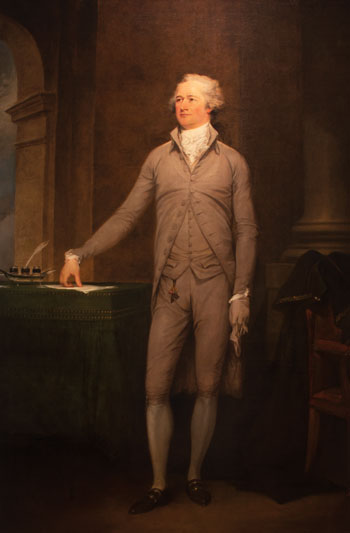
I had blogged earlier about John Trumbull’s iconic portrait of Hamilton, and about plans to house the painting for public display at Crystal Bridges Art Museum of American Art in Bentonville, Arkansas and the Metropolitan Museum of Art in New York City.  This week, the portrait was formally unveiled at the Met, so all the NYC Hamiltonians can go take a look at the full-length portrait in person!

John Trumbull, "Portrait of Alexander Hamilton," 1792, gift from Credit Suisse to Crystal Bridges and Metropolitan Museum

According to the Met’s press release:

An iconic life-size portrait by the celebrated Revolutionary-era painter John Trumbull of Alexander Hamilton, then Secretary of the Treasury under President George Washington, is now on view in The American Wing of The Metropolitan Museum of Art.  This is the painting’s first showing at the Metropolitan since it was donated, earlier this year, by the global wealth manager and investment bank Credit Suisse to both the Metropolitan Museum in New York and Crystal Bridges Museum of American Art in Bentonville, Arkansas. At the Metropolitan, the work—which is considered the greatest known portrait of Hamilton and one of the finest civic portraits from the Federal period—is on display in Gallery 755, “Faces of the Young Republic,” of the New Galleries for American Paintings, Sculpture, and Decorative Arts among portraits of other great heroes of the post-Revolutionary period.

Images of Hamilton: Hamilton Statue in Central Park

If you’ve visited Central Park, you may have come across a very handsome statue of Alexander Hamilton.  The statue is located between 82nd and 83rd streets on the East Side of the park.  The statue was donated by Hamilton’s son, John C. Hamilton to the park in 1880.  The Hamilton statue was sculpted by Carl H. Conrads, an American sculptor best known for his work commemorating the Civil War.  Conrads served in the Union Army during the Civil War and designed statues that you can find in West Point and San Francisco.

hampark

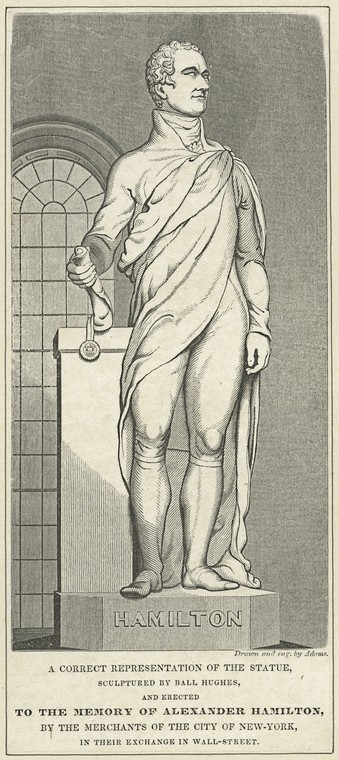
The 1880 statue actually replaces an earlier Hamilton statue that was destroyed in the Great Fire of 1835 and had stood on the floor of the original New York Stock Exchange building.  According to Inside the Apple: A Streetwise History of New York City:

“A valiant attempt was made to rescue a 15-foot statue of Alexander Hamilton from the floor of the exchange, but just as the statute reached the doorway, the roof collapsed, destroying it.  The statue, by Robert Ball Hughes, was the first marble statue created in the United States and had been installed only eight months earlier.  Though it took 45 years, the statue was ultimately replaced by Hamilton’s youngest son, John C. Hamilton, and it stands in Central Park behind the Metropolitan Museum of Art.  This statue in the park is remarkable in that it is made entirely of granite– not the easiest stone to carve–and it has long been thought that John C. Hamilton commissioned the work out of this durable stone so that no matter what calamities might befall Central Park his father’s statute would endure.”

The original statue is pictured here, in an image from the New York Public Library.

On November 22, 1880 Chauncey Mitchell Depew made a public address to commemorate the unveiling of the statue at Central Park.  Some excerpts are below:

“Precocious intellects in all ages of the world have flashed with meteoric splendor; and for a brief space amazed mankind; but he only whose full equipped mind knew no youth and never failed in the full maturity of its powers was Alexander Hamilton. ”

….

“…Hamilton, at eighteen, was hailed by the whole country as the peer of the Adamses and of Jay.  But when the multitude, smarting under wrongs and fired by the eloquence of their champion, sought riotous vengeance upon their enemies, he stayed the angry mob while the President of his College escaped, and offered to lead in defence of property and the majesty of the law.  Popular passion never swayed his judgment; personal ambition, or the applause of the hour, never moved or deterred him.”

“Hamilton forged the links and welded the chain which binds the Union.  He saw the dangers of Secession, and pointed out the remedy against it in the implied powers of the Constitution.”

“Upon the boundless sea of experiment without chart of compass, he invented both.  He smote the sources of revenue with such skill and power, that from the barren rocks flowed the streams which filled the Treasury and the Sinking Fund, and the exhausted land was fertilized by its own productiveness.  Out of chaos he developed perfected schemes which have stood every strain and met every emergency in our national life.”

For the full text of Depew’s remarks, see here.