1) Romantic quote pendant and bracelet– Available from the New York Times Store and from the New York Historical Society. This pendant was created by the New York Historical Society and features a quote from Hamilton to his wife, Elizabeth, in Hamilton’s October 5, 1780 letter. The letter was written a few months before the two married on December 14, 1780. The quote on the pendant states: “I meet you in every dream – and when I wake I cannot close my eyes again for ruminating on your sweetnesses.” For full context, here is the complete paragraph in which the sentence appears:
“I have told you, and I told you truly that I love you too much. You engross my thoughts too intirely to allow me to think of any thing else. You not only employ my mind all day; but you intrude upon my sleep. I meet you in every dream-and when I wake I cannot close my eyes again for ruminating on your sweetnesses. ‘Tis a pretty story indeed that I am to be thus monopolized, by a little nut-brown maid like you-and from a statesman and a soldier metamorphosed into a puny lover. I believe in my soul you are an inchantress.”
2) Cufflinks– Hamilton $10 bill cufflinks available from Etsy. Because nothing projects financial success like going into an interview with Hamilton cufflinks.
Michael Austin has written an interesting story for History News Network on the presidential election of 1800. Austin draws parallels between the current state of partisan politics and the bitter rivalries that emerged during the presidential contest between incumbent John Adams and Thomas Jefferson.
During that election, Hamilton and other high Federalists painted Jefferson and the Republicans as morally depraved atheists and fiery anti-government radicals who planned to set up guillotines on the banks of the Potomac and fill the new capital with blood. Republicans, on the other hand, portrayed Federalists as crypto-monarchists and usurpers of the Constitution. They pointed to the recent Alien and Sedition Acts as proof that Federalists would roll back the Bill of Rights at every available opportunity until they could declare Hamilton president-for-life and, from there, King of America.
And it got worse. Both Jeffersonians and Hamiltonians savaged the incumbent president, John Adams, a moderate Federalist who never quite managed to make either side happy. Hamiltonians worked as hard to throw the election to the other Federalist candidate, Charles Cotesworth Pinckney, as Republicans did to elect their hero Jefferson.
The unintended circulation of the Letter from Alexander Hamilton, Concerning the Public Conduct and Character of John Adams, Esq. President of the United States was considered a major factor in Adams’s defeat. If you haven’t read the letter before- I highly recommend it- full text available from Open Library.
In the letter, Hamilton begins with this premise: “Not denying to Mr. Adams patriotism and integrity, and even talents of a certain kind, I should be deficient in candour, were I to conceal the conviction, that he does not possess the talents adapted to the administration of government, and that there are great and intrinsic defects in his character, which unfit him for the office of chief magistrate.”
He describes Adams’s miliary plans during the Revolution and how these plans would have contributed to the defeat of the Continental Army. For example, Adams “was represented to be of the number of those” who favored shorter troop enlistment rather than Washington’s policy of having soldiers enlist for the term of the war. Hamilton also criticized Adams for ignoring the advice of his cabinet. He accused Adams of rash decisionmaking, particularly when related to the quasi-war with France and drew a comparison between Adams and “the modest and sage Washington,” who “consulted much, pondered much, resolved slowly, resolved surely.” Hamilton showcased instances of Adams’s uncertainty and found him to be “so much at variance with himself, as well as with sound policy, that we are driven to seek a solution for it in some system of concession to his political enemies.” The purpose of Hamilton’s letter was to draw support from within the Federalist Party towards Charles Pinckney, a Southern Federalist. However, after Adams won the Federalist nomination, the letter was circulated throughout the country by the Jeffersonians. Hamilton’s reasoned and damning attack on Adams played a part in the contentious election. Although Hamilton could have adopted the party line and backed Adams, he took the opposite course, understanding that he would lose the support of half his party in future races. For better and for worse, Hamilton was a man of convictions and of impulse.
Mock Politics produced a humorous set of Jefferson v. Adams attack ads:
In an interesting post-script to the election, Hamilton eventually persuaded fellow Federalists to choose Jefferson over Aaron Burr. Smithsonian Magazine has a great piece explaining the deadlock- because of the system in place, Congress had to decide between Jefferson and his running mate Aaron Burr. Many Federalists saw Jefferson as the ultimate enemy and were pushing for a Burr presidency. Hamilton stated:
Mr. Jefferson, though too revolutionary in his notions, is yet a lover of liberty and will be desirous of something like orderly Government.–Mr. Burr loves nothing but himself-Thinks of nothing but his own aggrandizement–and will be content with nothing short of permanent power in his own hands.–No compact, that he should make with any passion in his breast except Ambition, could be relied upon by himself.–How then should we be able to rely upon our agreement with him? Mr. Jefferson I suspect will not dare much. Mr. Burr will Dare every thing in the sanguine hope of affecting every thing.
An introduction to some of the more unusual Hamilton products available:
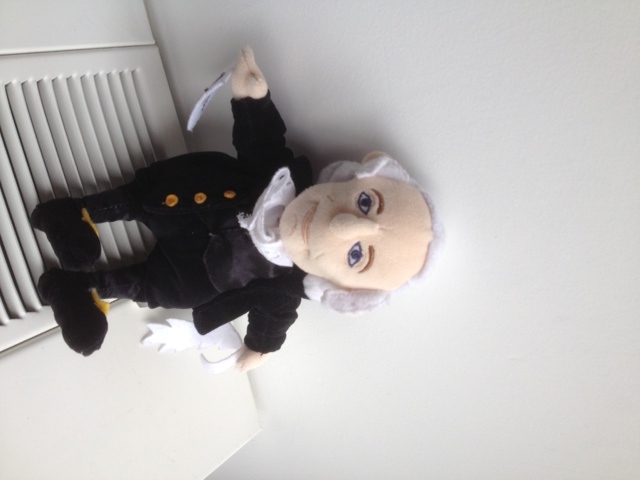
1) Hamilton plush doll/stuffed animal: I bought mine at the Trinity Church gift shop, but it is also available online. My roommate in law school found this doll incredibly creepy, and as much as I love all things Hamilton, there is something a little unnerving about this particular piece. I’d suggest sticking to the Bobblehead if you want a more accurate Hamilton.
2) Commemorative strands of Hamilton’s hair: History for Sale has ten strands of Hamilton’s hair available from the “largest collector of famous hair,” as listed in the Guinness Book of World Records. For just under $8,000, you can own ten strands of Hamilton’s hair, collected from various points of his life. If you’re just looking for one or two strands, Ebay has deals ranging from $99-$495. While I do love collectible Hamilton items, I’ve never found the appeal of collecting hair strands from two centuries ago.
3) Alexander Hamilton Revolutionary Action Figure– The Alexander Hamilton American light infantry command action figure commemorates Hamilton’s position as Lieutenant Colonel of the Light Infantry Division that fought at Yorktown in 1781. Hamilton’s heroic conduct in Yorktown brought him to Washington’s attention and Hamilton had extremely close relationships with Marquis de Lafayette and John Laurens, fellow commanders in the division. The figure is available on Amazon, Sierra Toy Soldiers, and The History Store
Exactly 201 years ago, on November 16, 1801, the first issue of the New York Post was published. The newspaper was created by Hamilton and some his close political supporters at a time of almost total defeat for Federalists in the national political scene. Jefferson had been inaugurated as president in March of 1801, and his party had control of both the House and the Senate. Hamilton had alienated John Adams with the unintended widespread publication of his confidential 1800 pamphlet “The Public Conduct and Character of John Adams.” Additionally, Adams and Hamilton had taken opposite positions on the decision of whether to elect Thomas Jefferson or Aaron Burr as president, which fell to the House of Representatives. Believing Aaron Burr to be an unprincipled threat to American society, and believing that Jefferson had at least some sense of personal honor, Hamilton ignored his long-term political disagreements with Jefferson and threw his support behind him. This decision isolated Hamilton even more from the new Federalist Party.
In April, Hamilton returned to New York and turned his attention to his law practice and to building up his relationships in New York. As part of this effort, Hamilton convinced some of his close supporters that they lacked an adequate newspaper to express their political beliefs. Hamilton selected William Coleman, a noted journalist and Federalist (who had briefly gone into an unprofitable legal partnership with Aaron Burr) to be the editor of the new publication. Coleman had worked with Hamilton before, and edited a version of the Federalist Papers. Hamilton circulated a “founders’ list” and raised the money for the first publication of the paper. The first issue of the paper, most likely created as a collaboration between Hamilton and Coleman, carried this statement: “The design of this paper is to diffuse among the people correct information on all interesting subjects, to inculcate just principles in religion, morals, and politics; and to cultivate a taste for sound literature.” After Hamilton’s death, Coleman published A collection of the facts and documents, relative to the death of Major General Alexander Hamilton.
I came across this Youtube video, “Everybody Hates Hamilton.” The video is culled from clips of the HBO miniseries John Adams. Although it is only based on one TV show (based on David McCullough’s biography of Adams), the theme of Hamilton as a scapegoat is echoed. It boggles my mind that Hamilton, who came to New York as a penniless illegitimate teenager from the West Indies and became a champion of a new republic and the architect of its economy has been caricatured by so many people as a staunch monarchist and a ruthless and unprincipled politician.
In The American Commonwealth, Viscount James Bryce said Hamilton’s “countrymen seem to have never, either in his lifetime or afterwards, duly recognized his splendid gifts.” Hamilton’s political enemies brought up the circumstances of his birth, cast doubt on his relationship with President Washington, and generally blamed him for having a vision that they couldn’t comprehend. Adams called him the “bastard brat of a Scottish peddler.” Jefferson wrote to Washington:
I will not suffer my retirement to be clouded by the slanders of a man whose history, from the moment at which history can stoop to notice him, is a tissue of machinations against the liberty of the country which has not only received him and given him bread, but heaped its honors on his head.
In many ways, this legacy continues today. Historians regularly characterize Hamilton as a Machiavellian statesman. One author has even gone so far as to say that “Hamilton’s Curse” must be repudiated in order for America to be truly free.
Why?
I contend that Hamilton’s steadfast commitment to his principles is at the root of his unpopularity. Unlike Jefferson, Hamilton did not bow to the winds of popularity at the slightest inclination. Instead, he faced the consequences of making unpopular decisions when he believed them to be morally or economically necessary.
Here are some examples:
Protecting the Tories
As a college student in New York, Hamilton became convinced of the Revolutionary cause and threw himself into it with all his physical and mental energy. However, when an angry mob of patriots stood at the door of Myles Cooper, the president of King’s College, Hamilton held off the mob for hours in order to prevent Cooper from being attacked. After the Revolution was won, a popular movement began to strip any Loyalists of their property and prevent them from becoming full citizens in the new republic. Hamilton firmly opposed this movement and insisted that even Loyalists have the opportunity to be citizens in the new nation.
Hamilton, the most brilliant American statesman who ever lived, possessing the loftiest and keenest intellect of his time, was of course easily the foremost champion in the ranks of the New York Federalists; second to him came Jay…Both of them watched with uneasy alarm the rapid drift toward anarchy; and both put forth all their efforts to stem the tide…In particular they abhorred the vindictive laws directed against the persons and property of Tories; and they had the manliness to come forward as the defenders of the helpless and excessively unpopular Loyalists. They put a stop to the wrongs which were being inflicted on these men, and finally succeeded in having them restored to legal equality with other citizens, standing up with generous fearlessness against the clamor of the mob.
Economic Policies
Almost all of Hamilton’s economic policies, from establishing a National Bank to assuming the debts of the states to imposing an excise tax on whiskey, were politically unpopular but proved to be lifesaving for the new nation. Hamilton took on every uphill battle and, sometimes by sheer force of will, pushed those around him into accepting his plans. For example, Hamilton insisted that the government pay all of its war debts, including debts to speculators. During the Revolution, the Continental Congress sold war bonds to many supporters, including soldiers. However, over the long course of the war, many of the original owners of the bonds often sold them to speculators. After the War, there was a popular movement to disregard the debt altogether. Hamilton firmly believed that honoring this debt was essential to the financial progress of the nation. He eventually convinced resistant Southern congressmen to back him by agreeing to move the nation’s capital to the South.
Throughout his life, Hamilton was willing to make politically unpopular choices when he believed them to be necessary, or morally right. Hamilton is the ultimate historical underdog, and even as he rose to prominence in America, he never allowed the quest for popularity to overcome his moral convictions. Humans have a tendency to take the easy route, to “get along” with everyone whenever possible, and to generally follow the status quo and take the path of least resistance. As we all know, being part of the crow, or better yet, being the most popular person in the crowd can be a heady feeling. On the other hand, facing down a mob or being the only voice advocating your beliefs is always a struggle. Somehow, Hamilton maintained his public principles, even when they had unpleasant consequences. Hamilton’s life presents us all with a challenge: can we truly stand for what we believe in, no matter what the consequences?
The above sources lay out the sensational details of the affair: Hamilton became involved with Maria Reynolds in 1791, when she came to his home in Philadelphia and claimed that she was destitute and had been abandoned and abused by her husband. Hamilton and Reynolds became involved immediately. Maria’s husband, James Reynolds knew about the affair (and may have even pushed Maria to seduce Hamilton) and sought money from Hamilton. James Reynolds was arrested for financial crimes and accused Hamilton of entering into monetary relationships with Reynolds for personal gain and abusing his position. Reynolds accused Hamilton of being deeply concerned in speculation and frequently advancing money to Reynolds for these purposes. The information came into the hands of Congressman Frederick A. Muhlenberg, who shared it with Senator James Monroe and Congressman Abraham Venable. These three men confronted Hamilton in December 1792, and Hamilton immediately disclosed the affair and showed them letters from Reynolds in order to clear himself of the corruption charges. The exchange concluded with the understanding that the three men would keep silent about the details of the affair. The three men also gave a copy of the initial documents with information from Reynolds that was discredited by Hamilton to John Beckley, clerk of the House of Representatives. In 1793, Reynolds divorced her husband and Aaron Burr served as her divorce lawyer. In 1795, Hamilton resigned as Treasury Secretary, where he had been making only $3,500 a year, and resumed private practice in New York, making around $11,000 a year. In 1797, Beckley was fired as Clerk of the House and he turned over his copy of the documents to infamous Republican journalist James T. Callender. Callender, without making any further investigation about truth of the claims, immediately published Beckley’s documents. Scandal erupted and corruption accusations swirled. Hamilton believed that his political enemy Monroe, who Washington had just recalled from his position as ambassador to France, was behind the documents being released. The two men came to the brink of a duel, and Aaron Burr, Monroe’s would-be second, helped negotiate between the two parties and averted the duel. In August 1797, Hamilton published a pamphlet with all of his correspondence with Reynolds, deciding that admitting to a sordid affair would be better than the stain of the public corruption allegations.
When the pamphlet was published, Hamilton’s allies were shocked:
When the work appeared, Hamilton’s friends were appalled. “What shall we say …” Webster wrote, “of a man who has borne some of the highest civil and military employments, who could deliberately … publish a history of his private intrigues, degrade himself in the estimation of all good men, and scandalize a family, to clear himself of charges which no man believed. …” General Henry Knox wrote to General David Cobb, “Myself and most of his other friends conceive this confession humiliating in the extreme, and such a text as will serve his enemies.”
While the details of the affair are indeed scandalous, the most revealing and important part of the story is Hamilton’s response to it. His decision is a perfect example of what makes him such an interesting and complex historical figure. Hamilton was flawed and succeptible to temptation in his personal life, but he was doggedly honest in his professional life. He ignored the personal consequences of admitting to the affair and made a full confession, something that few political figures of any period would do. To Hamilton, even the unsubstantiated stirrings of corruption were unacceptable.
Unlike David Petraeus and the countless other politicians involved in modern sex scandals, Hamilton did not make a public revelation out of necessity, but out of his sense of honor. Even though Hamilton was no longer in office when news of the affair broke, he placed the sanctity of the position over his private interests and his own reputation. If Hamilton had listened to his friends or had a modern day spin doctor, he would have allowed the rumors to live instead of feeding the fire with a full, dramatic revelation. For better and for worse, Hamilton was a person who followed his own mind and lived by his own unbendable code with regard to his political life, even when his personal life fell short of that code.
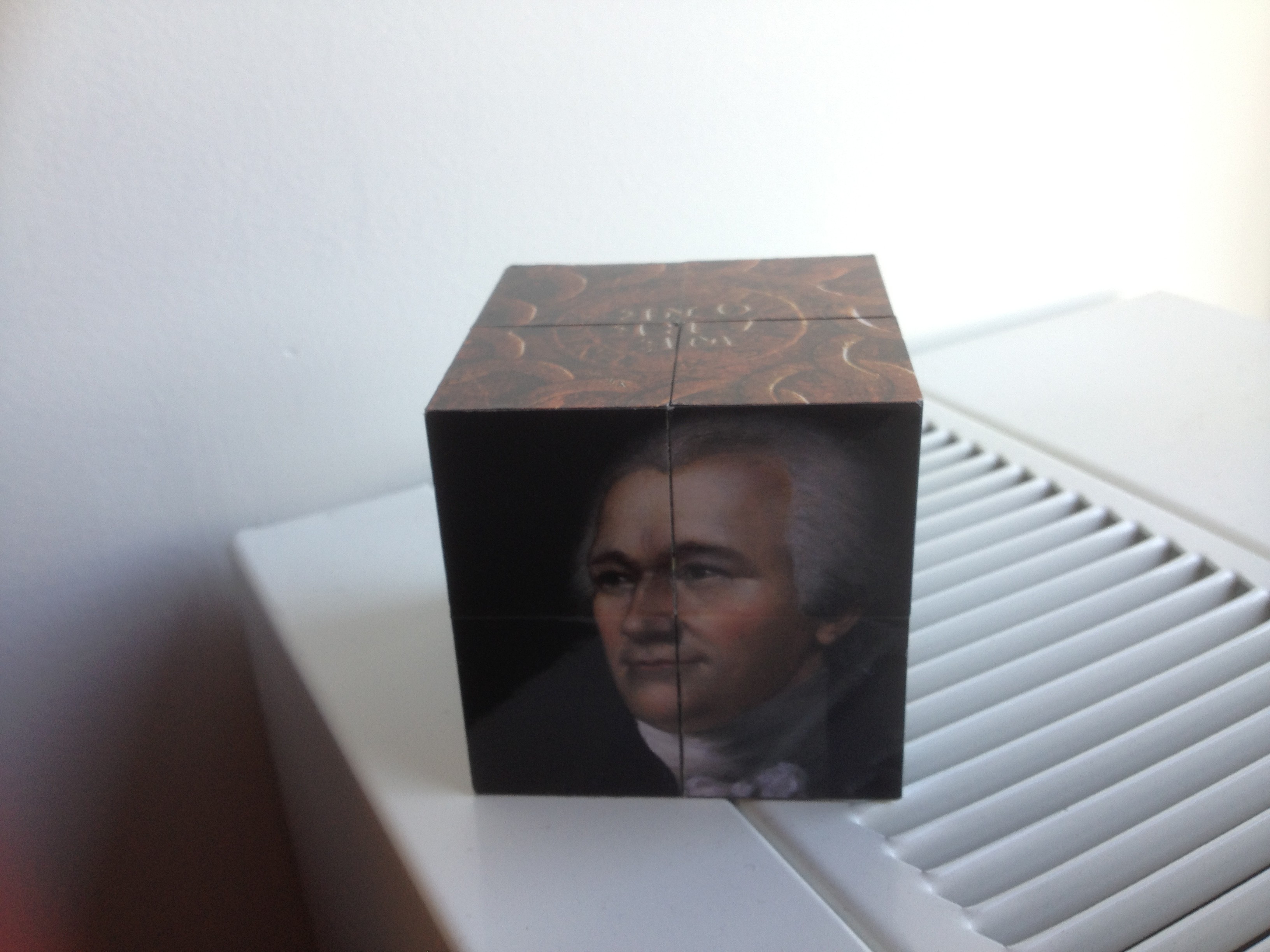
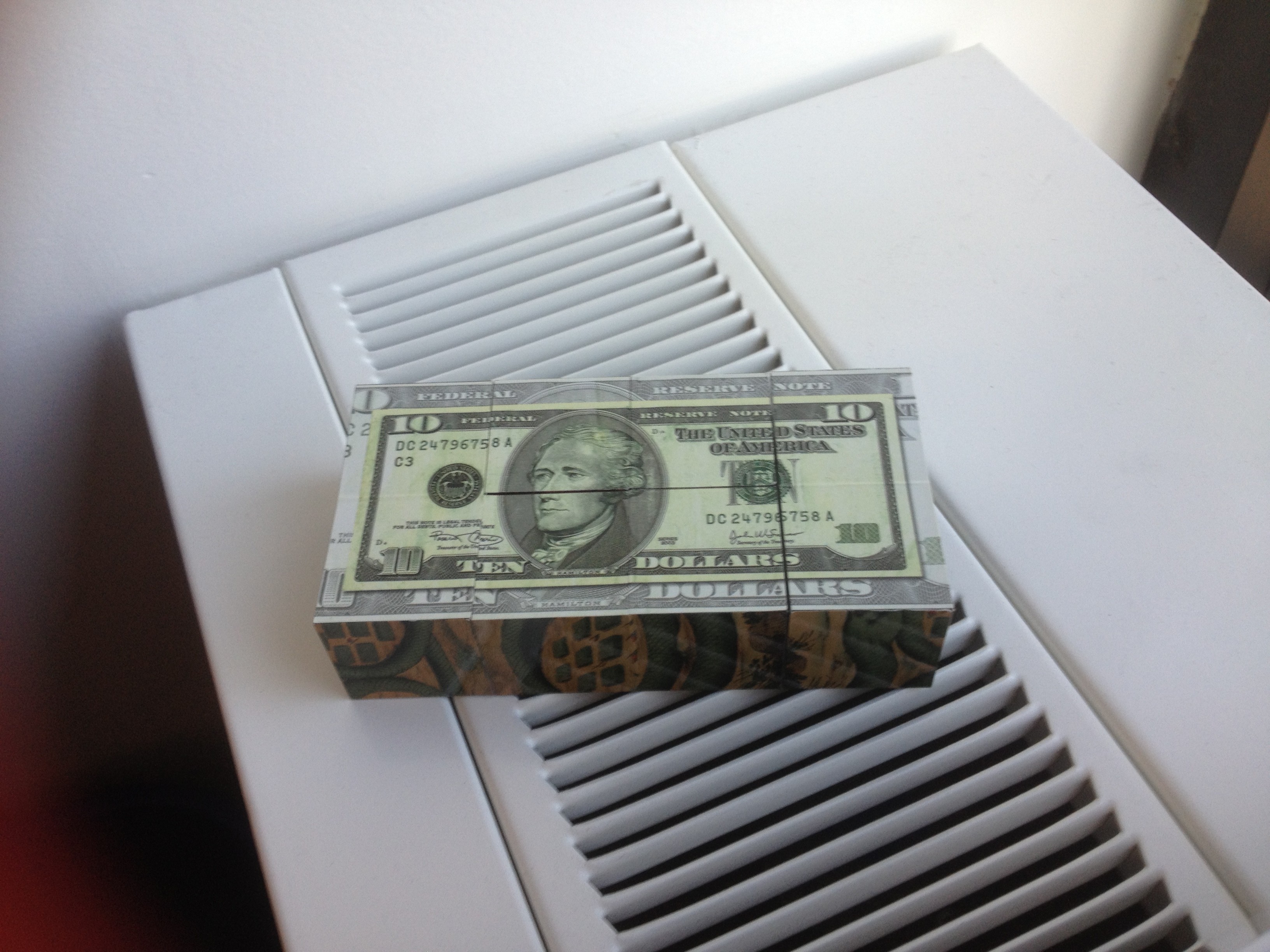
This morning, I got into the office, looked at my desk, and realized how many awesome Hamilton accessories I have in my office.I’m sharing reviews of my three favorite Hamilton accessories since the holidays are coming up! [Note: I am not getting advertising revenue for these reviews and all pictures are from my personal collection.]
1) Hamilton History Cube– Nifty picture cube featuring nine images from the New York Historical Society. Great to play with on your desk. Comes in a gift box. Warning- the pictures will wear out if you play with the cube constantly. I’m currently on my second one and I bought both from the Trinity Church gift shop. {Available online from the NY Historical Society and sold at the Trinity Church Gift Shop}
2) Hamilton Bobblehead– My bobblehead is by far the coolest thing in my office. Royal Bobbles has done a brilliant job with the detail on Hamilton’s face and clothes. At under $20, I thought this was a steal. However, Hamilton’s walking stick slipped out of his hands after a few months and I had to superglue part of his wig back together. {Available from the History Channel and Amazon}
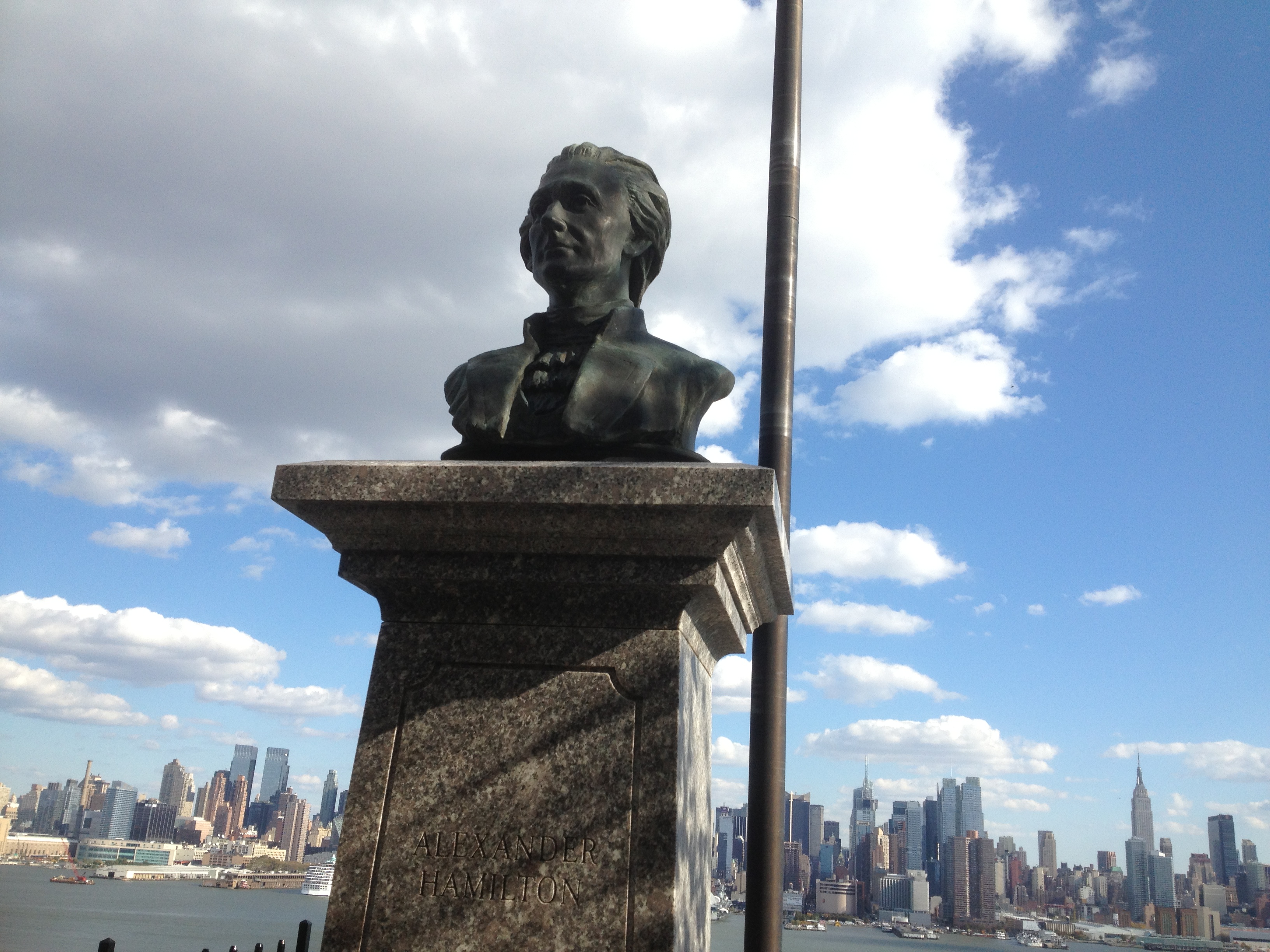
3) Mini-Hamilton Bust– This 6-inch bust works as a great paperweight or just a guard for your desk. The detail on the face is pretty neat. When I bought it, I expected it to be bigger, and at almost $30 it is a bit expensive for the size. {available from Amazon}
Gawker reported on Saturday that a journalism student at SUNY Oswego was suspended for asking questions as part of a class assignment to profile a public figure. The student, Alex Myers, chose to profile hockey coach Ed Gosek. As part of his research, he sent emails to rival coaches asking them for their perspective on Gosek. Myers concluded his email by stating: “Be as forthcoming as you like, what you say about Mr Gosek does not have to be positive.” The school charged him with dishonesty and with “disruptive behavior.” Although Myers was spared a suspension, he was ordered to write letters of apology to Gosek and the coaches he contacted. This instance is one of many in which citizens and journalists have been penalized for asking questions and trying to seek out the truth. Prosecutors across the country have tried to charge people with wiretapping for videotaping police conduct. While some courts and the Department of Justice have suggested that the First Amendment protects such conduct, prosecutions continue.
Mr. Myers’ story reminded me of Alexander Hamilton’s role in the 1803 case People v. Croswell, 3 Johns. Cas. 337 N.Y. 1804. The defendant, Harry Croswell, was indicted for “being a malicious and seditious man, of a depraved mind and wicked and diabolical disposition, and also deceitfully, wickedly, and maliciously devising, contriving and intending, Thomas Jefferson, Esq., President of the United States of America, to detract from, scandalize, traduce, vilify” him. Croswell was the editor of The Wasp, a Federalist publication, and accused Thomas Jefferson of paying people to make accusations against Washington, Adams, and other Federalists. Croswell was convicted by the lower court and asked Hamilton to represent him on the appeal. Hamilton threw himself into the case, culminating with a 6 hour oration to a standing room only. In his argument, Hamilton stated that “the liberty of the press consists in the right to publish, with impunity, truth, with good motives, and for justifiable ends, whether it respects government, magistracy, or individuals.” Despite Hamilton’s efforts, the court upheld the tradition, and Hamilton was bitterly disappointed. He died the next year, before he got the chance to see the New York Legislature pass a law essentially codifying his argument and granting immunity for truthful speech.
Throughout his life, Hamilton had an intimate and often complex relationship with liberty of the press. In Federalist 84, Hamilton stated:
“On the subject of the liberty of the press, as much has been said, I cannot forbear adding a remark or two: In the first place, I observe that there is not a syllable concerning it in the constitution of this state, and in the next, I contend that whatever has been said about it in that of any other state, amounts to nothing. What signifies a declaration that “the liberty of the press shall be inviolably preserved?” What is the liberty of the press? Who can give it any definition which would not leave the utmost latitude for evasion? I hold it to be impracticable; and from this, I infer, that its security, whatever fine declarations may be inserted in any constitution respecting it, must altogether depend on public opinion, and on the general spirit of the people and of the government.”
Hamilton used newspapers as his primary means of public persuasion and published both the Federalist Papers and his arguments in support of the Revolution as newspaper pieces. Hamilton also founded the New York Post in 1801 with a group of investors. However, Hamilton was also the subject of brutally negative press coverage by Republican newspapers. After his public confession of his affair with Maria Reynolds, Hamilton was the subject of persistent embarrassing coverage. During the Adams administration, Hamilton also supported the Alien and Sedition Acts, and David Frothingham (printer for a Republican publication) was charged and convicted of criminal libel against Hamilton for making comments about his alleged corruption as Secretary of the Treasury. Despite the complications of this relationship, the position Hamilton argued in Croswell was consistent throughout his life. He believed that journalists should be free to find and publish truth. Perhaps the journalism program at SUNY Oswego could learn from Hamilton’s example.
Huffington Post Canada has included Trinity Church, the site of Alexander Hamilton’s gravesite, on its list of five must-see cemeteries around the world.
The article states: “Trinity Church and St. Paul’s Chapel, New York — A modest little green space in Lower Manhattan, this cemetery is best known for one tremendously significant resident: Alexander Hamilton, a founding father of the United States, the nation’s first secretary of state and a Revolutionary War hero. Hamilton isn’t buried in Arlington National Cemetery or on a palatial estate, however. He was shot and killed in a duel with Aaron Burr in 1804 and now rests across the street from a discount shoe store. Hamilton’s rise and fall is a significant part of early American history and you will learn more about it with a visit to this historic church. Trinity Church’s St. Paul’s Chapel, located five blocks north of Hamilton’s gravesite, played a significant role in the aftermath of the September 11, 2001 terrorist attacks and is home to a memorial honouring the victims and emergency response crews. The chapel survived that catastrophic event and the 1776 fire that swept through the city.”
Other cemeteries included on the list include Novodevichy Cemetery in Moscow, La Recoleta in Buenos Aires, Père Lachaise in Paris, and St. Louis Cemetery in New Orleans.
Welcome to It’s Hamiltime! Watch this space for a variety of Alexander Hamilton-related content including news, interviews, pop culture analysis, and book reviews.
Why Hamilton?
Alexander Hamilton died in 1804, over 200 years ago. Why should we care about him today?
Unpopular in his own time and often ignored by scholars in the modern narrative of the Revolution and Founding, Hamilton was the embodiment of the American Dream and a study in contradictions. Hamilton was a master political strategist who never understood the art of popularity; the architect of the modern American economy who died in debt; a man of both immense bouts of energy and unparalleled productivity and crippling physical frailty; and a proponent of self-interest who paved the way for a system of political idealism.
Hamilton’s many roles included:
1) Revolutionary orator
2) Washington’s long-time Military aide
3) Economic mastermind
4) Champion of the Constitution




 It's Hamiltime!