Hamil-Swag: Hamilton Public Fan Art (Updated)

(Apologies for the incomplete post this morning!)

Since the official opening of the Hamilton musical to rave reviews last week, the internet has been providing us with some gems of Hamilton fan art, memes, and gifs inspired by the show.  Here are some of my favorites from what I’ve seen so far!  If you’ve seen (or made) others that I should add to this list, hit me up in the comments section or on Twitter @itshamiltime!

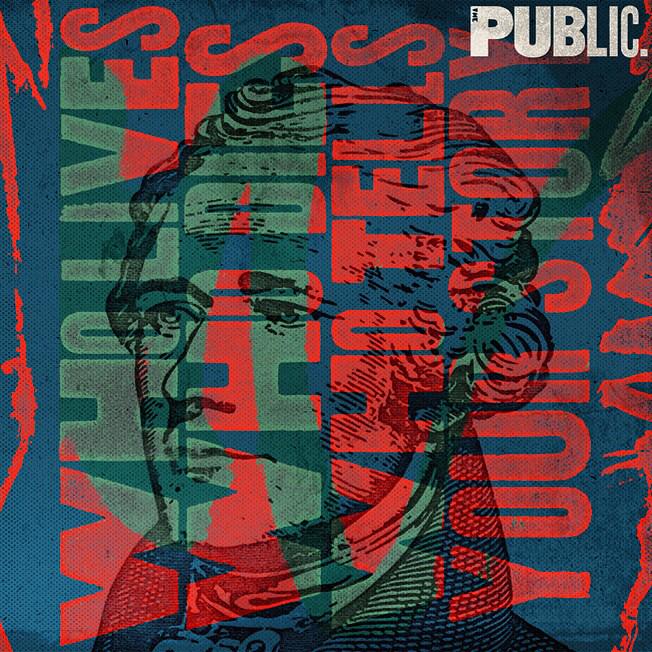
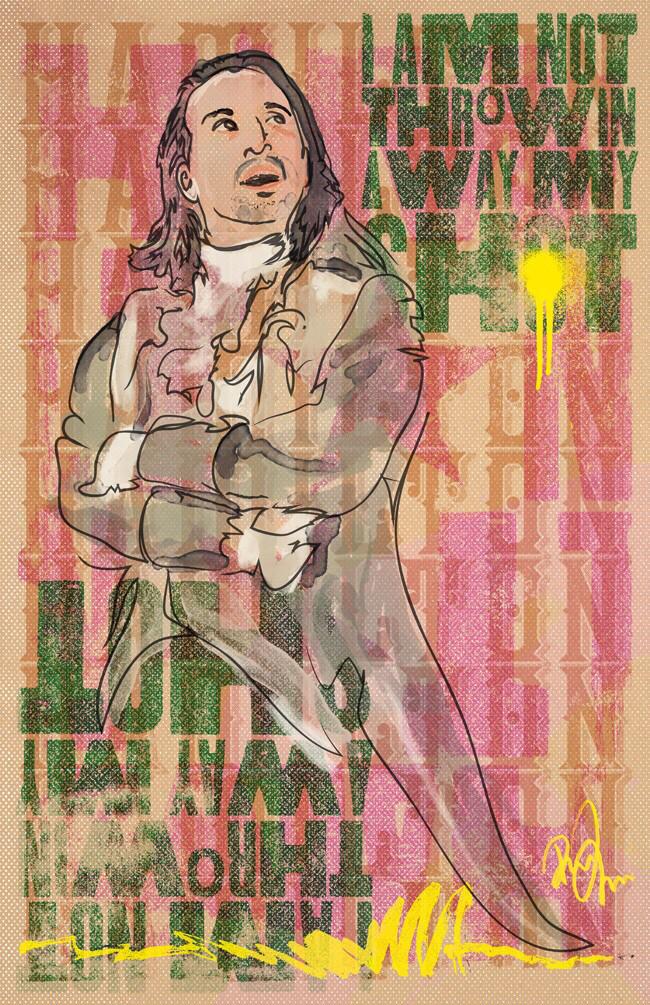
Twitter user @drpeccidesign shared some awesome images, juxtaposing lyrics from the show with images of Hamilton.  These two were my favorite.

Embedded image permalink
https://twitter.com/drpeccidesign/status/566844657464655873
Embedded image permalink
https://twitter.com/drpeccidesign/status/568638128145043456

Last week, Publius-Esquire published this sketch of Thomas Jefferson (Daveed Diggs) and Alexander Hamilton (Lin-Manuel Miranda) from the show.  (They both look too smiley here to be mid-rap battle!)

Sketch from Publius Esquire: http://publius-esquire.tumblr.com/post/111122186915/sketched-thomas-jefferson-daveed-diggs-and

She also did this one of Aaron Burr (Leslie Odom Jr.) and Alexander Hamilton (Lin-Manuel Miranda) back-to-back with duel pistols.  (This makes me wish that I had some artistic ability!)

From Publius-Esquire http://publius-esquire.tumblr.com/post/109950243610/wanted-to-draw-lin-manuel-miranda-and-leslie-odom

On February 18, Twitter user  published this image, juxtaposing lyrics from the show against an unfocused backdrop of Hamilton’s face.

2-27-2015 1-59-30 PM

Of course, a short Hamilton montage is now available from the Public Theater with some highlights from the show!

Tickets to Hamilton on Broadway go on sale March 8th via Ticketmaster!

Hamil-Tunes: Hamilton and Burr’s Pre-Duel Dinner

The week before their fateful/fatal interview in Weehawken, Hamilton and Burr both attended a 4th of July dinner meeting of the Society of the Cincinnati at Fraunces Tavern.  The Society was a group of Revolutionary War officers and Hamilton was president general, succeeding George Washington after his death.  During the dinner, Burr and Hamilton reportedly sat at the very same table!  While Burr seemed silent and serious, Hamilton was in seemingly high spirits and accepted a request to entertain his fellow former officers with a military song.

John Trumbull (who painted some of my favorite portraits of Hamilton and was also a member of the Society) wrote in his memoirs:

“On the 4th of July, I dined with the Society of the Cincinnati, my old military comrades, and then met, among others Gen. Hamilton and Col. Burr.  The singularity of their manner was observed by all, but few had any suspicion of the cause. Burr, contrary to his wont, was silent, gloomy, sour ; while Hamilton entered with glee into all the gaiety of a convivial party, and even sang an old military song.  A few days only passed, when the wonder was solved by that unhappy event which deprived the United States of two of their most distinguished citizens.”

Historians have disputed what song Hamilton actually sang, with some suggesting he sang “The Drum,” and others “How Stands the Glass Around.”

Ron Chernow writes:

“At first, Hamilton could not be induced to sign, then submitted.  ‘Well, you shall have it,’ he said, doubltess to cheers from the veterans.  Some have said his valedictory song was a haunting old military ballad called ‘How Stands the Glass Around,’ a song reputedly sung by General Wolfe on the eve of his battlefield death outside Quebec in 1759.  Others said that it was a soldiers’ drinking song called ‘The Drum.’  Both tunes expressed a common sentiment: a soldier’s proud resignation in the face of war and death.”

In his lecture on Hamilton’s military career, James Edward Graybill published a letter from Hamilton’s grandson Schuyler Hamilton regarding the song Hamilton sang prior to the duel which stated:

“I have always been of the opinion, from what I have heard from my father and uncles, that the song sung by my grandfather at the dinner of the Cincinnati where Colonel Burr was present, was General Wolff’s famous camp song, which begins with the words ‘How stands the glass around?'”

The first two stanzas of How Stands the Glass Around are reprinted below and express the brotherhood and solidarity of soldiers facing the threat of imminent danger and possible death.  Listen to a rendition of the song in the embedded video from YouTube!

How stands the glass around?
For shame you take no care, my boys,
How stands the glass around?
Let wine and mirth abound;
The trumpet sound,
The colors they do fly my boys;
To fight, kill or wound;
As you would be found,
Contented with hard fare, my boys
On the cold ground
O why, soldiers why?
O why should we be melancholy boys,
O why soldiers why?
Whose bus’ness is to die;
What? sighing? Fye!
Drink on, drown fear, be jolly boys;
‘Tis he, you or I, wet, hot, cold or dry;
We’re always bound to follow boys,
And scorn to fly.

Death Feud: John Adams’ Obsession with Hamilton’s Legacy

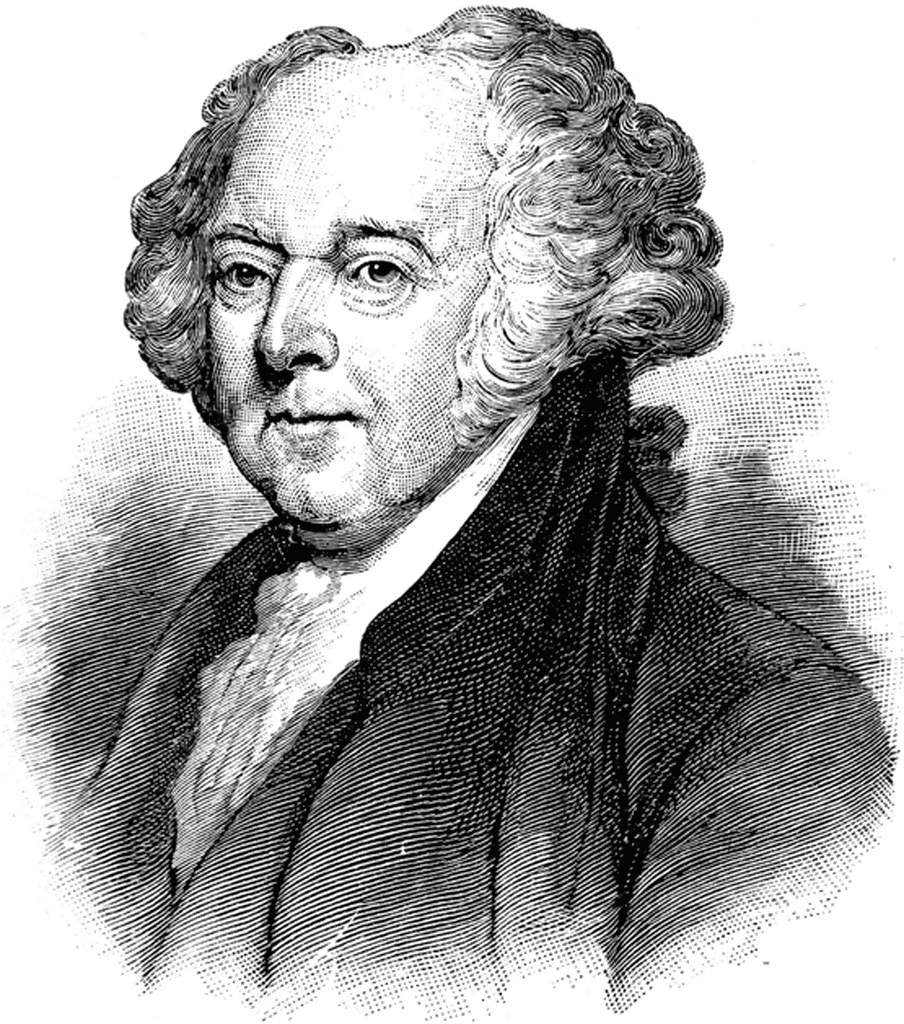
The rivalry between Alexander Hamilton and John Adams during Hamilton’s lifetime is well documented.  During Washington’s presidency, Adams was openly suspicious of Hamilton’s role in the administration and his ambitions. When Adams was running for a second term, Hamilton published a letter to his supporters Concerning the Public Conduct and Character of John Adams, Esq. President of the United States.  When this letter was published more widely, it damaged Adams’ hopes of winning the election and fractured the Federalist Party. (You can read more about Hamilton’s role in that election here).

But what happened after Hamilton’s death is less known and just as interesting.  While Jefferson reportedly expressed admiration for his former rival after the fatal duel and even enacted a bust of Hamilton opposite his own at Monticello, Adams went on a private quest to sink Hamilton’s reputation.  Adams shared rumors about Hamilton’s romantic indiscretions and ambitions to many powerful people in his private circles, including Dr. Benjamin Rush and Adams’ cousin, William Cunningham.

http://etc.usf.edu/clipart/0/81/adams_4_lg.gif

In 1806, Adams wrote to Dr. Rush of the pamphlet and of Hamilton’s “delirium of ambition.”  In this letter, Adams referred to Hamilton as the “bastard brat of a Scotch pedlar” and spoke of rumors that Hamilton had, before his death, threatened to publish an unflattering memoir of George Washington:

Although I read with tranquility and suffered to pass without adversion in silent contempt the base insinuations of vanity and a hundred lies besides published in a pamphlet against me by an insolent coxcomb who rarely dined in good company, where there was good wine, without getting silly and vaporing about his administration like a young girl about her brilliants and trinkets, yet I lose all patience when I think of a bastard brat of a Scotch pedlar daring to threaten to undeceive the world in their judgment of Washington by writing an history of his battles and campaigns. This creature was in a delirium of ambition; he had been blown up with vanity by the tories, had fixed his eyes on the highest station in America, and he hated every man, young or old, who stood in his way or could in any manner eclipse his laurels or rival his pretensions. . . .

In a decades-long correspondence with his cousin William Cunningham, Adams suggested that Hamilton should have been branded with “everlasting infamy” because of the circumstances of his birth and not given a chance to participate in respectable society,  Adams reportedly wrote (per Cunningham’s quote of an undiscovered Adams letter):

“Conjugal fidelity is the fountain of all virtue. Statesmen, philosophers, and the Christian Religion, unite in representing adultery & fornication, as the worst of crimes; and Hamilton, for his insult to this essence of a good education, deserved to be branded with everlasting infamy.”

Adams was obsessed with Hamilton’s lack of morality, and seemed to take gleeful pleasure in recounting stories of Hamilton’s sexual exploits, particularly rumors about Hamilton’s sisters-in-law.  Adams also wrote about Hamilton’s ambitions ruining the country.  On a September 27, 1808 letter, Adams stated:

” Hamilton’s Ambition, intrigues and Caucuses have ruined the cause of rational federalism by encumbering and entangling it with men and measures that ought never to have been brought forward.”

In an April 1811, Cunningham implored Adams to take back some of the unfounded accusations he had leveled against Hamilton, calling them a “poisoned chalice.”

Should you now refuse to recal the calumny you have spread of Hamilton in secret; or to supply the evidence of your heinous charges, will you not oblige his friends to strip from your hands, before you slip out of life, the poisoned chalice whose contents you have infused into the minds of many around you, to work, like canine madness in the veins, after its propagator has perished?

Adams’ actions came to light in 1823, when a political pamphlet containing the correspondence between Adams and Cunningham from 1803-1812 was published in order to sink John Quincy Adam’s chances of becoming president.  You can read the entire pamphlet for free on Google Books, or read some of the correspondence on Founders Online (highly recommended- this is gripping stuff).

A contemporary review of the correspondence noted:

It appears by Cunningham’s letters to Mr. Adams, that the latter had written two concerning Hamilton, filled with matters of such a character that he would not leave them in Cunningham’s hands : he insisted on their being returned to him, and they were returned : but their contents are intimated in Cunningham’s answers. The accusations are of atrocious vices. One, that Hamilton was totally destitute of integrity. The whole of the world where Hamilton was Known will acquit him of this charge, and with scorn repel the foul calumny.

I had read about Adams’ attacks on Hamilton’s reputation in several biographies of Hamilton, but reading some of the actual correspondence was interesting because it shows how deeply ingrained and consuming Adams’ hatred of Hamilton was even decades after Hamilton’s death and Adams’ retirement from the political scene.  Talk about holding a grudge!

“Silent Night:” the Hamilton Connection

On December 2, 2014 Time Magazine published its analysis of the most popular Christmas song ever, and determined that “Silent Night” was “the most popular Christmas song ever.”  The Time article states:

The names Joseph Mohr and Franz Xaver Gruber have largely vanished into the annals of Christmas tormentors, but their greatest triumph lives on. “Silent Night,” which Mohr wrote the lyrics for (in German) in 1816 and Gruber put to music two years later, is the most recorded Christmas song in the modern era of the holiday’s substantial oeuvre.

To determine this fact, TIME crawled the records at the U.S. Copyright Office, which offers digitized registrations going back to 1978, and collected data on every Christmas album recorded since that time. “Silent Night,” it turns out, is not merely the most popular carol; with 733 copyrighted recordings since 1978, it is nearly twice as dominant as “Joy to the World,” a distant second with 391 records to its name.

The origins of “Silent Night” in the United States actually have a Hamiltonian twist.  According to the Silent Night Society:

During a tour of America in 1839, the Rainer Family Singers sang “Silent Night!” during a Christmas day concert held in front of the Alexander Hamilton Memorial by the Trinity Church at the end of Wall Street in New York City. This is the first recorded performance of “Silent Night!” in the United States.

Gage Averill offers more detail in his book Four Parts, No Waiting: A Social History of American Barbershop Quartet.

“At a concert at the Alexander Hamilton Monument near Trinity Church in Manhattan, the Rainers premiered “Silent Night [Stille Nacht] for American audiences.  The Rainers and another singing family, the Strassers, were chiefly responsible for spreading this song…throughout Europe.”

A May 1, 1841 advertisement in the Newport Mercury newspaper announces that the Rainer Family was giving a Farewell Concert at the Masonic Hall in Newport, Rhode Island.

Rainer Family

I have not seen any information on why the Rainer Singers chose Trinity Church/the Hamilton Monument as a concert venue, and would be interested in learning more if anyone is familiar with these details!

T.R. on Hamilton

President Theodore Roosevelt is an iconic figure in American history.  The 26th President of the United States was also a noted soldier, environmentalist, and historian.  Roosevelt wrote a history of New York entitled New York: A Sketch of the City’s Social, Political, and Commercial Progress from the First Dutch Settlement to Recent Times.

Roosevelt described New York’s emergence as the “Federalist City” and Hamilton’s role in this:

“It was during this period of the foundation of the Federal government, and during the immediately succeeding period of the supremacy of the Federalists in national affairs that New York City played its greatest and most honorable part in the government of the nation. Never before or since has it occupied so high a position politically, compared to the country at large; for during these years it was the seat of power of the brilliant Federalist party of New York State. Alexander Hamilton, John Jay, and at the end of the time Gouverneur Morris, lived in the city, or so near it as to have practically the weight and influence of citizens; and it was the home likewise of their arch-foe Aaron Burr, the prototype of the skilful, unscrupulous ward-politician, so conspicuous in the later periods of the city’s development.

Hamilton, the most brilliant American statesman who ever lived, possessing the loftiest and keenest intellect of his time, was of course easily the foremost champion in the ranks of the New York Federalists; second to him came Jay, pure, strong and healthy in heart, body, and mind. Both of them watched with uneasy alarm the rapid drift toward anarchy; and both put forth all their efforts to stem the tide. They were of course too great men to fall in with the views of those whose antagonism to tyranny made them averse from order. They had little sympathy with the violent prejudices produced by the war. In particular they abhorred the vindictive laws directed against the persons and property of Tories; and they had the manliness to come forward as the defenders of the helpless and excessively unpopular Loyalists. They put a stop to the wrongs which were being inflicted on these men, and finally succeeded in having them restored to legal equality with other citizens, standing up with generous fearlessness against the clamor of the mob.”

Roosevelt also described how Hamilton and New York complemented each other:

 Hamilton and Jay were the heart of the Federalist party in the city and State. Both were typical New Yorkers of their time,—being of course the very highest examples of the type, for they were men of singularly noble and lofty character. Both were of mixed and non-English blood, Jay being of Huguenot and Hollander stock, and Hamilton of Scotch and French creole. Hamilton, born out of New York, was in some ways a more characteristic New Yorker than Jay; for New York, like the French Revolution, has always been pre-eminently a career open to talent. The distinguishing feature of the city has been its broad liberality; it throws the doors of every career wide open to all adopted citizens.

Saving King’s College: Hamilton and Columbia University

Columbia University is one of the most distinguished educational institutions in the world.  US News ranks it as one of the top colleges in the country and it has a stellar reputation for academics and research.  (Not to mention, my little brother Sid graduated from Columbia a few years ago!) King’s College held a special place in Hamilton’s affections.  His two year experience as a student was a catalyst for his revolutionary ideas and the basis for some of the most important and long-lasting friendships, including his friendship with Robert Troup.  King’s College was a fundamentally Tory institution, and during Hamilton’s time there, college president Myles Cooper was vehemently opposed to the revolutionary sentiment in New York.

In fact, as David C. Humphrey writes in From King’s College to Columbia, 1746-1800:

“Probably half or more of all the King’s College students and alumni living in 1776 became loyalists.  so did Myles Cooper, four of the five other men who taught liberal arts at King’s between 1770 and 1777, and more than two-thirds of the governors who participated in policy making during the early 1770s.  The college leaders conceived of their institution as a bulwark of the established order, not as its critic.  On the very eve of the Revolution they sought to strengthen the college’s ties to the Crown.”

In Stand, Columbia: a History of Columbia University in the City of New York, 1754-2004, Robert McCaughey writes that “Tory loyalities and eight years out of operation had nearly consigned” King’s College to the “dustbin of history.”

James Duane, the first postwar mayor of New York City, who had come under scrutiny for siding with Hamilton in the Rutgers v. Waddington case and limiting the application of the Trespass Act of 1783, was a major advocate for saving the college.  Duane, along with George Clinton, John Jay, and Alexander Hamilton, spearheaded an effort to reopen the college under the auspices of the New York state legislature.  In early 1784, Duane initiated a discussion in the New York Senate, and “on March 24, 1784, the senate received a ‘Petition of Governors of King’s College’ urging adoption of Duane’s proposal.”

The Columbia website states:

“In 1784, Hamilton and fellow state legislator John Jay (Kings College 1764) were instrumental in reviving King’s College as Columbia College. Hamilton served as a regent of Columbia from 1784 to 1787, and as a trustee from 1787 until his death on July 11, 1804, when he was shot in a duel by his political rival Aaron Burr. Hamilton is buried in the Trinity Church cemetery. The Alexander Hamilton Medal, presented each year by the Columbia College Alumni Association, is the highest tribute awarded to a member of the Columbia College community. Winners include Columbia president Dwight D. Eisenhower and alumni Richard Rodgers and Oscar Hammerstein II.”

On April 13, 1787, Hamilton, Duane, and Jay’s efforts paid off and the New York Legislature approved a new charter that allowed the college more freedom and self-government than the more restrictive 1784 charter.   Robert A. McCaughey writes:

“In point of fact, the 1787 charter made the college substantially more private than King’s College under the 1754 charter or Columbia College under the 1784 charter.  None of its twenty-four trustees were to be state officeholders serving as ex officio members, and all replacements for future trustees were to be elected by incumbents.  The board was henceforth to be wholly self-perpetuating, as it would remain until 1908, when provisions were first made for alumni nominations to the board.  No less important in terms of the institution’s future identity, the charter explicitly linked for the first time governance and locale by its prepositional designation of ‘the Trustees of Columbia College in the City of New York..'”

This 1787 charter was the foundation upon which Columbia College was built, and which allowed the college to grow over time as an institution.

Eliphalet Nott’s “On the Death of Hamilton” and the Condemnation of Dueling

Eliphalet Nott, a notable clergyman in Albany, used the occasion of Hamilton’s death in 1804 to deliver a widely-publicized condemnation of the practice of dueling.  Nott’s sermon was “one of several sermons delivered by prominent preachers at that time, and having for their immediate purpose the breaking up of the custom of dueling.”  William Jennings Bryan also included the sermon in his collection of The World’s Famous Orations, published in 1906, over 100 years after the duel., and it was considered an example of the principles of elocution.

Nott began his sermon with a passionate description of the many facets of Hamilton’s career and personal life that made him worthy of national acclaim.

Would to God my talents were adequate to the occasion. But such as they are, I devoutly proffer them to unfold the nature and counteract the influence of that barbarous custom which, like a resistless torrent, is undermining the foundations of civil government, breaking down the barriers of social happiness, and sweeping away virtue, talents, and domestic felicity in its desolating course. Another and an illustrious character—a father—a general—a statesman—the very man who stood on an eminence and without a rival among sages and heroes, the future hope of his country in danger—this man, yielding to the influence of a custom which deserves our eternal reprobation, has been brought to an untimely end.

The Hero, called from his sequestered retreat, whose first appearance in the field, tho a stripling, conciliated the esteem of Washington, our good old father. Moving by whose side, during all the perils of the Revolution, our young chieftain was a contributor to the veteran’s glory, the guardian of his person, and the copartner of his toils.

The Conqueror, who, sparing of human blood when victory favored, stayed the uplifted arm and nobly said to the vanquished enemy, “Live!”

The Statesman, the correctness of whose principles and the strength of whose mind are inscribed on the records of Congress and on the annals of the council chamber; whose genius impressed itself upon the Constitution of his country; and whose memory the government—illustrious fabric, resting on this basis—will perpetuate while it lasts; and shaken by the violence of party should it fall, which may Heaven avert, his prophetic declarations will be found inscribed on its ruins.

The Counselor, who was at once the pride of the bar and the admiration of the court; whose apprehensions were quick as lightning, and whose development of truth was luminous as its path; whose argument no change of circumstances could embarrass; whose knowledge appeared intuitive; and who, by a single glance, and with as much facility as the eye of the eagle passes over the landscape, surveyed the whole field of controversy; saw in what way truth might be most successfully defended and how error must be approached; and who, without ever stopping, ever hesitating, by a rapid and manly march, led the listening judge and the fascinated juror, step by step, through a delightsome region, brightening as he advanced, till his argument rose to demonstration, and eloquence was rendered useless by conviction; whose talents were employed on the side of righteousness; whose voice, whether in the council chamber, or at the bar of justice, was virtue’s consolation; at whose approach oppressed humanity felt a secret rapture, and the heart of injured innocence leaped for joy.

Where Hamilton was, in whatever sphere he moved, the friendless had a friend, the fatherless a father, and the poor man, tho unable to reward his kindness, found an advocate. It was when the rich oppressed the poor; when the powerful menaced the defenseless; when truth was disregarded or the eternal principles of justice violated—it was on these occasions that he exerted all his strength; it was on these occasions that he sometimes soared so high and shone with a radiance so transcendent, I had almost said, so “heavenly, as filled those around him with awe and gave to him the force and authority of a prophet.”

The Patriot, whose integrity baffled the scrutiny of inquisition; whose manly virtue never shaped itself to circumstances; who, always great, always himself, stood amid the varying tides of party, firm, like the rock which, far from land, lifts its majestic top above the waves and remains unshaken by the storms which agitate the ocean.

The Friend, who knew no guile; whose bosom was transparent and deep; in the bottom of whose heart was rooted every tender and sympathetic virtue; whose various worth opposing parties acknowledged while alive, and on whose tomb they unite, with equal sympathy and grief, to heap their honors.

He then went on to criticize societal institutions for permitting the custom of dueling to continue and used the tragedy of Hamilton’s death to spur his audience to take action to condemn dueling.

But I have said, and I repeat it, there are those whom I can not forgive. I can not forgive that minister at the altar who has hitherto forborne to remonstrate an this subject. I can not forgive that public prosecutor who, entrusted with the duty of avenging his country’s wrongs, has seen those wrongs, and taken no measures to avenge them. I can not forgive that judge upon the bench, or that governor in the chair of state, who has lightly passed over such offenses. I can not forgive the public, in whose opinion the duelist finds a sanctuary. I can not forgive you, my brethren, who till this late hour have been silent while successive murders were committed.

No; I cannot forgive you that you have not in common with the freemen of this State, raised your voice to the powers that be and loudly and explicitly demanded an execution of your laws; demanded this in a manner which, if it did not reach the ear of government, would at least have reached the heavens and pleaded your excuse before the God that filleth them—in whose presence as I stand I should not feel myself innocent of the blood that crieth against us had I been silent. But I have not been silent. Many of you who hear me are my witnesses—the walls of yonder temple, where I have heretofore addressed you, are my witnesses, how freely I have animadverted upon this subject in the presence both of those who have violated the laws and of those whose indispensable duty it is to see the laws executed on those who violate them.

A short time since, and he who is the occasion of our sorrows was the ornament of his country. He stood on an eminence, and glory covered him. From that eminence he has fallen—suddenly, for ever fallen. His intercourse with the living world is now ended; and those who would hereafter find him must seek him in the grave. There, cold and lifeless, is the heart which just now was the seat of friendship. There, dim and sightless, is the eye whose radiant and enlivening orb beamed with intelligence; and there, closed for ever, are those lips on whose persuasive accents we have so often and so lately hung with transport! From the darkness which rests upon his tomb there proceeds, methinks, a light in which it is clearly seen that those gaudy objects which men pursue are only phantoms. In this light, how dimly shines the splendor of victory; how humble appears the majesty of grandeur! The bubble which seemed to have so much solidity has burst; and we again see that all below the sun is vanity.

Nott’s sermon was not alone.  At a Philadelphia meeting, one of the resolutions was that “the clergymen of several denominations, be requested to expatiate, on Sunday next, upon the irreligious and pernicious tendency of a custom, which has deprived our country of one of her best and most valuable citizens.”
Hamilton at the Public Theater: Additional Casting Underway

Broadway World reported today that “auditions are currently underway to fill several key roles” in Lin-Manuel Miranda’s forthcoming Hamilton play at the Public Theater.  The show is scheduled to run from January 20-February 22, 2015.  Tickets for the show went on sale to Public Theater members last week and tickets to the general public will go on sale July 29.  (I am going to the January 21 and January 23 performances!).  Interestingly, the casting call lists an extension closing date of May 10, 2015, suggesting that perhaps the theater is anticipating a longer run for the show.

Backstage reprinted the casting call, which seeks actors for the parts of Aaron Burr, George Washington, and a few other characters:

HAMILTON
Dir: Thomas Kail
Music/Lyrics: Lin-Manuel Miranda
Music Spvsr: Alex Lacamoire
Choreo: Andy Blankenbuehler
Casting: Telsey + Company/Bethany Knox
1st reh: 11/24/14. Runs: 1/20 – 2/22/15
Extension Closing: 5/10/15
Hamilton

GENERAL NOTE: Looking for people of all ages and all ethnicities for these roles. This storyline spans 25 years+, so age is not literal – like Aaliyah said, it’s nothin’ but a number.

SEEKING:

AARON BURR: tenor/baritone, sings and raps in equal measure. Our narrator. A cool, steely reserve. An orphan raised in wealth, plays his cards and opinions close to the vest. Slow to anger, but when he gets there, look out. Javert meets Mos Def.

GEORGE WASHINGTON: tenor/baritone, sings and raps in equal measure. Authoritative, regal, aloof, aware of his place in history at all times. John Legend meets Mufasa.

HERCULES MULLIGAN/JAMES MADISON (dual role): Tenor/baritone, MUST be able to sing and rap well.
MULLIGAN is the life of the party, dripping with swagger, streetwise and hilarious. Joins the revolution to get out of being a tailor’s apprentice, and befriends Laurens, Hamilton and Lafayette. Busta Rhymes meets Donald O’Connor. MADISON is incisively intelligent, quiet, professorial. A former Hamilton ally, he becomes Jefferson’s detail man concerning all matters—he gets things done. RZA meets Zach from Chorus Line.

KING GEORGE: tenor, British accent. The King of England. Entitled, pouty nihilist. Sees the American Colonies as a deluded former lover, who will come crawling back. Rufus Wainwright meets King Herod in JCS.

PEGGY SCHUYLER/MARIA REYNOLDS (dual role.): Mezzo-soprano. PEGGY SCHUYLER: sweet, shy, youngest of the three Schuyler Sisters. The Michelle Williams of Destiny’s Child. MARIA REYNOLDS: sultry, young, calculating. Affects the role of a damsel in distress to seduce Hamilton. Jasmine Sullivan meets Carla from Nine.

All other roles have been CAST.

Hamilton, Paterson, and Economic Independence

Leonard A. Zax, president of the Hamilton Partnership for Paterson, recently published an article in NorthJersey.com regarding Hamilton’s role in pushing America towards economic independence by building strong support for American innovation.  Zax states:

Fifteen years after the Declaration of Independence and long after the British had surrendered, America remained woefully dependent upon England for all manufactured goods, including military supplies. Hamilton recognized that America could never be free from foreign dominance without economic independence, and as treasury secretary he created an ambitious strategy to achieve it, starting in Paterson.

Hamilton’s plan was to harness the force of the Great Falls, then the most forceful waterfall in America —the British still claimed the lands around Fort Niagara — to power the new industries that would secure our economic future. The Paterson Great Falls are 300 feet wide and 77 feet high and pour up to 2 billion gallons of water into a narrow chasm each day. Hamilton knew the Falls could provide power to mills at a time when there was virtually no manufacturing in the United States.

Paterson became the world’s first planned city of innovation, the Silicon Valley of the American Industrial Revolution. Today, the Great Falls is a living reminder of the birthplace of American industry at a time when manufacturing was the high-tech of the day.

Paterson Great Falls

The Paterson Great Falls National Historical Park website states:

The history of the City of Paterson includes its beginnings as the ambitious project of Hamilton and the Society for Establishing Useful Manufacturers (S.U.M.) in 1792 at the Great Falls, the early development of water power systems for industrial use, and the various types of manufacturing that occurred in the District’s mills into the 20th Century. These included cotton fabrics, railroad locomotives, textile machinery, jute, and silk spinning, weaving, and dyeing, among many others. preserves this important legacy.

Founders Online features many fascinating primary source documents showing Hamilton’s ambitious architecture for this early Silicon Valley hybrid.  These documents make clear how important Hamilton’s farsightedness was to the ultimate success of America’s early industrial revolution.  As Sax suggests, without Hamilton’s economic vision, the United States could have been a nation with independence in name only, dependent on Great Britain to supply all manufactured goods.

  • Prospectus of the Society for Establishing Useful Manufactures
  • Proposals to Contract for the Construction of the Manufacturing Plant of the Society for Establishing Useful Manufactures
  • Draft Minutes of a Meeting of a Committee of the Directors of the Society for Establishing Useful Manufactures

Hamilton [College] on Hamilton: Voices from Students Past

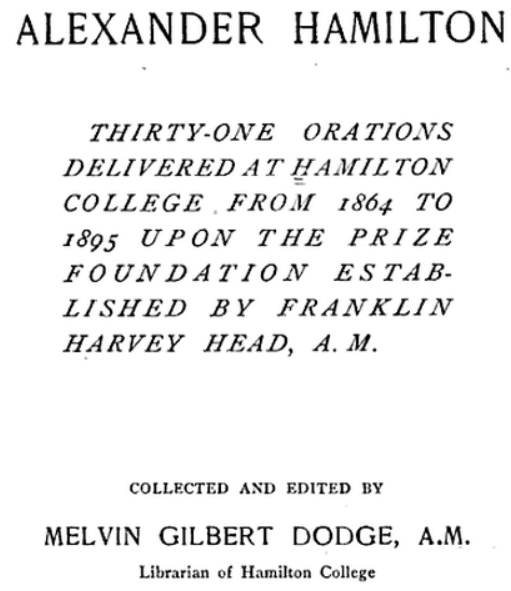
HamCol Book


I came across an interesting collection that I wanted to share.  Franklin Harvey Head, who penned an extremely influential address on the meaning and goals of liberal arts education in the US, sponsored a prize foundation at Hamilton College that awarded the top student orator for each year a prize for preparing and delivering a speech on Alexander Hamilton.  The introduction to the collection states “Mr. Head established the prize called by his name, designating that the subject for this Prize Oration year by year should have reference to the character and career of Alexander Hamilton.”  The introduction also notes:

“No name from the rolls of our struggle for independence and our binding together as a nation awakens more intense interest or opens wider fields for consideration than that of Hamilton.  From the first appearance of the youthful student, to the tragic hour on the heights of Weehawken, the story has the attraction of romance, and in it can be found the kindling of influences potent not only for then but for all time.”

The thirty-one topics include:

  • Hamilton as a Constitutional Statesman
  • The Character and Statesmanship of Hamilton
  • Hamilton as an Expounder of the Constitution
  • The Intellectual Rank of Hamilton among his Contemporaries
  • Hamilton as a Political Prophet
  • The Relations of Hamilton and Burr
  • Our Political Indebtedness to Hamilton
  • Hamilton Compared with His European Contemporaries
  • The Position of Hamilton in American History
  • The Career and Character of Hamilton
  • Alexander Hamilton and Thomas Jefferson
  • The French Revolution and the Political Doctrines of Hamilton
  • Alexander Hamilton and Salmon P. Chase
  • Hamilton and Seward as Political Leaders
  • Alexander Hamilton and Louis Adolphe Thiers
  • The Death of Hamilton
  • The Political Doctrines of Hamilton in the Light of Recent American History
  • Hamilton and the Tariff Question
  • Alexander Hamilton and Benjamin Disraeli
  • The Political Services of Hamilton and Webster
  • The Debt of Our Government to Washington and Hamilton
  • Hamilton and the Presidential Election of 1800
  • The Military Services of Hamilton
  • The Verdict of Experience on Hamilton’s Constitutional Theories
  • Hamilton and the Constitutional Convention of 1787
  • The Influence of “The Federalist”
  • Hamilton, Webster, Seward
  • The Principles that Distinguish Hamilton and Jefferson as Statesmen
  • Alexander Hamilton and John Adams
  • Hamilton as a Lawyer
  • Hamilton and the Code of Honor
  • Hamilton’s Theory of the United States Senate

The collection of thirty-one prize-winning student oration is interesting for several reasons.  First, it offers us a snapshot of what students in the 1864-1895 time period were focused on studying.  Second, the range of topics varies from purely historical discussions of particular aspects of Hamilton’s legacy, to discussions of Hamilton in comparison to contemporary political figures.  I found the essays comparing Hamilton with contemporary politicians (Disraeli, Thiers, etc) extremely interesting.  Those orations offered an insight both into Hamilton and into the political theory of the late 1860s.  Keep in mind that these orations were being delivered for the three decades immediately after the Civil War, when the nation was still reeling.  Little wonder that students would seek lessons from the Constitutional period for guidance during another time of division and crisis.

The full text of the thirty-one orations is available via Google Books and Cornell’s Internet Archive..