I wrote earlier about Philip Hamilton’s untimely death at age 19 in a duel at the Weehawken Dueling Grounds. I came across this letter from Hamilton to his friend Richard Kidder Meade, dated August 27, 1782, describing his seven month old son.
“You reproach me with not having said enough about our little stranger. When I wrote last I was not sufficiently acquainted with him to give you his character…He is truly a very fine young gentleman, the most agreeable in his conversation and manners of any I ever knew–nor less remarkable for his intelligence and sweetness of temper. You are not to imagine by my beginning with his mental qualifications that he is defective in personal. It is agreed on all hands, that he is handsome, his features are good, his eye is not only sprightly and expressive but it is fully of benignity. His attitude in sitting is by connoisseurs esteemed graceful and he has a method of waving his hands that announces the future orator. He stands however rather awkwardly and his legs have not all the delicate slimness of his fathers. It is feared He may never excel as much in dancing which is probably the only accomplishment in which he will not be a model. If he has any fault in manners, he laughs too much. He has now passed his Seventh Month.”
And here’s an illustration of Hamilton and his son from Tumblr
Haiti has a tumultuous and fascinating history, and was the focus of a clash of opinions between Jefferson and the Federalists from 1799-1806. Hamilton supported the Haitian revolution and the government established under Toussaint L’Ouverture, a former slave. He helped draft Haiti’s constitution and advocated open trade with the new nation. On the other hand, Jefferson and his southern constituency were horrified by the idea of a free black republic.
Haiti was first discovered and conquered by Columbus and claimed for the Spanish as Hispaniola in 1492. The Spanish used it as a trading port and maintained control of the island until 1625, when the Spanish lost control due to Dutch resistance and retreated from most of the island. The French began establishing their presence on the island in the 1620s and in 1664, the French West India Company claimed the western part of the island. The French began to import large numbers of African slaves and set up a plantation economy focused on the production of sugar and coffee. Slave rebellions were frequent because of brutal conditions, so in 1685, King Louis XIV enacted the Code Noir, which served as the basis of the law of slavery in Saint- Domingue and the other French plantation colonies. Although the Code Noir legalized manumission of slaves and provided some rights for free blacks, it also created “a rigorously punitive scheme for the discipline of slave labor.” As time passed, the government began to pass laws restricting the rights of the large free black population, the gens de couleur. The combination of oppression towards slaves and towards the free black population created a tinderbox situation. In 1789, Vincent Ogé, a wealthy member of the gens de couleur petitioned the colonial government for equal rights for free people of color in Haiti. When his demands were rejected, he tried to lead an uprising, but was unsuccessful. In 1791, more slave rebellions occured, and successfully overthrew the government. Toussaint L’Ouverture emerged as the leader of the movement and the unofficial leader of the government. France officially ended slavery in its colonies in 1794, prompting L’Ouverture to support the French against the Spanish. Then, the British attempted to invade the island, but L’Ouverture drove them out in 1798 and took control of the government.
Now, the American government had to decide what to do with this new, unique political situation of slaves rebelling and actually controlling the government and military.
In Nation Among Nations, Thomas Bender describes the Haiti debate:
“Haiti heightened the partisan division. Much of the debate over American policy towards Haiti was framed within the larger debate between France and Britain, as Britain maneuvered to take advantage of troubles on the island. But, as Linda Kerber has observed, the debate about foreign policy “kept sliding into the subject of slavery.” When Federalists talked about the profits of trade, southern Republicans- Jefferson’s core constituency- saw only the question of American recognition of a black republic.”
Ted Widmer states: Under the Washington and Adams administrations, “a policy of quiet indifference [towards Haiti] gradually turned into commercial and even military support– support without which it would have been impossible for the experiment in black democracy to survive. ”
Hamilton understood the complicated political landscape surrounding the decision and on February 9, 1799 wrote:
…as in every thing else, we must unite caution with decision. The United States must not be committed on the independence of St. Domingo. No guaranty—no formal treaty—nothing that can rise up in judgment. It will be enough to let Toussaint be assured verbally, but explicitly, that upon his declaration of independence a commercial intercourse will be opened, and continue while he maintains it, and gives due protection to our vessels and property. I incline to think the declaration of independence ought to precede.
In June 1799, Adams issued a proclamation regarding Commerce with St. Domingo and allowed US ships to trade with Haiti. Hamilton worked closely with his friend and Adams’ Secretary of State, Timothy Pickering to develop this support. While some historians have inaccurately characterized this collaboration as occurring behind Adams’ back, Adams was in fact fully aware of these events and told Pickering that the negotiations with L’Ouverture “enjoyed his fullest approbation.” Hamilton was impressive in his “active sympathy for Haiti.” Hamilton and Pickering worked to have Hamilton’s close boyhood friend Edward Stevens deployed as Consul General of the United States at Cape-Francais in 1799. Hamilton also drafted the Haitian Constitution.
However, when Jefferson came to power, he immediately tried to recalled Stevens and embargoed trade with Haiti. As Bender states:
“Unlike Adams, [Jefferson] was widely recognized for his support of revolutions, even the French one. In defense of its turn to violence, he observed that ‘the tree of liberty must be refreshed from time to time with the blood of patriots and tyrants.’ But was what tolerable in Paris was not so in Cap Haitien. The revolution there terrified Jefferson.”
Jefferson’s complete resistance to the events in Haiti was a direct product of his racism and his desire to help his constituents maintain a slave system in the South. He feared that the example of a black republic would encourage resistance in the South. Ironically, the Louisiana Purchase was made possible only because Napoleon’s defeat in Haiti made a French empire in America pointless. Henry Adams described the acquisition of that territory and the prevention of French invasion as a debt owed by the American people “to the desperate courage of five hundred thousand Haytian negroes who would not be enslaved.” Clearly, Jefferson never saw it that way. After Hamilton’s death, American foreign policy became increasingly proslavery, and in 1806, a stiff embargo was placed on Haitian trade. Napoleon captured Toussaint L’Ouverture, who died in captivity. For a complete background of the Haitian revolution and the response of the Founding Fathers, see Gordon S. Brown’s Toussaint’s Clause: The Founding Fathers and the Haitian Revolution.
Paul Finkelman recently wrote a fascinating piece in the New York Times focusing on Thomas Jefferson’s views on race. Finkelman states:
Jefferson was always deeply committed to slavery, and even more deeply hostile to the welfare of blacks, slave or free. His proslavery views were shaped not only by money and status but also by his deeply racist views, which he tried to justify through pseudoscience.
There is, it is true, a compelling paradox about Jefferson: when he wrote the Declaration of Independence, announcing the “self-evident” truth that all men are “created equal,” he owned some 175 slaves. Too often, scholars and readers use those facts as a crutch, to write off Jefferson’s inconvenient views as products of the time and the complexities of the human condition.
But while many of his contemporaries, including George Washington, freed their slaves during and after the revolution — inspired, perhaps, by the words of the Declaration — Jefferson did not. Over the subsequent 50 years, a period of extraordinary public service, Jefferson remained the master of Monticello, and a buyer and seller of human beings.
Rather than encouraging his countrymen to liberate their slaves, he opposed both private manumission and public emancipation. Even at his death, Jefferson failed to fulfill the promise of his rhetoric: his will emancipated only five slaves, all relatives of his mistress Sally Hemings, and condemned nearly 200 others to the auction block. Even Hemings remained a slave, though her children by Jefferson went free.
Nor was Jefferson a particularly kind master. He sometimes punished slaves by selling them away from their families and friends, a retaliation that was incomprehensibly cruel even at the time. A proponent of humane criminal codes for whites, he advocated harsh, almost barbaric, punishments for slaves and free blacks. Known for expansive views of citizenship, he proposed legislation to make emancipated blacks “outlaws” in America, the land of their birth. Opposed to the idea of royal or noble blood, he proposed expelling from Virginia the children of white women and black men.
I was discussing the issue this weekend with Rand Scholet at the Alexander Hamilton Awareness Society, and it is truly remarkable how progressive Hamilton’s views on race were compared to many of his contemporaries. Hamilton grew up in the West Indies and was surrounded by slavery: slaves accounted for almost 90% of the total population. He participated in the slave trade on an administrative basis as a young clerk, and developed a disgust towards the entire institution. When Hamilton was involved with the Revolution, he advocated allowing blacks to join the Continental Army, despite opposition from many of his contemporaries. Hamilton’s philosophies on race were comparatively extremely progressive. I plan to write a series of blog posts highlighting Hamilton’s stance on slavery and other racial issues including the incorporation of black soldiers into the Continental Army, the New York Manumission Society, and the rebellion in Haiti. For more background on this issue, see James Oliver Horton’s Alexander Hamilton: Slavery and Race in a Revolutionary Generation.
An introduction to some of the more unusual Hamilton products available:
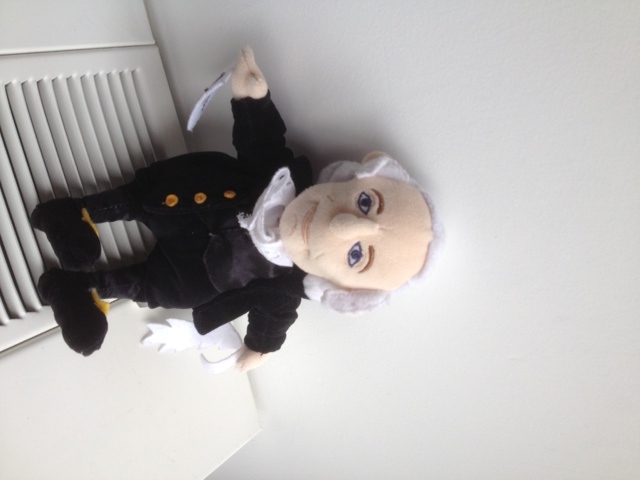
1) Hamilton plush doll/stuffed animal: I bought mine at the Trinity Church gift shop, but it is also available online. My roommate in law school found this doll incredibly creepy, and as much as I love all things Hamilton, there is something a little unnerving about this particular piece. I’d suggest sticking to the Bobblehead if you want a more accurate Hamilton.
2) Commemorative strands of Hamilton’s hair: History for Sale has ten strands of Hamilton’s hair available from the “largest collector of famous hair,” as listed in the Guinness Book of World Records. For just under $8,000, you can own ten strands of Hamilton’s hair, collected from various points of his life. If you’re just looking for one or two strands, Ebay has deals ranging from $99-$495. While I do love collectible Hamilton items, I’ve never found the appeal of collecting hair strands from two centuries ago.
3) Alexander Hamilton Revolutionary Action Figure– The Alexander Hamilton American light infantry command action figure commemorates Hamilton’s position as Lieutenant Colonel of the Light Infantry Division that fought at Yorktown in 1781. Hamilton’s heroic conduct in Yorktown brought him to Washington’s attention and Hamilton had extremely close relationships with Marquis de Lafayette and John Laurens, fellow commanders in the division. The figure is available on Amazon, Sierra Toy Soldiers, and The History Store
I came across this Youtube video, “Everybody Hates Hamilton.” The video is culled from clips of the HBO miniseries John Adams. Although it is only based on one TV show (based on David McCullough’s biography of Adams), the theme of Hamilton as a scapegoat is echoed. It boggles my mind that Hamilton, who came to New York as a penniless illegitimate teenager from the West Indies and became a champion of a new republic and the architect of its economy has been caricatured by so many people as a staunch monarchist and a ruthless and unprincipled politician.
In The American Commonwealth, Viscount James Bryce said Hamilton’s “countrymen seem to have never, either in his lifetime or afterwards, duly recognized his splendid gifts.” Hamilton’s political enemies brought up the circumstances of his birth, cast doubt on his relationship with President Washington, and generally blamed him for having a vision that they couldn’t comprehend. Adams called him the “bastard brat of a Scottish peddler.” Jefferson wrote to Washington:
I will not suffer my retirement to be clouded by the slanders of a man whose history, from the moment at which history can stoop to notice him, is a tissue of machinations against the liberty of the country which has not only received him and given him bread, but heaped its honors on his head.
In many ways, this legacy continues today. Historians regularly characterize Hamilton as a Machiavellian statesman. One author has even gone so far as to say that “Hamilton’s Curse” must be repudiated in order for America to be truly free.
Why?
I contend that Hamilton’s steadfast commitment to his principles is at the root of his unpopularity. Unlike Jefferson, Hamilton did not bow to the winds of popularity at the slightest inclination. Instead, he faced the consequences of making unpopular decisions when he believed them to be morally or economically necessary.
Here are some examples:
Protecting the Tories
As a college student in New York, Hamilton became convinced of the Revolutionary cause and threw himself into it with all his physical and mental energy. However, when an angry mob of patriots stood at the door of Myles Cooper, the president of King’s College, Hamilton held off the mob for hours in order to prevent Cooper from being attacked. After the Revolution was won, a popular movement began to strip any Loyalists of their property and prevent them from becoming full citizens in the new republic. Hamilton firmly opposed this movement and insisted that even Loyalists have the opportunity to be citizens in the new nation.
Hamilton, the most brilliant American statesman who ever lived, possessing the loftiest and keenest intellect of his time, was of course easily the foremost champion in the ranks of the New York Federalists; second to him came Jay…Both of them watched with uneasy alarm the rapid drift toward anarchy; and both put forth all their efforts to stem the tide…In particular they abhorred the vindictive laws directed against the persons and property of Tories; and they had the manliness to come forward as the defenders of the helpless and excessively unpopular Loyalists. They put a stop to the wrongs which were being inflicted on these men, and finally succeeded in having them restored to legal equality with other citizens, standing up with generous fearlessness against the clamor of the mob.
Economic Policies
Almost all of Hamilton’s economic policies, from establishing a National Bank to assuming the debts of the states to imposing an excise tax on whiskey, were politically unpopular but proved to be lifesaving for the new nation. Hamilton took on every uphill battle and, sometimes by sheer force of will, pushed those around him into accepting his plans. For example, Hamilton insisted that the government pay all of its war debts, including debts to speculators. During the Revolution, the Continental Congress sold war bonds to many supporters, including soldiers. However, over the long course of the war, many of the original owners of the bonds often sold them to speculators. After the War, there was a popular movement to disregard the debt altogether. Hamilton firmly believed that honoring this debt was essential to the financial progress of the nation. He eventually convinced resistant Southern congressmen to back him by agreeing to move the nation’s capital to the South.
Throughout his life, Hamilton was willing to make politically unpopular choices when he believed them to be necessary, or morally right. Hamilton is the ultimate historical underdog, and even as he rose to prominence in America, he never allowed the quest for popularity to overcome his moral convictions. Humans have a tendency to take the easy route, to “get along” with everyone whenever possible, and to generally follow the status quo and take the path of least resistance. As we all know, being part of the crow, or better yet, being the most popular person in the crowd can be a heady feeling. On the other hand, facing down a mob or being the only voice advocating your beliefs is always a struggle. Somehow, Hamilton maintained his public principles, even when they had unpleasant consequences. Hamilton’s life presents us all with a challenge: can we truly stand for what we believe in, no matter what the consequences?
Huffington Post Canada has included Trinity Church, the site of Alexander Hamilton’s gravesite, on its list of five must-see cemeteries around the world.
The article states: “Trinity Church and St. Paul’s Chapel, New York — A modest little green space in Lower Manhattan, this cemetery is best known for one tremendously significant resident: Alexander Hamilton, a founding father of the United States, the nation’s first secretary of state and a Revolutionary War hero. Hamilton isn’t buried in Arlington National Cemetery or on a palatial estate, however. He was shot and killed in a duel with Aaron Burr in 1804 and now rests across the street from a discount shoe store. Hamilton’s rise and fall is a significant part of early American history and you will learn more about it with a visit to this historic church. Trinity Church’s St. Paul’s Chapel, located five blocks north of Hamilton’s gravesite, played a significant role in the aftermath of the September 11, 2001 terrorist attacks and is home to a memorial honouring the victims and emergency response crews. The chapel survived that catastrophic event and the 1776 fire that swept through the city.”
Other cemeteries included on the list include Novodevichy Cemetery in Moscow, La Recoleta in Buenos Aires, Père Lachaise in Paris, and St. Louis Cemetery in New Orleans.


 It's Hamiltime!