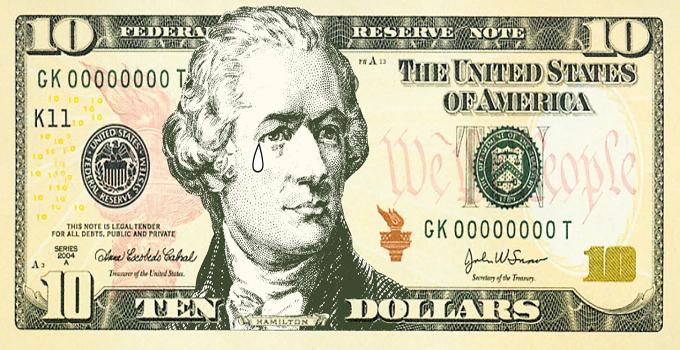
Yesterday, Jack Lew announced that the $10 bill would be undergoing a complete redesign to feature a woman on the currency.
The Fact Sheet released by the Treasury Department states that: “Secretary Lew has made clear that the image of Alexander Hamilton will remain part of the $10 note.” However, no specifics about what position Hamilton’s image would have has been released yet.
The Treasury Department website about the New Ten asks for the public to provide them with ideas and feedback and states:
In exercising the responsibility to select currency features and design, Treasury Secretary Jack Lew has made clear that the public’s input is an important and valuable part of the process for the redesign of the $10 note. Treasury wants to hear from the American people and engage in a public dialogue about how we can use the new $10 note to best represent the values of our inclusive democracy. Treasury staff will also seek public comment through other forums including round tables, and open houses. Share your ideas, symbols, designs or any other feedback that can inform the Secretary as he considers options for the $10 redesign.
Chris Matthews of Fortune called Lew’s decision to redesign the $10, rather than removing Andrew Jackson from the $20 “the worst decision Jack Lew has made.” I believe that it is a fundamental mistake for the Treasury Department to abandon its spiritual father by removing Hamilton from the $10 bill. Without Hamilton, the Treasury Department and a national currency would not exist.
At the same time, I am fully supportive of the idea of removing Andrew Jackson from the $20 and replacing him with a woman. Jackson spent his career fighting the idea of paper money and a central banking system. Even the movement asking for a woman to appear on currency has been focused on putting a woman on the $20, and over 600,000 people (myself included) voted on candidates to replace Jackson on the bill at the website http://www.womenon20s.org/.
Alexander Hamilton is uniquely qualified to retain a prominent place on American currency. Hamilton fought vigorous opposition from Jefferson and other contemporaries to establish a national bank. He single-handedly established the economic foundations of the young nation. Hamilton also made significant, game-changing contributions to the Revolutionary War and had a major role in establishing Constitution and the foundations of our government.
Michael Newton posted several quotes from Hamilton’s contemporaries about his role in developing the foundation of the American financial system, including Daniel Webster’s statement that Hamilton:
“…smote the rock of the national resources, and abundant streams gushed forth. He touched the dead corpse of the public credit, and it sprung to its feet. The fabled birth of Minerva from the brain of Jove was hardly more sudden or more perfect than the financial system of the United States as it burst forth from the conception of Alexander Hamilton.”
Secretary Lew’s statement made clear that the Treasury Department is seeking public input on the redesign. If you are passionate about this issue, I urge you to participate in public forums, send comments and letters to Treasury, and use your social media presence to ensure that Hamilton’s image continues to be the face of the $10 bill.
On July 9, 1804, a few days before his fateful duel with Aaron Burr, Alexander Hamilton signed his last will of testament.
In the Name of God Amen! I Alexander Hamilton of the City of New York Counsellor at Law do make this my last Will and Testament as follows. First I appoint John B Church Nicholas Fish and Nathaniel Pendleton of the City aforesaid Esquires to be Executors and Trustees of this my Will and I devise to them their heirs and Assigns, as joint Tenants and not as Tenants in common, All my Estate real and personal whatsoever and wheresoever upon Trust at their discretion to sell and dispose of the same, at such time and times in such manner and upon such terms as they the Survivors and Survivor shall think fit and out of the proceeds to pay all the Debts which I shall owe at the time of my decease, in whole, if the fund shall be sufficient, proportionally, if it shall be insufficient, and the residue, if any there shall be to pay and deliver to my excellent and dear Wife Elizabeth Hamilton.
Hamilton had a long history with each of the individuals he chose as his executors: John Church, Nathaniel Pendleton, and Nicholas Fish. John Church was the husband of Angelica Schuyler and Hamilton’s brother-in-law. Nicholas Fish had been Hamilton’s friend since they were teenagers involved in the early part of the Revolution. Fish even named his son after Hamilton (Hamilton Fish would go on to become Governor of New York and Secretary of State under President Grant). Virginian Nathaniel Pendleton was a close friend and colleague of Hamilton’s at the New York Bar. In the 1790s, Pendleton had been named a potential candidate for the position of Secretary of State, but Hamilton feared that he had “been somewhat tainted by the prejudices of Mr. Jefferson and Mr. Madison.” When Hamilton and Pendleton were both practicing in New York, they became close friends. Pendleton also served as Hamilton’s second in his duel with Burr, and he helped Hamilton put his affairs in order before the duel.
The second part of Hamilton’s will expressed his concern for the financial situation of his family. Hamilton was aware that because he had focused his career in the public service, he would not be leaving his wife and children in the best financial footing.
Though if it shall please God to spare my life I may look for a considerable surplus out of my present property—Yet if he should speedily call me to the eternal wor[l]d, a forced sale as is usual may possibly render it insufficient to satisfy my Debts. I pray God that something may remain for the maintenance and education of my dear Wife and Children. But should it on the contrary happen that there is not enough for the payment of my Debts, I entreat my Dear Children, if they or any of them shall ever be able, to make up the Deficiency. I without hesitation commit to their delicacy a wish which is dictated by my own. Though conscious that I have too far sacrificed the interests of my family to public avocations & on this account have the less claim to burthen my Children, yet I trust in their magnanimity to appreciate as they ought this my request. In so unfavourable an event of things, the support of their dear Mother with the most respectful and tender attention is a duty all the sacredness of which they will feel. Probably her own patrimonial resources will preserve her from Indigence. But in all situations they are charged to bear in mind that she has been to them the most devoted and best of mothers. In Testimony whereof I have hereunto subscribed my hand the Ninth day of July in the year of our lord One thousand Eight hundred & four.
Hamilton’s will was part of a series of documents that Hamilton delivered to Nathaniel Pendleton prior to the duel and opened after Hamilton’s death. In a letter dated July 4, 1804, the same day that Hamilton and Burr sat at the same table for dinner with other former Continental Army officers at Fraunces Tavern, Hamilton thanked Pendleton for helping him finalize his affair before the duel.
I thank you My Dear Sir for your friendly offices in this last critical scene, if such it shall be. Excuse me for having inserted your name as Executor. I fear it may not be in your favor to do much good to my family. But I am sure you will do all the good you can.
I’ve posted earlier about the November 1801 death of Philip Hamilton in a duel with George I. Eacker. Philip’s dramatic death triggered a flurry of highly politicized press coverage. Federalist newspapers painted Philip as a boyish victim of a seasoned lawyer who was unable to look past a youthful teasing. In contrast, Republican newspapers claimed that Philip and Price were aggressors and had viciously attacked Eacker and cornered him into a duel, leaving him no choice but to protect his honor. A detailed account with more complete excerpts of this back-and-forth between rival newspapers was published in 1867 by Historical Magazine and is available via Google ebooks.
The New York Evening Post’s November 24, 1801 death notice stated:
“This morning, in the 20th year of his age, Philip Hamilton, eldest son of General Hamilton– murdered in a duel–”
…
“On Friday evening last, young Hamilton and young Price, sitting in the same box with Mr. George I Eacker, began in levity a conversation respecting an oration delivered by the latter in July, and made use of some expressions respecting it, which were overheard by Eacker, who asked Hamilton to step into the lobby; Price followed—here the expression damned rascals was used by Eacker to one of them, and a little scuffle ensued; but they soon adjourned to a public house: an explanation was then demanded, which one of them the official expression was meant for; after a little hesitation, it was declared to be meant for each…”
The Post characterized Philip Hamilton as
“…a young man of most amiable disposition and cultivated mind; much esteemed and affectionately beloved by all who had the pleasure of his acquaintance.”
On November 25, 1801, The New-York Gazette and General Advertiser published a similar account of the proceedings leading up to the duel:
“On the morning of the 14th instant, Mr. Philip Hamilton, eldest son of General Hamilton, in the 20th year of his age, of a wound received in a duel with Capt. George I. Eacker. Few events have so much interested the public, whether they consider the youth and promising talents of the deceased, the feelings of most affectionate parents, or the false honor to which his life was sacrificed.
The duel was occasioned by some frolicksome and satirical expressions made by Mr. Hamilton and a young Mr. Price, at a Theatre, on the Friday preceding, about an oration of Mr. Eacker’s and in his hearing. This conduct Mr. Eacker resented in a very intemperate manner, collared Mr. Hamilton, called them damned rascals and villains, and said if he did not hear from them, he would treat them as such. Challenges were consequently sent to him by both.
Mr. Eacker and Mr. Price met on the Sunday following, and after exchanging four shots without injury to either, the seconds interfered. On Monday, the fatal duel between Mr. Eacker and Mr. Hamilton took place. Young Hamilton was shot through the body, on the first discharge, and fell without firing. He languished until the next morning, and then expired.”
In response to the accounts in the New York Evening post and the New-York Gazette, the Republican American Citizen and General Advertiser, , expressed outrage at the characterization of Philip’s death as “murder” and portrayed Philip and Richard Price as being responsible for the duel. Some excerpts of this press coverage are included below, and more is available here:
“Immediately preceding the pantomime, the box being full, Messrs. Hamilton and Price, leaving the opposite side of the house, again intruded into the box occupied by Mr. Eacker and his party. At the moment of their entrance, they commenced a loud conversation, replete with the most sarcastic remarks upon Mr. Eacker. Their manner was more offensive, if possible than their conversation. Mr. Eacker himself, thus pointedly the object of contempt and ridicule, and his name being mentioned aloud, could no longer sustain the painful sensation resulting from his situation.”
….
“Mr. Price and the unfortunate Mr. Hamilton, were, we assure the public, the aggressors. They violently assaulted Mr. Eacker, whose conduct through every stage of the unfortunate affair, was perfectly honorable and exempt from blame. They commenced the assault upon and challenged Mr. Eacker.
Interestingly, the American Citizen’s coverage does not mention Eacker’s 4th of July oration, although the newspaper had published excerpts of in its July 24, 1801 edition. Although Hamilton’s name does not appear in the excerpts of Eacker’s speech I have read (I have only read newspaper excerpts and have not seen the entire published speech), Eacker’s criticisms of the Federalist party directly attack Hamilton’s policies. In the excerpt below, Eacker describes how the Federalists have undermined the principles of the revolution, and how the Washington and Adams administrations damaged these principles.
“We have already seen the sacred principles of our revolution openly assaulted, and its venerable advocates reviled and exposed to public contempt. The endeavours to undermine the popular attachment to a free government are notorious. We have seen foreign influence attempting to make us subservient to its projects of hostility and ambition!
…
“An alliance, offensive and defensive, with the enemy of our greatness, was openly advocated; and the poisonous works of corruption nearly involved our destiny in total ruin!”
In Thomas Jefferson: An Intimate History, Fawn McCay Brodie wrote:
“Philip had gone out of his way to invite a duel, had gone into the duel with no intention of firing, thus inviting a duel or death, all this to defend the honor of his father, a father who had by humiliating confession recently brought agonies to his family and made himself the butt of national ridicule. Philip could have chosen no way to die that would have brought his parents greater agony and guilt.”
Eacker died within three years of the duel, immediately before Alexander Hamilton’s death in 1804. Notably, Eacker and Philip Hamilton (and Alexander and Elizabeth Hamilton) are fairly close neighbors in death. In Walks in Our Churchyards: Old New York, Trinity Parish, John Flavel Mines wrote of Eacker’s death: “Young Eacker died of consumption before three years had passed…and is buried in St. Paul’s Churchyard on the Vesey Street Side.” Philip Hamilton is buried across the street, at an unknown spot in Trinity Church. According to Allan Pollock’s 1880 History of Trinity Church and Its Grave Yard, Philip was “interred in this same plot of ground, about ten years before the death of his father.”
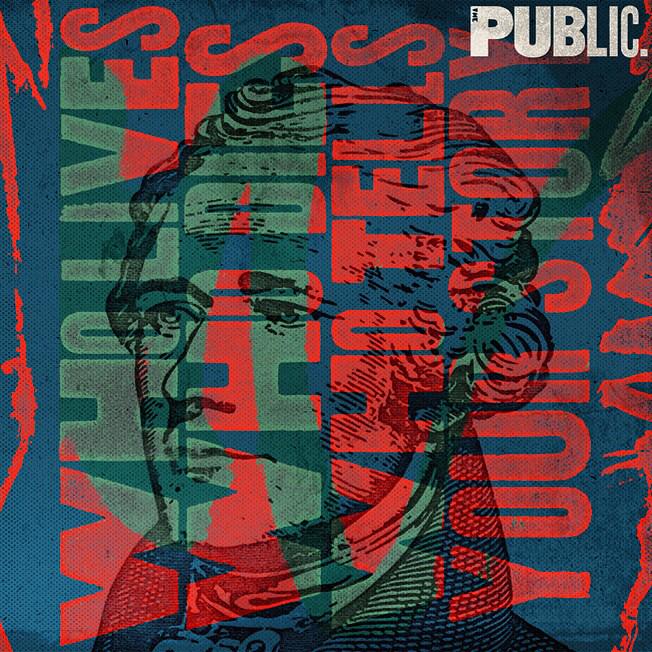
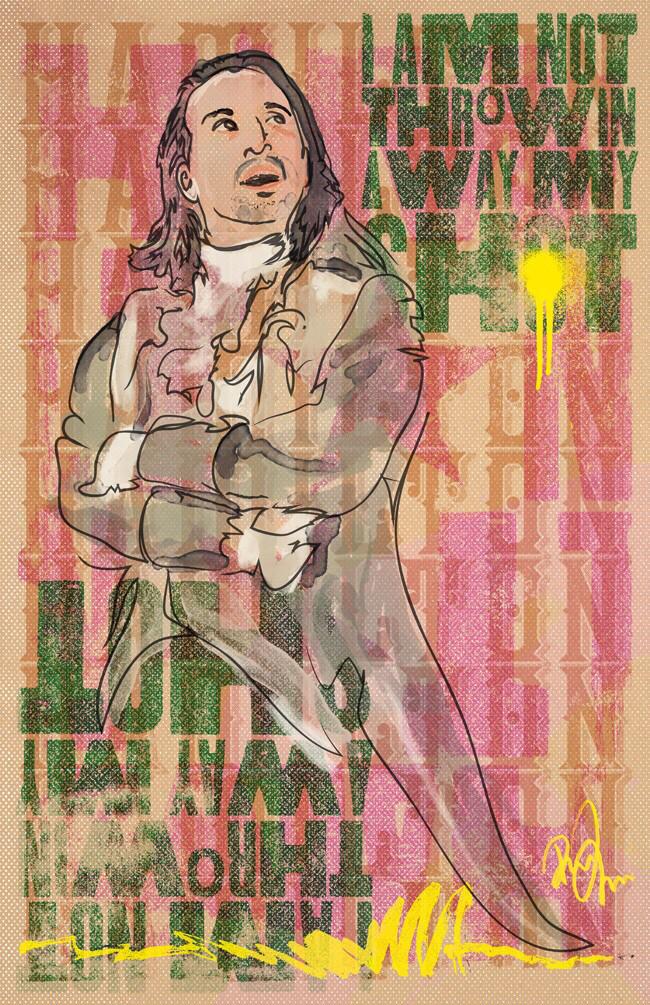
Since the official opening of the Hamilton musical to rave reviews last week, the internet has been providing us with some gems of Hamilton fan art, memes, and gifs inspired by the show. Here are some of my favorites from what I’ve seen so far! If you’ve seen (or made) others that I should add to this list, hit me up in the comments section or on Twitter @itshamiltime!
Twitter user @drpeccidesign shared some awesome images, juxtaposing lyrics from the show with images of Hamilton. These two were my favorite.
Last week, Publius-Esquire published this sketch of Thomas Jefferson (Daveed Diggs) and Alexander Hamilton (Lin-Manuel Miranda) from the show. (They both look too smiley here to be mid-rap battle!)
She also did this one of Aaron Burr (Leslie Odom Jr.) and Alexander Hamilton (Lin-Manuel Miranda) back-to-back with duel pistols. (This makes me wish that I had some artistic ability!)
The week before their fateful/fatal interview in Weehawken, Hamilton and Burr both attended a 4th of July dinner meeting of the Society of the Cincinnati at Fraunces Tavern. The Society was a group of Revolutionary War officers and Hamilton was president general, succeeding George Washington after his death. During the dinner, Burr and Hamilton reportedly sat at the very same table! While Burr seemed silent and serious, Hamilton was in seemingly high spirits and accepted a request to entertain his fellow former officers with a military song.
John Trumbull (who painted some of my favorite portraits of Hamilton and was also a member of the Society) wrote in his memoirs:
“On the 4th of July, I dined with the Society of the Cincinnati, my old military comrades, and then met, among others Gen. Hamilton and Col. Burr. The singularity of their manner was observed by all, but few had any suspicion of the cause. Burr, contrary to his wont, was silent, gloomy, sour ; while Hamilton entered with glee into all the gaiety of a convivial party, and even sang an old military song. A few days only passed, when the wonder was solved by that unhappy event which deprived the United States of two of their most distinguished citizens.”
Historians have disputed what song Hamilton actually sang, with some suggesting he sang “The Drum,” and others “How Stands the Glass Around.”
“At first, Hamilton could not be induced to sign, then submitted. ‘Well, you shall have it,’ he said, doubltess to cheers from the veterans. Some have said his valedictory song was a haunting old military ballad called ‘How Stands the Glass Around,’ a song reputedly sung by General Wolfe on the eve of his battlefield death outside Quebec in 1759. Others said that it was a soldiers’ drinking song called ‘The Drum.’ Both tunes expressed a common sentiment: a soldier’s proud resignation in the face of war and death.”
In his lecture on Hamilton’s military career, James Edward Graybill published a letter from Hamilton’s grandson Schuyler Hamilton regarding the song Hamilton sang prior to the duel which stated:
“I have always been of the opinion, from what I have heard from my father and uncles, that the song sung by my grandfather at the dinner of the Cincinnati where Colonel Burr was present, was General Wolff’s famous camp song, which begins with the words ‘How stands the glass around?'”
The first two stanzas of How Stands the Glass Around are reprinted below and express the brotherhood and solidarity of soldiers facing the threat of imminent danger and possible death.Listen to a rendition of the song in the embedded video from YouTube!
How stands the glass around?
For shame you take no care, my boys,
How stands the glass around?
Let wine and mirth abound;
The trumpet sound,
The colors they do fly my boys;
To fight, kill or wound;
As you would be found,
Contented with hard fare, my boys
On the cold ground
O why, soldiers why?
O why should we be melancholy boys,
O why soldiers why?
Whose bus’ness is to die;
What? sighing? Fye!
Drink on, drown fear, be jolly boys;
‘Tis he, you or I, wet, hot, cold or dry;
We’re always bound to follow boys,
And scorn to fly.
The rivalry between Alexander Hamilton and John Adams during Hamilton’s lifetime is well documented. During Washington’s presidency, Adams was openly suspicious of Hamilton’s role in the administration and his ambitions. When Adams was running for a second term, Hamilton published a letter to his supporters Concerning the Public Conduct and Character of John Adams, Esq. President of the United States. When this letter was published more widely, it damaged Adams’ hopes of winning the election and fractured the Federalist Party. (You can read more about Hamilton’s role in that election here).
But what happened after Hamilton’s death is less known and just as interesting. While Jefferson reportedly expressed admiration for his former rival after the fatal duel and even enacted a bust of Hamilton opposite his own at Monticello, Adams went on a private quest to sink Hamilton’s reputation. Adams shared rumors about Hamilton’s romantic indiscretions and ambitions to many powerful people in his private circles, including Dr. Benjamin Rush and Adams’ cousin, William Cunningham.
In 1806, Adams wrote to Dr. Rush of the pamphlet and of Hamilton’s “delirium of ambition.” In this letter, Adams referred to Hamilton as the “bastard brat of a Scotch pedlar” and spoke of rumors that Hamilton had, before his death, threatened to publish an unflattering memoir of George Washington:
Although I read with tranquility and suffered to pass without adversion in silent contempt the base insinuations of vanity and a hundred lies besides published in a pamphlet against me by an insolent coxcomb who rarely dined in good company, where there was good wine, without getting silly and vaporing about his administration like a young girl about her brilliants and trinkets, yet I lose all patience when I think of a bastard brat of a Scotch pedlar daring to threaten to undeceive the world in their judgment of Washington by writing an history of his battles and campaigns. This creature was in a delirium of ambition; he had been blown up with vanity by the tories, had fixed his eyes on the highest station in America, and he hated every man, young or old, who stood in his way or could in any manner eclipse his laurels or rival his pretensions. . . .
In a decades-long correspondence with his cousin William Cunningham, Adams suggested that Hamilton should have been branded with “everlasting infamy” because of the circumstances of his birth and not given a chance to participate in respectable society, Adams reportedly wrote (per Cunningham’s quote of an undiscovered Adams letter):
“Conjugal fidelity is the fountain of all virtue. Statesmen, philosophers, and the Christian Religion, unite in representing adultery & fornication, as the worst of crimes; and Hamilton, for his insult to this essence of a good education, deserved to be branded with everlasting infamy.”
Adams was obsessed with Hamilton’s lack of morality, and seemed to take gleeful pleasure in recounting stories of Hamilton’s sexual exploits, particularly rumors about Hamilton’s sisters-in-law. Adams also wrote about Hamilton’s ambitions ruining the country. On a September 27, 1808 letter, Adams stated:
” Hamilton’s Ambition, intrigues and Caucuses have ruined the cause of rational federalism by encumbering and entangling it with men and measures that ought never to have been brought forward.”
In an April 1811, Cunningham implored Adams to take back some of the unfounded accusations he had leveled against Hamilton, calling them a “poisoned chalice.”
Should you now refuse to recal the calumny you have spread of Hamilton in secret; or to supply the evidence of your heinous charges, will you not oblige his friends to strip from your hands, before you slip out of life, the poisoned chalice whose contents you have infused into the minds of many around you, to work, like canine madness in the veins, after its propagator has perished?
Adams’ actions came to light in 1823, when a political pamphlet containing the correspondence between Adams and Cunningham from 1803-1812 was published in order to sink John Quincy Adam’s chances of becoming president. You can read the entire pamphlet for free on Google Books, or read some of the correspondence on Founders Online (highly recommended- this is gripping stuff).
A contemporary review of the correspondence noted:
It appears by Cunningham’s letters to Mr. Adams, that the latter had written two concerning Hamilton, filled with matters of such a character that he would not leave them in Cunningham’s hands : he insisted on their being returned to him, and they were returned : but their contents are intimated in Cunningham’s answers. The accusations are of atrocious vices. One, that Hamilton was totally destitute of integrity. The whole of the world where Hamilton was Known will acquit him of this charge, and with scorn repel the foul calumny.
I had read about Adams’ attacks on Hamilton’s reputation in several biographies of Hamilton, but reading some of the actual correspondence was interesting because it shows how deeply ingrained and consuming Adams’ hatred of Hamilton was even decades after Hamilton’s death and Adams’ retirement from the political scene. Talk about holding a grudge!
Many of you have visited Hamilton Grange National Memorial, the only home Hamilton ever owned. However, before he built his country home, Hamilton resided in several other New York City addresses.
Allan McLane Hamilton described Hamilton’s New York addresses in The Intimate Life of Alexander Hamilton:
“Hamilton, during the early years of his practice, lived at 57 Wall Street before his removal to Philadelphia with the rest of the Cabinet. On his return in 1795, he occupied a small house at 56 Pine Street, and later moved to 58 Partition Street (now Fulton Street), then to Liberty Street, near Broadway. From there he went to 26 Broadway, where he lived until 1802, when he built and occupied his country seat, nine miles above the city, which he called “The Grange,” after the Scotch home of his ancestors.”
He further describes Hamilton’s neighborhood in 26 Broadway:
“When he lived at 26 Broadway, the west side of that thoroughfare below Trinity Church was, with one exception built up and occupied by well-to-do and prominent persons. The exception was a small gun-shop on the south-west corner of Morris Street.”
Ferdinand S. Bartram similarly described the 26 Broadway location as “the most fashionable residence portion of the city.”
In his book The American Skyscraper, 1850-1940: A Celebration of Height, Joseph J. Korom writes:
“The soil beneath the Standard Oil Building, its site officially recorded and known as 26 Broadway, once belonged to Native Americans, to the Dutch, then the British, and for a time it even supported the home of Alexander Hamilton. But probably this site is most celebrated because of the series of “Standard Oil Buildings” that occupied it.
The world’s most celebrated, and to some the most notorious, oil concern was headquartered on these premises starting in 1885. The Standard Oil Trust Company headquarters would remain at this location for the next forty-nine years.”
In his biography of John D. Rockefeller, Ron Chernow described the 1885 construction of the Standard Oil building:
“In late 1883, Standard Oil began to assemble real estate at the southern tip of Manhattan for new headquarters, destined to soar above Broadway at Bowling Green on the onetime site of Alexander Hamilton’s home. Having long outgrown William’s old offices at two different locations on Pearl Street, the firm had operated for three years from modest, unprepossessing quarters at 44 Broadway. Now, on May 1, 1885, after spending nearly one million dollars on it, Standard Oil moved into its impregnable new fortress, a massive, granite, nine-story building. The combine’s name didn’t appear outside, just the building number. Twenty-six Broadway soon became the world’s most famous business address, shorthand for the oil trust itself, evoking its mystery, power, and efficiency.”
The building was designated as a New York City landmark in 1995. The report from the Landmarks Preservation Commission states:
The powerful sculptural massing and arresting silhouette of the Standard Oil Building represent the new set-back skyscraper forms that emerged during the early 1920s. Limestone curtain walls facing Broadway, Beaver Street, and New Street are enriched with large-scale neo-Renaissance ornamentation that enhance the building’s picturesque quality. The building, erected as Standard Oil approached its fiftieth year of operation, reinforced the presence of the oil industry giant in the heart of New York City’s financial and shipping center. From the headquarters building at No. 26 Broadway, John D. Rockefeller’s associates directed the Standard Oil Company that monopolized the American oil industry, endured a sensational anti-trust decision, and retained a dominant role in the international oil business. Although Standard Oil’s successor firm sold the structure in 1956, the building at No. 26 Broadway has remained a prominent address in lower Manhattan.
Angelica Hamilton was born on September 25, 1784, a year after her older brother Philip. She was named after her aunt, Angelica Schuyler Church. Angelica was described as charming and lively, and would often play piano with her father.
In a November 1793 letter to Angelica, Hamilton, ever the affectionate father, wrote:
I was very glad to learn, my dear daughter, that you were going to begin the study of the French language. We hope you will in every respect behave in such a manner as will secure to you the good-will and regard of all those with whom you are. If you happen to displease any of them, be always ready to make a frank apology. But the best way is to act with so much politeness, good manners, and circumspection, as never to have occasion to make any apology. Your mother joins in best love to you. Adieu, my very dear daughter.
In the Intimate Life of Alexander Hamilton, Allan McLane Hamilton wrote:
“Angelica, a very beautiful girl, was born shortly after her father’s residence in New York City after the peace. She was evidently a charming character and very much like the aunt after whom she was named, being clever and talented. She seems to have had good musical training, and this lady frequently speaks of her in her letters from London. ‘Adieu, my dear Eliza,’ wrote Angelica Church in 1796, ‘I shall bring with me a Governness who understands music pretty well, she will be able to instruct Angelica and Eliza.’
The piano which Angelica received as a gift from her aunt and played with her father is on display at Hamilton Grange National Memorial.
Upon receipt of the news of her brother’s death in the Eacker duel, she suffered so great a shock that her mind became permanently impaired, and although taken care of by her devoted mother for a long time there was no amelioration in her condition, and she was finally placed under the care of Dr. MacDonald of Flushing, and remained in his charge until her death at the age of seventy-three. During her latter life she constantly referred to the dear brother so nearly her own age as if alive. Her music, that her father used to oversee and encourage, stayed by her all these years. To the end she played the same old-fashioned songs and minuets upon the venerable piano that had been bought for her, many years before, in London, by Angelica Church, during her girlhood, and was sent to New York through a friend of her father. She survived her mother by two and a half years.”
Having been exceedingly close to her older brother, Angelica was so unhinged by his death that she suffered a mental breakdown. That fall, Hamilton did everything in his power to restore her health at the Grange and catered to her every wish. He asked Charles C. Pinckney to send her watermelons and three or four parakeets- “She is very fond of birds” – but all the loving attention did not work, and her mental problems worsened. James Kent tactfully described the teenage girl as having “a very uncommon simplicity and modesty of deportment.” She lived until age seventy-three and wound up under the care of a Dr. Macdonald in Flushing, Queens. Only intermittently lucid, consigned to an eternal childhood, she often did not recognize family members. For the rest of her life, she sang songs that she had played on the piano in duets with her father, and she always talked of her dead brother as if he were still alive. In her will, Eliza entreated her children to be “kind, affectionate, and attentive to my said unfortunate daughter Angelica.” In 1856, Angelica’s younger sister, Eliza, contemplating Angelica’s expected death, wrote, “Poor sister, what a happy release will be hers. Lost to herself half a century!”
In my post on Monday about Elizabeth Hamilton, I mentioned her affection for a bust of Hamilton created by Giuseppe Ceracchi that Mrs. Hamilton showed visitors to her DC home. Ron Chernow’s description states:
“…the tour’s highlight stood enshrined in the corner: a marble bust of her dead hero, carved by an Italian sculptor, Giuseppe Ceracchi, during Hamilton’s heyday as the first Treasury secretary. Portrayed in the classical style of a noble Roman senator, a toga draped across one shoulder, Hamilton exuded a brisk energy and a massive intelligence in his wide brow, his face illuminated by the half smile that often played about his features.
Interestingly, Jefferson also has a history with the bust of Hamilton created by Ceracchi. In 1792, Jefferson wrote a letter recommending Ceracchi to his colleagues in 1792, and endorsed him as a “”a very celebrated sculptor of Rome.”
Jefferson placed two busts, a likeness of himself and his political opponent Alexander Hamilton, opposite one another in the Entrance Hall. Both were modeled by the Italian sculptor Giuseppe Ceracchi in Philadelphia in 1793 and 1794. In the Life of Thomas Jefferson, Henry Stephens Randall (Jefferson’s grandson and biographer) noted:
“After gazing a moment at these objects, the eye settled with a deeper interest on busts of Jefferson and Hamilton, by Ceracchi, placed on massive pedestals on each side of the main entrance ‘opposed in death as in life,’ as the surviving original sometimes remarked, with a pensive smile, as he observed the notice they attracted.”
In Affairs of Honor: National Politics in the New Republic, Joanne Freeman writes:
“Jefferson went to his grave struggling to cast his relationship with Hamilton in the right light, trying to depict himself as a liberal, right-minded leader rather than the petty and vindictive politician he often appeared to be. It was concern for his reputation that inspired him to put Hamilton’s bust in the main entrance way to Monticello; there could be no nobler act than to acknowledge the greatness of one’s enemies– and only the greatest of men could defeat such a foe.”
David Bernard Dearinger writes that “Ceracchi’s bust became the best-known image of Hamilton and was used extensively by later artists for posthumous portraits of him.”




 It's Hamiltime!