2) Pillowcase- Found on All Things Hamilton (thanks to Nicole for the suggestion!)- I love the idea, but this is not my favorite depiction of Hamilton. When they print this pillowcase with a different image, I might just have to buy it…
4) Tea Towels– I honestly don’t know what the function of a tea towel is, but this is still pretty cool. Available on Amazon.
I like the idea of a Hamilton clock, but I dislike this particular quote excerpt because I think it is very misleading. In reality, Hamilton was deflecting the suggestion that his genius came easily and offering an explanation of his approach and work ethic. The full context of what he said is this:
Men give me credit for some genius. All the genius I have lies in this; when I have a subject in hand, I study it profoundly. Day and night it is before me. My mind becomes pervaded with it. Then the effort that I have made is what people are pleased to call the fruit of genius. It is the fruit of labor and thought.
I have this up in my office- such a great motivation to focus!
While Alexander Hamilton and Aaron Burr’s 1804 duel is notorious in history and pop culture, a lesser-known deadly duel occurred three years earlier between Hamilton’s oldest son, Philip, and George Eacker, a critic of Hamilton and supporter of Burr.
Hamilton took great pride in his son’s academic achievements. He wrote to him regularly while Philip was studying at boarding school, and created a rigorous set of rules to govern Philip’s study schedule. In 1797, when Philip was a young teenager, he contracted a deadly illness and Hamilton reportedly “administered every dose of medicine” to his son during his recovery.
The close relationship between father and son may have contributed to Philip’s eagerness to defend his father’s name. Eacker, a 27-year-old lawyer, had made a speech in July accusing Alexander Hamilton of being willing to overthrow Thomas Jefferson’s presidency by force. In the speech, Eacker accused Hamilton of misusing his position as Inspector General during the Adams administration to intimidate his political enemies. On November 20, 19-year-old Philip and his friend Richard Price confronted Eacker about the speech when the three men were at a social event. After Eacker insulted them, the boys challenged Eacker to a duel. Dueling was already illegal in New York, so the men planned to meet in New Jersey. Eacker and Richard Price took the field first at Weehawken, on November 22. They exchanged shots, but no one was injured; according to convention, honor was satisfied. The next day, Philip faced Eacker and fell to a ball from Eacker’s smoothbore dueling pistol. He died the next day. The death caused a massive strain on the Hamilton family and led to the nervous breakdown of Hamilton’s daughter Angelica.
Robert Troup observed about Hamilton after Philip’s death in a December 5, 1801 letter to Rufus King:
Never did I see a man so completely overwhelmed with grief as Hamilton had been. The scene I was present at, when Mrs. Hamilton came to see her son on his deathbed (he died about a mile out of the city) and when she met her husband and son in one room, beggars all description! Young Hamilton was very promising in genius and acquirements, and Hamilton formed high expectations of his future greatness!”
Alexander Hamilton was killed three years later, on the same dueling grounds in Weehawken and with the same dueling pistols.
Michael Austin has written an interesting story for History News Network on the presidential election of 1800. Austin draws parallels between the current state of partisan politics and the bitter rivalries that emerged during the presidential contest between incumbent John Adams and Thomas Jefferson.
During that election, Hamilton and other high Federalists painted Jefferson and the Republicans as morally depraved atheists and fiery anti-government radicals who planned to set up guillotines on the banks of the Potomac and fill the new capital with blood. Republicans, on the other hand, portrayed Federalists as crypto-monarchists and usurpers of the Constitution. They pointed to the recent Alien and Sedition Acts as proof that Federalists would roll back the Bill of Rights at every available opportunity until they could declare Hamilton president-for-life and, from there, King of America.
And it got worse. Both Jeffersonians and Hamiltonians savaged the incumbent president, John Adams, a moderate Federalist who never quite managed to make either side happy. Hamiltonians worked as hard to throw the election to the other Federalist candidate, Charles Cotesworth Pinckney, as Republicans did to elect their hero Jefferson.
The unintended circulation of the Letter from Alexander Hamilton, Concerning the Public Conduct and Character of John Adams, Esq. President of the United States was considered a major factor in Adams’s defeat. If you haven’t read the letter before- I highly recommend it- full text available from Open Library.
In the letter, Hamilton begins with this premise: “Not denying to Mr. Adams patriotism and integrity, and even talents of a certain kind, I should be deficient in candour, were I to conceal the conviction, that he does not possess the talents adapted to the administration of government, and that there are great and intrinsic defects in his character, which unfit him for the office of chief magistrate.”
He describes Adams’s miliary plans during the Revolution and how these plans would have contributed to the defeat of the Continental Army. For example, Adams “was represented to be of the number of those” who favored shorter troop enlistment rather than Washington’s policy of having soldiers enlist for the term of the war. Hamilton also criticized Adams for ignoring the advice of his cabinet. He accused Adams of rash decisionmaking, particularly when related to the quasi-war with France and drew a comparison between Adams and “the modest and sage Washington,” who “consulted much, pondered much, resolved slowly, resolved surely.” Hamilton showcased instances of Adams’s uncertainty and found him to be “so much at variance with himself, as well as with sound policy, that we are driven to seek a solution for it in some system of concession to his political enemies.” The purpose of Hamilton’s letter was to draw support from within the Federalist Party towards Charles Pinckney, a Southern Federalist. However, after Adams won the Federalist nomination, the letter was circulated throughout the country by the Jeffersonians. Hamilton’s reasoned and damning attack on Adams played a part in the contentious election. Although Hamilton could have adopted the party line and backed Adams, he took the opposite course, understanding that he would lose the support of half his party in future races. For better and for worse, Hamilton was a man of convictions and of impulse.
Mock Politics produced a humorous set of Jefferson v. Adams attack ads:
In an interesting post-script to the election, Hamilton eventually persuaded fellow Federalists to choose Jefferson over Aaron Burr. Smithsonian Magazine has a great piece explaining the deadlock- because of the system in place, Congress had to decide between Jefferson and his running mate Aaron Burr. Many Federalists saw Jefferson as the ultimate enemy and were pushing for a Burr presidency. Hamilton stated:
Mr. Jefferson, though too revolutionary in his notions, is yet a lover of liberty and will be desirous of something like orderly Government.–Mr. Burr loves nothing but himself-Thinks of nothing but his own aggrandizement–and will be content with nothing short of permanent power in his own hands.–No compact, that he should make with any passion in his breast except Ambition, could be relied upon by himself.–How then should we be able to rely upon our agreement with him? Mr. Jefferson I suspect will not dare much. Mr. Burr will Dare every thing in the sanguine hope of affecting every thing.
An introduction to some of the more unusual Hamilton products available:
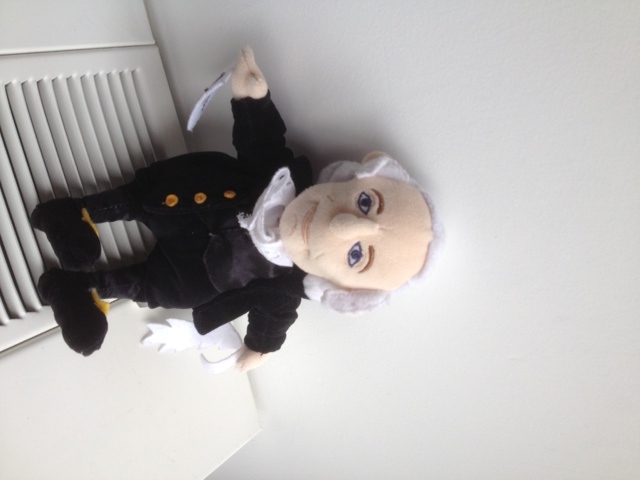
1) Hamilton plush doll/stuffed animal: I bought mine at the Trinity Church gift shop, but it is also available online. My roommate in law school found this doll incredibly creepy, and as much as I love all things Hamilton, there is something a little unnerving about this particular piece. I’d suggest sticking to the Bobblehead if you want a more accurate Hamilton.
2) Commemorative strands of Hamilton’s hair: History for Sale has ten strands of Hamilton’s hair available from the “largest collector of famous hair,” as listed in the Guinness Book of World Records. For just under $8,000, you can own ten strands of Hamilton’s hair, collected from various points of his life. If you’re just looking for one or two strands, Ebay has deals ranging from $99-$495. While I do love collectible Hamilton items, I’ve never found the appeal of collecting hair strands from two centuries ago.
3) Alexander Hamilton Revolutionary Action Figure– The Alexander Hamilton American light infantry command action figure commemorates Hamilton’s position as Lieutenant Colonel of the Light Infantry Division that fought at Yorktown in 1781. Hamilton’s heroic conduct in Yorktown brought him to Washington’s attention and Hamilton had extremely close relationships with Marquis de Lafayette and John Laurens, fellow commanders in the division. The figure is available on Amazon, Sierra Toy Soldiers, and The History Store
I came across this Youtube video, “Everybody Hates Hamilton.” The video is culled from clips of the HBO miniseries John Adams. Although it is only based on one TV show (based on David McCullough’s biography of Adams), the theme of Hamilton as a scapegoat is echoed. It boggles my mind that Hamilton, who came to New York as a penniless illegitimate teenager from the West Indies and became a champion of a new republic and the architect of its economy has been caricatured by so many people as a staunch monarchist and a ruthless and unprincipled politician.
In The American Commonwealth, Viscount James Bryce said Hamilton’s “countrymen seem to have never, either in his lifetime or afterwards, duly recognized his splendid gifts.” Hamilton’s political enemies brought up the circumstances of his birth, cast doubt on his relationship with President Washington, and generally blamed him for having a vision that they couldn’t comprehend. Adams called him the “bastard brat of a Scottish peddler.” Jefferson wrote to Washington:
I will not suffer my retirement to be clouded by the slanders of a man whose history, from the moment at which history can stoop to notice him, is a tissue of machinations against the liberty of the country which has not only received him and given him bread, but heaped its honors on his head.
In many ways, this legacy continues today. Historians regularly characterize Hamilton as a Machiavellian statesman. One author has even gone so far as to say that “Hamilton’s Curse” must be repudiated in order for America to be truly free.
Why?
I contend that Hamilton’s steadfast commitment to his principles is at the root of his unpopularity. Unlike Jefferson, Hamilton did not bow to the winds of popularity at the slightest inclination. Instead, he faced the consequences of making unpopular decisions when he believed them to be morally or economically necessary.
Here are some examples:
Protecting the Tories
As a college student in New York, Hamilton became convinced of the Revolutionary cause and threw himself into it with all his physical and mental energy. However, when an angry mob of patriots stood at the door of Myles Cooper, the president of King’s College, Hamilton held off the mob for hours in order to prevent Cooper from being attacked. After the Revolution was won, a popular movement began to strip any Loyalists of their property and prevent them from becoming full citizens in the new republic. Hamilton firmly opposed this movement and insisted that even Loyalists have the opportunity to be citizens in the new nation.
Hamilton, the most brilliant American statesman who ever lived, possessing the loftiest and keenest intellect of his time, was of course easily the foremost champion in the ranks of the New York Federalists; second to him came Jay…Both of them watched with uneasy alarm the rapid drift toward anarchy; and both put forth all their efforts to stem the tide…In particular they abhorred the vindictive laws directed against the persons and property of Tories; and they had the manliness to come forward as the defenders of the helpless and excessively unpopular Loyalists. They put a stop to the wrongs which were being inflicted on these men, and finally succeeded in having them restored to legal equality with other citizens, standing up with generous fearlessness against the clamor of the mob.
Economic Policies
Almost all of Hamilton’s economic policies, from establishing a National Bank to assuming the debts of the states to imposing an excise tax on whiskey, were politically unpopular but proved to be lifesaving for the new nation. Hamilton took on every uphill battle and, sometimes by sheer force of will, pushed those around him into accepting his plans. For example, Hamilton insisted that the government pay all of its war debts, including debts to speculators. During the Revolution, the Continental Congress sold war bonds to many supporters, including soldiers. However, over the long course of the war, many of the original owners of the bonds often sold them to speculators. After the War, there was a popular movement to disregard the debt altogether. Hamilton firmly believed that honoring this debt was essential to the financial progress of the nation. He eventually convinced resistant Southern congressmen to back him by agreeing to move the nation’s capital to the South.
Throughout his life, Hamilton was willing to make politically unpopular choices when he believed them to be necessary, or morally right. Hamilton is the ultimate historical underdog, and even as he rose to prominence in America, he never allowed the quest for popularity to overcome his moral convictions. Humans have a tendency to take the easy route, to “get along” with everyone whenever possible, and to generally follow the status quo and take the path of least resistance. As we all know, being part of the crow, or better yet, being the most popular person in the crowd can be a heady feeling. On the other hand, facing down a mob or being the only voice advocating your beliefs is always a struggle. Somehow, Hamilton maintained his public principles, even when they had unpleasant consequences. Hamilton’s life presents us all with a challenge: can we truly stand for what we believe in, no matter what the consequences?
The above sources lay out the sensational details of the affair: Hamilton became involved with Maria Reynolds in 1791, when she came to his home in Philadelphia and claimed that she was destitute and had been abandoned and abused by her husband. Hamilton and Reynolds became involved immediately. Maria’s husband, James Reynolds knew about the affair (and may have even pushed Maria to seduce Hamilton) and sought money from Hamilton. James Reynolds was arrested for financial crimes and accused Hamilton of entering into monetary relationships with Reynolds for personal gain and abusing his position. Reynolds accused Hamilton of being deeply concerned in speculation and frequently advancing money to Reynolds for these purposes. The information came into the hands of Congressman Frederick A. Muhlenberg, who shared it with Senator James Monroe and Congressman Abraham Venable. These three men confronted Hamilton in December 1792, and Hamilton immediately disclosed the affair and showed them letters from Reynolds in order to clear himself of the corruption charges. The exchange concluded with the understanding that the three men would keep silent about the details of the affair. The three men also gave a copy of the initial documents with information from Reynolds that was discredited by Hamilton to John Beckley, clerk of the House of Representatives. In 1793, Reynolds divorced her husband and Aaron Burr served as her divorce lawyer. In 1795, Hamilton resigned as Treasury Secretary, where he had been making only $3,500 a year, and resumed private practice in New York, making around $11,000 a year. In 1797, Beckley was fired as Clerk of the House and he turned over his copy of the documents to infamous Republican journalist James T. Callender. Callender, without making any further investigation about truth of the claims, immediately published Beckley’s documents. Scandal erupted and corruption accusations swirled. Hamilton believed that his political enemy Monroe, who Washington had just recalled from his position as ambassador to France, was behind the documents being released. The two men came to the brink of a duel, and Aaron Burr, Monroe’s would-be second, helped negotiate between the two parties and averted the duel. In August 1797, Hamilton published a pamphlet with all of his correspondence with Reynolds, deciding that admitting to a sordid affair would be better than the stain of the public corruption allegations.
When the pamphlet was published, Hamilton’s allies were shocked:
When the work appeared, Hamilton’s friends were appalled. “What shall we say …” Webster wrote, “of a man who has borne some of the highest civil and military employments, who could deliberately … publish a history of his private intrigues, degrade himself in the estimation of all good men, and scandalize a family, to clear himself of charges which no man believed. …” General Henry Knox wrote to General David Cobb, “Myself and most of his other friends conceive this confession humiliating in the extreme, and such a text as will serve his enemies.”
While the details of the affair are indeed scandalous, the most revealing and important part of the story is Hamilton’s response to it. His decision is a perfect example of what makes him such an interesting and complex historical figure. Hamilton was flawed and succeptible to temptation in his personal life, but he was doggedly honest in his professional life. He ignored the personal consequences of admitting to the affair and made a full confession, something that few political figures of any period would do. To Hamilton, even the unsubstantiated stirrings of corruption were unacceptable.
Unlike David Petraeus and the countless other politicians involved in modern sex scandals, Hamilton did not make a public revelation out of necessity, but out of his sense of honor. Even though Hamilton was no longer in office when news of the affair broke, he placed the sanctity of the position over his private interests and his own reputation. If Hamilton had listened to his friends or had a modern day spin doctor, he would have allowed the rumors to live instead of feeding the fire with a full, dramatic revelation. For better and for worse, Hamilton was a person who followed his own mind and lived by his own unbendable code with regard to his political life, even when his personal life fell short of that code.
This morning, I got into the office, looked at my desk, and realized how many awesome Hamilton accessories I have in my office.I’m sharing reviews of my three favorite Hamilton accessories since the holidays are coming up! [Note: I am not getting advertising revenue for these reviews and all pictures are from my personal collection.]
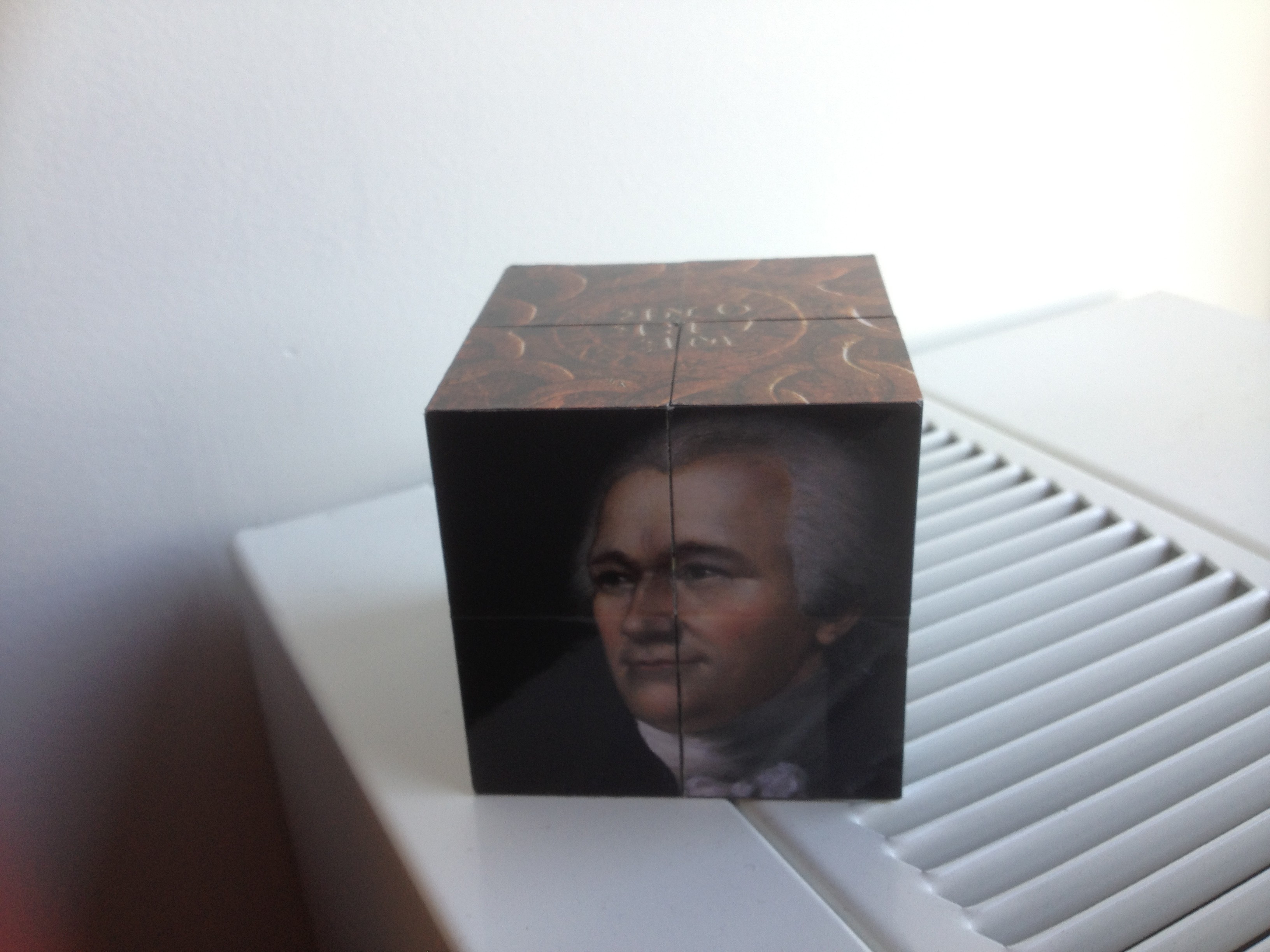
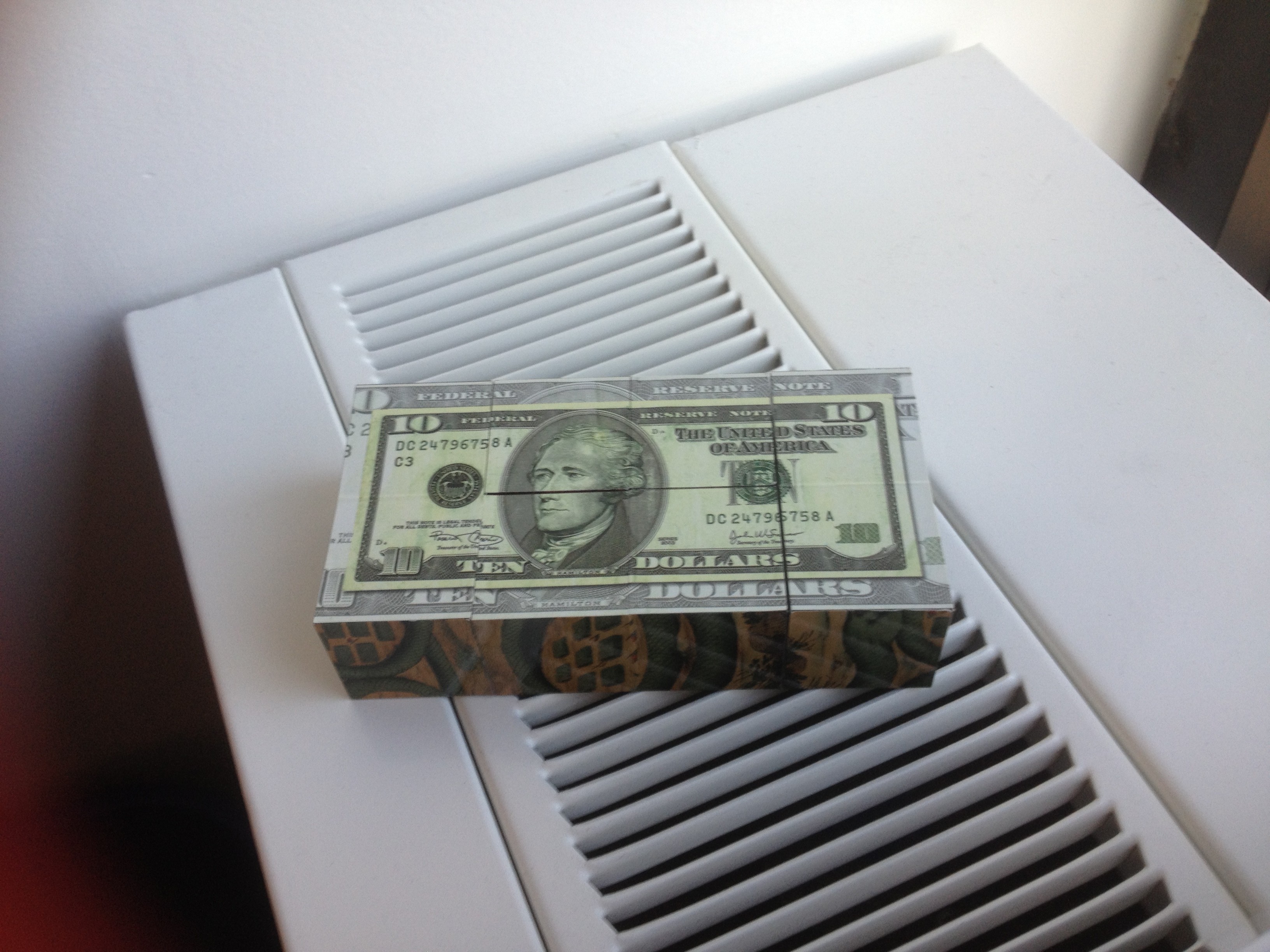
1) Hamilton History Cube– Nifty picture cube featuring nine images from the New York Historical Society. Great to play with on your desk. Comes in a gift box. Warning- the pictures will wear out if you play with the cube constantly. I’m currently on my second one and I bought both from the Trinity Church gift shop. {Available online from the NY Historical Society and sold at the Trinity Church Gift Shop}
2) Hamilton Bobblehead– My bobblehead is by far the coolest thing in my office. Royal Bobbles has done a brilliant job with the detail on Hamilton’s face and clothes. At under $20, I thought this was a steal. However, Hamilton’s walking stick slipped out of his hands after a few months and I had to superglue part of his wig back together. {Available from the History Channel and Amazon}
3) Mini-Hamilton Bust– This 6-inch bust works as a great paperweight or just a guard for your desk. The detail on the face is pretty neat. When I bought it, I expected it to be bigger, and at almost $30 it is a bit expensive for the size. {available from Amazon}




 It's Hamiltime!