In 1896, the Atlantic published an article entitled “Reminiscences of Mrs. Alexander Hamilton” as part of its Contributors’ Club series. The author recalled a childhood summer spent with Mrs. Hamilton when the author was 13 years old. The whole piece is worth reading, and was quoted by Ron Chernow in his biography of Hamilton. I’ve included a few excerpts below that I found particularly moving.
In the first excerpt, the author describes the tour that Mrs. Hamilton gave visitors to her Washington, D.C. home.
“I remember nothing more distinctly than a sofa and chairs with spindle legs, upholstered in black broadcloth, embroidered in flowery wreaths by Mrs. Hamilton herself, and a marble bust of Hamilton standing on its pedestal in a draped corner. That bust I can never forget, for the old lady always paused before it in her tour of the rooms, and leaning on her cane, gazed and gazed, as if she could never be satisfied.”
The bust referenced was designed by Giuseppe Ceracchi, and was one of Mrs. Hamilton’s favorite images of her husband.
In another excerpt, the author describes Mrs. Hamilton’s longing to see her husband at the end of her life:
“…she leaned back in her chair a long time with closed eyes, as if lost to all around her. I never heard her complain, and I loved her with a reverent love that made me feel awed as the long silence was broken by the murmured words, ‘I am so tired– it is so long. I want to see Hamilton.'”
“When Mrs. Hamilton died, at the age of ninety-seven, although an internment in Trinity Church had been for years a forbidden thing, her last request was granted. Quietly, at night, the frail little form was laid to rest there by the side of her beloved and illustrious husband.”
Urban Dictionary’s lengthy top definition of a hipster states in part:
Hipsters are a subculture of men and women typically in their 20’s and 30’s that value independent thinking, counter-culture, progressive politics, an appreciation of art and indie-rock, creativity, intelligence, and witty banter. The greatest concentrations of hipsters can be found living in the Williamsburg, Wicker Park, and Mission District neighborhoods of major cosmopolitan centers such as New York, Chicago, and San Francisco respectively. Although “hipsterism” is really a state of mind,it is also often intertwined with distinct fashion sensibilities. Hipsters reject the culturally-ignorant attitudes of mainstream consumers, and are often be seen wearing vintage and thrift store inspired fashions, tight-fitting jeans, old-school sneakers, and sometimes thick rimmed glasses.
Founding Father Joy has a “Hamilton is Hip” mousepad available at Zazzle for $11.95 that portrays a scruffy Hamilton with hipster glasses.
There is also a “Hipster Hamilton” design (which I have previously featured as a t-shirt design) that is available as a mug for $16.95 from Zazzle. The description states: “Hipster Hamilton loves tall boys, cloves, indie bands and all things hipster. He’s also on the $10 bill, but you’ve probably never heard of it.”
Instagram user fwacata shared this illustrated $10 bill featuring a bespectacled, scruffy Hamilton.
Interestingly (and I don’t know if there is a connection with our Hamilton), I just discovered Hamilton the Hipster Cat on the interweb! He is a California rescue cat who just happens to have an adorable hipster mustache.
In 2004, the city of Hamilton, Ohio unveiled a dramatic, larger-than-life sculpture of Alexander Hamilton entitled “The American Cape” featuring Hamilton wearing an American flag as a cape. The statue is reportedly the largest rendition of Alexander Hamilton in existence.
An August 2003 piece in the Cincinatti Enquirer described the efforts to commission the statue and stated:
“After 213 years, Alexander Hamilton will finally have a prominent place in his namesake town. A bronze statue of him, by metal sculptor Kristen Visbal of Lewes, Del., will be erected next year. The piece is another victory for the region’s sculpture enthusiasts and people who enjoy the area’s history and heritage.”
The sculptor, Kristen Visbal describes the statue on her website:
This life and a half public monument was installed on High Street in Hamilton, Ohio in October, 2004. Created as the namesake work for the City, Visbal was selected through an international competition. The American Cape depicts Alexander Hamilton as orator and is the largest rendition of this historical figure to date. The piece was named for the large cape which billows behind Hamilton and is complete with the 13 star flag of Hamilton’s era.
Hey Hamilton! a website dedicated to providing local information about Hamilton, Ohio states:.
It was commissioned in May 2003 by Historic Hamilton Inc. and Hamilton, Ohio, City of Sculpture, Inc. The artist was selected after 10 area citizens considered entries from around the world. The American Cape — which is the largest likeness of Hamilton in the nation — faces east on High Street between Second and Third streets. It has been described as depicting “the intellectual versus military attributes of this Founding Father.” It is called “a non-traditional historical piece” with “Hamilton as orator with a full-length cape, which blows up and back and becomes the 13-star American flag of Hamilton’s era.”
“The sculpture’s portrait was modeled primarily after the John Trumbull image engraved on the $10 bill by GFC Smillie in 1906.” The City of Sculpture said, “the piece will join at least eight sculptural works of Hamilton throughout the country and is the largest likeness of Hamilton to date, followed by the seven-foot, nine-inch sculpture located in front of the Capitol Rotunda in Washington, D. C.”
The sculpture, cast in bronze in Norman, Oklahoma, is “surrounded with 18 imbedded granite diamonds [in the sidewalk], highlighting quotes by Alexander Hamilton.”
On the south side of High Street are plaques highlighting phases of Hamilton’s life and his major contributions to forming the United States.
Something to check out if you’re ever in Butler County, Ohio!
On July 4, 1860, the New York Times published a constitutional analysis from James A. Hamilton, Alexander Hamilton’s third son. The letter was entitled: Property in Man.: Letter from Hon. James A. Hamilton on the Doctrine of the Constitution Concerning Slavery. Hamilton’s letter is a fascinating constitutional analysis from a contemporary perspective.
The editors of the New York Times introducing the letter noted:
We publish this morning a paper from one of the surviving sons of ALEXANDER HAMILTON, upon the leading political topic of the day, which merits and will repay a careful perusal. It discusses the provisions of the Federal Constitution on the subject of Slavery, in a spirit of candor and with the temper and ability of a statesman. We remember no document of any kind in which this whole subject is presented with more convincing force and clearness than in this.
As we have hitherto insisted, the pending political contest is simply a struggle of contending sections for power. Possession of the Federal Government is what both North and South are striving for. But there is a motive for this contest on both sides, — and the leading motive of the South is a determination to regard Slavery as their paramount interest, and its protection and perpetuation as their settled policy. They have invented the doctrine that slaves are made property by virtue of State laws; — that they are recognized as property by the Federal Constitution; — that they may, therefore, be taken, held and treated as property in every territory and other part of the United States where the Constitution is the supreme law; and that the Federal Government is bound to protect their owners in the possession and control, of this property, whenever the Territorial Government shall fail to do so. If this position can once be established, the slaveholding interest becomes at once and forever the controlling interest of the Government.
It is scarcely necessary to say that no such doctrine can ever be incorporated into the body of American law. It matters little what Presidents may do, what Congress may vote, what Party Conventions may decree, or what the Supreme Court may decide, in regard to it. They may give a temporary show of validity to the claim; they may postpone the day when it shall be effectually and forever scouted from the councils of our Government, — but they can no more prevent that day from coming than they can prevent the setting of to-day’s sun. The people of this country will never sanction any such principle. Neither sophistry nor force can ever induce them to give it their recognition. If resisted only by constitutional weapons, and in the spirit of the Union, they will sweep away the arrogant and preposterous claim without undue damage to the interest on whose behalf it is preferred. But a violent and revolutionary resistance on the part of the slaveholding interest, will involve far more serious and fatal results.
Mr. HAMILTON’s letter sets forth the constitutional doctrine in regard to Slavery. It proves conclusively that the Constitution does not recognize slaves as property, or as in any respect under the special protection and control of the Federal Government, — but as “persons held to service or labor in one State under the laws thereof.” This is the constitutional basis on which the whole subject rests, and upon which the political treatment of it must be based. We commend the letter to all who are interested in the principles which underlie the party contests of the day.
The lengthy letter is well worth reading in its entirety for anyone interested in the Civil War or in constitutional analysis of slavery in the 1860s. However, some of the key points are outlined for you below.
Hamilton introduced the piece by explaining that his intention was to refute the proposition, expressed in Justice Taney’s Dred Scott opinion and by many supporters of slavery that:
“the right of property in a slave is distinctly and expressly affirmed in the Constitution” — and Southern men generally, with their allies in the North, insist that the Constitution of the United States, proprio vigore, carries Slavery wherever it reaches; and that, as property, they have a right to take their slaves into the Territories of the United States — there to be protected by a slave code, to be enacted by Congress.
Hamilton argued, that contrary to Justice Taney’s contention that slavery was supported in the Constitution,
“…it was the deliberate purpose, not of individual members alone, but of the Convention, to exclude from the Constitution, not only the hated word “Slave” but the detested thing “Slavery;” and we have, therefore, the right to insist — before it can be asserted, with any title to our respect, that this august and intelligent body affirmed or establish. ed “the right of property in a slave,” and thus reversed the established law of Nature on that subject — that the language of the Constitution should be found to be so explicit; as to be irresistible.”
Hamilton went on to criticize the Southern interpretation of slavery as contrary to the original object of the framers:
“The object of the framers of the Constitution was: To establish the Union, and a government for that Union on the basis of the equality of man; to secure the blessings of liberty to themselves and their posterity; to give to the Federal Government, no more power over the States or the people thereof than “was essential to preserve that Union; to direct the foreign relations and such relations among the States and the people thereof, as were necessary and proper. To regulate commerce, and to secure the power of taxation; at the same time to leave with the States and the people thereof the regulation of such subjects as are of a domestic and social character; and particularly the rights of private property, and the control and disposition thereof. In this view of the subject it may be asked — Could the power to establish Slavery in a State come within the scope and object of the Government of the Union? On the other hand, if it were to exist at all, must it not be considered of a character so entirely social and domestic as to be most emphatically one of the reserved rights of the States, and consequently without and beyond the jurisdiction or power of the Federal Government.
This interpretation is that which “the Fathers” held to be true; and it is that under which the Government was administered during more than one half century of its existence, with the approval of all the departments of the Government, and of the people of all parts of the country.
We are told by Southern men of distinguished rank, with an arrogance in tone and manner which can never be properly indulged among equals, that unless the North shall renounce this interpretation, sanctioned by time and the highest authority, and adopt that of Chief Justice TANEY and Mr. BUCHANAN, with the Democracy of the South, the Government and Union of the United States are to be destroyed, and with them the brightest hopes of mankind, founded on popular government.
This recent heresy is dictated alone by a lust for power, disguised under an assertion, made with all the confidence of truth and sincerity, that unless the Territories of the United States shall be opened to Slavery, there to be protected by Congress, the institution will be so “cribbed, coffined and confined,” as to be distroyed by its increasing numbers.”
Hamilton also published a short piece outlining some basic principles that framed his perspective.
“Every man has a property in his own person; this nobody has a right to but himself.” — Locke.
“Natural liberty is the gift of the beneficent Creator of the whole human race.” — Hamilton.
“Slavery is a system of outrage and robbery.” — Socrates.
“Slavery is a system of the most complete injustice.” — Plato.
“No man by nature is the property of another.” — Dr. Johnson.
“Slavery in all its forms, in all its degrees, is a violation of divine law, and a degradation, of human nature.” — Brissot.
“Not only does the Christian religion. but nature herself cry out against the state of Slavery.” — Pope Leo X.
“The wise and good men throughout all time; and the Christian Church throughout all the world; with an unimportant exception during a brief period in our own country, have denounced ‘Slavery’ as ‘an atrocious debasement of human nature.’ — Franklin.
Although James A. Hamilton’s analysis was written five decades after his father’s death, I find it fascinating to loosely trace Hamilton’s anti-slavery efforts as part of the New York Manumission Society to his son’s beliefs and conduct during the Civil War. During the war, Hamilton was active on the Union side and documented several meetings with President Lincoln in his memoirs, including one immediately before the Emancipation Proclamation was issued.
(Look for more It’s Hamiltime! posts on James A. Hamilton soon as part of an upcoming series on Hamilton’s family and friends).
8tracks user Glorfinedel created an Alexander Swagmilton playlist to celebrate Hamilton’s birthday. The playlist features a catchy mix of hip hop and pop songs.
On January 2, 1800, the body of a young woman named Gulielma Sands was found in a well in New York that had been developed by Aaron Burr’s Manhattan Company. The chief suspect in the murder was Ms. Sands’ suspected lover, Levi Weeks. Weeks was the brother of Ezra Weeks, a notable architect who had assisted with the construction of Hamilton’s Harlem home. Ezra Weeks was able to retain Alexander Hamilton, Aaron Burr, and Brockholst Livingston as Levi’s defense counsel. The Weeks trial was the first recorded murder trial in American history and people followed it with rapt attention. The grueling trial lasted 44 hours and had approximately 75 witnesses testify with only a single break in between the proceedings. Ultimately, Hamilton, Burr, and Livingston convinced the jury to acquit Mr. Weeks in less than 10 minutes. I’ve spoken in detail about the trial in my talk at Morris-Jumel mansion (the talk will be available online soon and I will post it on this blog) and the full digitized transcript from the Library of Congress is available here.
Although most of the participants of the famous trial have long since perished or disappeared, one remains: the infamous well itself.
The well and its creator were integral components of the murder mystery and subsequent trial. One early newspaper account of the discovery of Ms. Sands’ body is from the January 4, 1800 New York Spectator and states: “Yesterday afternoon, the body of a young woman…was found dead in a well recently dug by the Manhattan Company, a little east of Mr. Tyler’s….Strong suspicions are entertained of having been willfully murdered.”
The Manhattan Well was commissioned by Aaron Burr’s Manhattan Company, which had engendered controversy both for unnecessarily increasing the scope of its powers and for allegedly doing a poor job of delivering water to the citizens of New York. The charter of the Manhattan Company provided that in addition to providing water for New York City, the Company could form a bank and sell insurance subscriptions, among other things. The Manhattan Company eventually morphed into JP Morgan Chase, which is now the largest bank in the United States.
A May 1, 1799 editorial in the New York Gazette bashed Aaron Burr, John Church (Hamilton’s brother-in-law and Angelica Schuyler’s husband), John Watts, and the other founders of the Manhattan Company and stated that they were concerned with speculating and increasing their power rather than furthering the goal of clean water for New York.
“A law my fellow Citizens, more impolitic, alarming and corrupt has not been passed by any legislature since the Revolution. A law every clause of which is stamped with damning proof, that it was intended not to benefit the public; but to raise up an object of speculation to enrich those who were interested in it.”
Brian Phillips Murphy, who is now a history professor at Baruch College, published his 2009 dissertation on the Manhattan Well. The paper is entitled “‘A very convenient instrument’: The Manhattan Company, Aaron Burr, and the Eelection of 1800” and is a fascinating read if you are interested in learning more about the history of the Manhattan Company.
The Manhattan Well was referenced repeatedly during the trial of Levi Weeks. Several witnesses recounted hearing screams come from the vicinity of the well. For example, Catherine Lyon, a neighbor of Sands and Weeks testified:
“About a half an hour or less after I saw Elma, I heard from the field behind the hill at Lispernards a cry in the woman’s voice of ‘murder, murder, Oh save me!'”
Additionally Arnetta Van Norden, who lived 100 yards from the well testified:
“We live about half way from Broadway to the well. About 8 or 9 o’clock in the evening, my husband heard a noise, and he stood up and observed it was from the well. I then looked through the window, and we heard a woman cry out from towards the well, ‘Lord have mercy on me, Lord help me.”
“In 1817, a four-story building was built at 129 Spring Street, just south of the well. An 1872 Harper’s Weekly article stated that the well was located “in the rear of a carpenters shop at the end of an alley, No. 89½ Greene Street, a hundred feet or more north of Spring Street.”
During the years of 1852-1853 and 1854-1855, the Manual of the Corporation of the City of New York lists 129 Spring Street as the location of a pawnbroker named Leah Silver.
According to Angela Serratore of the Paris Review the area around the well was home to a brothel and an anti-tobacco shop:
In a small town, the well might’ve become a legendary destination, frequented by tourists and sulky, rebellious teenagers, but lower Manhattan refused to stay put, and soon the only physical reminder of Elma Sands was covered up. In the 1820s, the once-bucolic meadow became a neighborhood full of upper-middle-class row homes, including one at 129 Spring Street, which is today the legal address of the well. By midcentury, it was a destination for shopping, entertaining, and sinning.
Just half a block down from the well, at no. 111 Spring Street, there existed a brothel kept by a Mrs. Hattie Taylor, described in an 1870 guide to whorehouses as “a third class house, where may be found the lowest class of courtezans. It is patronized by roughs and rowdies, and gentlemen who turn their shirts wrong side out when the other side is dirty.” During this period, 129 Spring was a shop run by a Mr. O. Spotswood, the peddler of an antidote to tobacco addiction, leading the modern reader to ruminate upon the kind of person who, in 1862, is both hooked on smoking and desperate (one dollar for a packet of five remedies!) to quit.
On April 18, 1869, the New York Times published a paragraph about the well (containing some inaccurate statements about the trial):
“The old well, known as the Manhattan Well, down which was thrown the corpse of Gulielma Sands, murdered, as is believed, by her lover, Levi Weeks, some seventy years ago, and the locality of which had been forgotten, has been rediscovered by the occupant of the building No. 115 Spring-street. The well was found while the flower-garden of No. 115 was being dug. It is of large diameter and was covered over with large flat stones.
The supposed murderer invited the girl Sands to take a ride with him one Winter’s evening, and that was the last seen of her alive. Weeks was tried for the murder, and was defended by Aaron Burr, Alexander Hamilton and Edward P. Livingston. The evidence was insufficient to convict, but he found it convenient to leave the City as soon as the trial was concluded. The old well was known to exist, but its precise location had passed from the memory of the ‘oldest inhabitant.'”
On December 4, 1932, Bruce Rae of the New York Times noted in a book review:
“New Yorkers may be interested to know that they can still shout ‘Who killed Elma Sands’ into the very well where her body was found. It stands in an alley off Greene Street just above Spring.”
The Wall Street Journal reported in 2011 that the DaGrossa family, who owned the property at 129 Spring Street and ran it as the Manhattan Bistro, excavated their basement in 1980 and found the well “buried in a dirt-filled area off the basement.” While the Manhattan Bistro was in existence, the well was kept in the basement and was not on public display.
Several websites mention the well and discuss the murder mystery. In 2013 Curbed NY named the well one of the thirteen most haunted places in New York City (along with Morris-Jumel Mansion, St. Mark’s Church in-the-Bowery, and others).
Currently, the well is open to the public in the men’s department of the COS clothing store. I visited the store during my visit to New York last month. The well now has some stylish mannequins around it and seems to be doing quite well. Talk about living history!
After seeing Hamilton for a second time on Friday, January 23, 2015, a few additional aspects of the show stood out to me:
The choreography: Watching the show for a second time allowed me to take in more of the exuberant, dynamic choreography. The amount of movement on stage and the use of all aspects of the set made the Newman Theater seem large enough to set the stage for the American Revolution and the battles over the American founding. Quite an accomplishment for choreographer Andy Blankenbuehler, who also did the choreography for In the Heights and Bring It On. Blankenbuehler gave a brief interview published by Dance Magazine this month that provides some additional insight into his process for developing the show’s choreography
The ensemble was extremely talented and their performances contributed significantly to the dynamism of the performance. Everyone moved seamlessly, enabling the show to transition rapidly through three decades of American history. The performers in the ensemble included: Carleigh Bettiol, Ariana Debose, Sydney James Harcourt, Sasha Hutchings, Thayne Jasperson, Jon Rua, Seth Stewart, Betsy Struxness, and Ephraim Sykes.
Burr as the narrator- Odom’s Burr was a complex, morally ambiguous, and undeniably charismatic narrator. The show furthered his role as narrator by inserting him into various events in Hamilton’s life, Forrest Gump style (i.e. the Laurens-Lee duel, Hamilton’s wedding, the Reynolds Affair). Odom did an incredible job of humanizing Burr and expressing his inner conflicts.
Angelica Hamilton- Renee Elise Goldsberry (who also played the recurring role of ASA Geneva Pine on the CBS show Good Wife) brought her great voice and stage presence to several songs. The deep friendship and affection between Hamilton and his sister-in-law has long been a subject of historical speculation, and although the show took some liberties with history to bolster artistic effect (Angelica Schuyler eloped with John Church in 1777, three years before Alexander Hamilton met both sisters), I thought Angelica’s character worked very well and I enjoyed Goldsberry’s moving performance Friday night.
I thoroughly enjoyed the score and all of the songs and am already excited for the album. Some of my absolute favorites (without giving anything away) were:
“Alexander Hamilton”- way to start off with a bang. Loved this opening.
“You’ll Be Back”- Brian d’Arcy James had insane chemistry with the crowd as the hilarious yet manically sinister King George
“In the Room Where it Happens”- Leslie Odom Jr.’s rendition of the song during the second act was incredibly catchy and also made for some great character development. This is one I’ll be humming all the way back to Los Angeles.
“The Reynolds Pamphlet”- Daveed Diggs’ cocky exuberance made this song.
On Wednesday, January 21, I had the opportunity to watch the second showing of Hamilton at the Public Theater. Alternately hilarious and tragic, the show took a rapt audience on an emotional roller coaster ride through Hamilton’s life. While the show took some artistic liberties with Hamilton’s story, I was impressed by how much history was squeezed into the production. The show clocked in at just under three hours, and I was on the edge of my seat the whole time.
The multi-talented cast had great chemistry. Every cast member truly embraced his or her role. As Hamilton’s crew of friends before and during the Revolution, Daveed Diggs (Marquis de Lafayette), Anthony Ramos (John Laurens), and Okierete Onadowan (Hercules Mulligan) captured the upstart ambitions of young revolutionaries on the precipice and in the throes of war. Brian D’Arcy James (who originated the role of Shrek on Broadway) made a hysterical King George and the audience was in stitches every time he came on stage. Phillipa Soo was incredibly moving as Eliza Hamilton, and brought me to tears with some of her numbers towards the end of the play. Leslie Odom Jr. played Aaron Burr with a captivating combination of moral ambiguity, insecurity, ruthlessness, and charisma. Lin-Manuel Miranda, who was incredibly battling a sinus infection during the performance, truly inhabited the role of Hamilton and brought his sense of ambition. Renee Elise Goldsberry brought an elegant pathos to the role of Angelica Schuyler, and her voice was amazing. In a brief, but memorable role as Maria Reynolds, Jasmine Cephas Jones (who also played Peggy Schuyler), brought to life Hamilton’s femme fatale. Christopher Jackson played George Washington as a reluctant but committed leader, and the dynamic between Jackson and Miranda was fascinating. Daveed Diggs brought a hilariously cocky energy to his role as Thomas Jefferson, and the rap battles between Miranda and Diggs (MC’d by Jackson’s George Washington) over key issues of the day were both enlightening and uproarious.
The orchestra was off-stage, but the music was breathtaking and set the pace of the alternating emotions of the show (cannot wait to buy the soundtrack). The set was elaborate, and the venue at the Public Theater was intimate. The crowd rose to its feet after the three hour production, and the emotion exuding from both the cast and audience was palpable.
Props to the entire cast and crew for creating theater magic! I am torn between wanting everyone in America to see this play immediately and wanting to preserve the magic of this cast, in this venue, in Hamilton’s city. I’m already excited to see the January 23rd Friday performance before heading back to Los Angeles.
If you get a chance to see Hamilton during its run at the Public Theater, post your impressions in the comment section below!
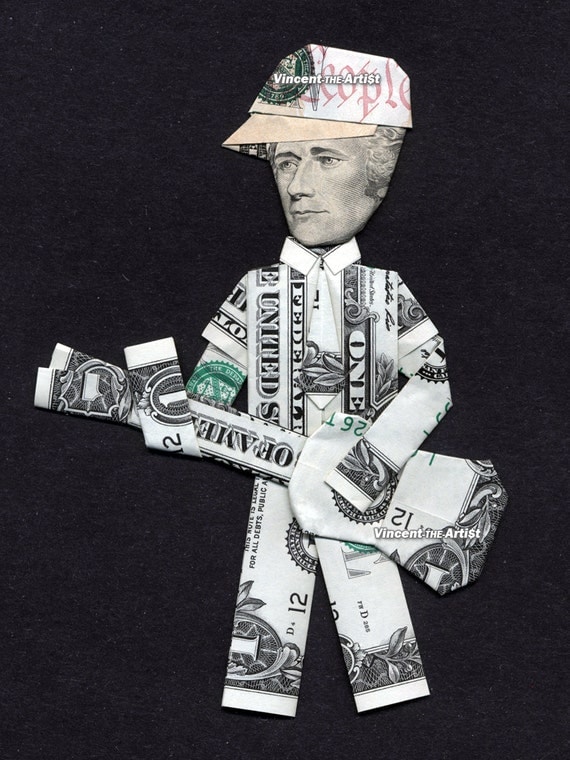
Hamilton Origami Figure available on Etsy for $44.95: “Up for sale is a beautifully crafted origami Alexander Hamilton Figurine. He’s wearing a Baseball Cap and a business suit and he’s jamming a guitar! The head is made of a $10 bill and the rest is made of $1 bills.”
I recently upgraded my iPhone and switched over to the iPhone 6. I previously had three different Hamilton-related covers for my iPhone 4S, but was on the hunt for something new. Here are the contenders I looked at:
Red Bubble has an “Alexander Swagilton” cover featuring Hamilton in some impressive stunner shades, available for $25. The description states: “Need I say more? The genius of finance comes all the way from St. Croix to hang out on your pillows, walls, and other swag-enabled places. Don’t tell Jefferson.”
They also have a “Ham the Man” design. The description states: “Alexander Hamilton: financial whiz kid, self-explanatory.”






 It's Hamiltime!

