Hamilton’s Views on Race and Slavery: The Haitian Revolution

Haiti has a tumultuous and fascinating history, and was the focus of a clash of opinions between Jefferson and the Federalists from 1799-1806. Hamilton supported the Haitian revolution and the government established under Toussaint L’Ouverture, a former slave. He helped draft Haiti’s constitution and advocated open trade with the new nation. On the other hand, Jefferson and his southern constituency were horrified by the idea of a free black republic.

Haiti was first discovered and conquered by Columbus and claimed for the Spanish as Hispaniola in 1492. The Spanish used it as a trading port and maintained control of the island until 1625, when the Spanish lost control due to Dutch resistance and retreated from most of the island. The French began establishing their presence on the island in the 1620s and in 1664, the French West India Company claimed the western part of the island. The French began to import large numbers of African slaves and set up a plantation economy focused on the production of sugar and coffee. Slave rebellions were frequent because of brutal conditions, so in 1685, King Louis XIV enacted the Code Noir, which served as the basis of the law of slavery in Saint- Domingue and the other French plantation colonies. Although the Code Noir legalized manumission of slaves and provided some rights for free blacks, it also created “a rigorously punitive scheme for the discipline of slave labor.” As time passed, the government began to pass laws restricting the rights of the large free black population, the gens de couleur. The combination of oppression towards slaves and towards the free black population created a tinderbox situation. In 1789, Vincent Ogé, a wealthy member of the gens de couleur petitioned the colonial government for equal rights for free people of color in Haiti. When his demands were rejected, he tried to lead an uprising, but was unsuccessful. In 1791, more slave rebellions occured, and successfully overthrew the government. Toussaint L’Ouverture emerged as the leader of the movement and the unofficial leader of the government. France officially ended slavery in its colonies in 1794, prompting L’Ouverture to support the French against the Spanish. Then, the British attempted to invade the island, but L’Ouverture drove them out in 1798 and took control of the government.

Now, the American government had to decide what to do with this new, unique political situation of slaves rebelling and actually controlling the government and military.

In Nation Among Nations, Thomas Bender describes the Haiti debate:

“Haiti heightened the partisan division. Much of the debate over American policy towards Haiti was framed within the larger debate between France and Britain, as Britain maneuvered to take advantage of troubles on the island. But, as Linda Kerber has observed, the debate about foreign policy “kept sliding into the subject of slavery.” When Federalists talked about the profits of trade, southern Republicans- Jefferson’s core constituency- saw only the question of American recognition of a black republic.”

Ted Widmer states: Under the Washington and Adams administrations, “a policy of quiet indifference [towards Haiti] gradually turned into commercial and even military support– support without which it would have been impossible for the experiment in black democracy to survive. ”

Hamilton understood the complicated political landscape surrounding the decision and on February 9, 1799 wrote:

…as in every thing else, we must unite caution with decision. The United States must not be committed on the independence of St. Domingo. No guaranty—no formal treaty—nothing that can rise up in judgment. It will be enough to let Toussaint be assured verbally, but explicitly, that upon his declaration of independence a commercial intercourse will be opened, and continue while he maintains it, and gives due protection to our vessels and property. I incline to think the declaration of independence ought to precede.

In June 1799, Adams issued a proclamation regarding Commerce with St. Domingo and allowed US ships to trade with Haiti. Hamilton worked closely with his friend and Adams’ Secretary of State, Timothy Pickering to develop this support. While some historians have inaccurately characterized this collaboration as occurring behind Adams’ back, Adams was in fact fully aware of these events and told Pickering that the negotiations with L’Ouverture “enjoyed his fullest approbation.” Hamilton was impressive in his “active sympathy for Haiti.” Hamilton and Pickering worked to have Hamilton’s close boyhood friend Edward Stevens deployed as Consul General of the United States at Cape-Francais in 1799. Hamilton also drafted the Haitian Constitution.

However, when Jefferson came to power, he immediately tried to recalled Stevens and embargoed trade with Haiti. As Bender states:

“Unlike Adams, [Jefferson] was widely recognized for his support of revolutions, even the French one. In defense of its turn to violence, he observed that ‘the tree of liberty must be refreshed from time to time with the blood of patriots and tyrants.’ But was what tolerable in Paris was not so in Cap Haitien. The revolution there terrified Jefferson.”

Jefferson’s complete resistance to the events in Haiti was a direct product of his racism and his desire to help his constituents maintain a slave system in the South. He feared that the example of a black republic would encourage resistance in the South. Ironically, the Louisiana Purchase was made possible only because Napoleon’s defeat in Haiti made a French empire in America pointless. Henry Adams described the acquisition of that territory and the prevention of French invasion as a debt owed by the American people “to the desperate courage of five hundred thousand Haytian negroes who would not be enslaved.” Clearly, Jefferson never saw it that way. After Hamilton’s death, American foreign policy became increasingly proslavery, and in 1806, a stiff embargo was placed on Haitian trade. Napoleon captured Toussaint L’Ouverture, who died in captivity. For a complete background of the Haitian revolution and the response of the Founding Fathers, see Gordon S. Brown’s Toussaint’s Clause: The Founding Fathers and the Haitian Revolution.

Hamil-Swag: Clothes

1) Children’s Alexander Hamilton Costume: aka how I will dress my future child.  Available from Buffalo Breath Costumes.

Click here to view larger image

2) T-Shirts: Cafe Press and Zazzle have a variety of designs to choose from.  My friend Morgan had a Hamilton shirt custom made for me, which was awesome.  Here are some of my favorites:

     – Foxiest of the Federalists (from Zazzle)

Alexander Hamilton- Foxiest of the Federalists T-shirt

– I ❤ Alexander Hamilton (Cafe Press has several color and design options)

Shirt

3) Baseball Cap- “In my previous life I was Alexander Hamilton.”

PL Alexander Hamilton Baseball Cap

Feel free to chime in with your favorite Hamil-Swag clothing!

Hamilton’s Views on Race and Slavery: Enlisting Black Soldiers in the Continental Army

In a March 14, 1779 letter to John Jay, then-president of the Continental Congress, Hamilton advocated a proposal to raise three or four battalions of black soldiers.  This was a project that Hamilton and his friend and fellow abolitionist John Laurens came up with together, and John Laurens delivered the letter to Jay.  In the letter, Hamilton stated:

The contempt we have been taught to entertain for the blacks, makes us fancy many things that are founded neither in reason nor experience; and an unwillingness to part with property of so valuable a kind will furnish a thousand arguments to show the impracticability or pernicious tendency of a scheme which requires such a sacrifice. But it should be considered, that if we do not make use of them in this way, the enemy probably will; and that the best way to counteract the temptations they will hold out will be to offer them ourselves. An essential part of the plan is to give them their freedom with their muskets. This will secure their fidelity, animate their courage, and I believe will have a good influence upon those who remain, by opening a door to their emancipation. This circumstance, I confess, has no small weight in inducing me to wish the success of the project; for the dictates of humanity and true policy equally interest me in favour of this unfortunate class of men.

In the book Black Patriots and Loyalists, Alan Gilbert describes the role of black soldiers in both the Loyalist and patriot cause.  The British actively recruited black soldiers, with Lord Dunmore’s November 1775 proclamation.  The proclamation stated that all indentured servants and slaves “free” who were “able and willing to wear arms.”  While black soldiers had been part of the colonial militias, Washington had refused to accept them into the official Continental Army.  However, Lord Dunmore’s proclamation prompted Washington’s decision to finally accept black soldiers in the army on December 31, 1775.  In 1781, during the Battle of Yorktown, when Hamilton was commanding a battalion of troops under Lafayette, Lieutenant Colonel de Gimat’s battalion was composed of a majority of black soldiers.

According to the Freedom Trail Foundation:

By 1779, 15% of the Continental Army and colonial militias were made of men of African decent. They saw action in every single major battle including Ticonderoga, Monmouth, Valley Forge, Princeton, and Washington’s Delaware crossing.

Despite the opposition of his contemporaries, and Washington’s initial refusal, Hamilton and Laurens persisted in advocating for the acceptance of black soldiers into the Continental Army.  Hamilton’s responses to the racist views of his contemporaries foreshadowed his lifelong commitment to the cause of abolition.  In sharp contrast to the blatant racism of “Enlightenment” thinker Jefferson, Hamilton never wavered on his philosophical opposition to slavery.

Hamilton and the Filibuster

Changing the rules of the filibuster has again come front and center, with various prominent Democratic senators calling for a change in the Senate procedural rules to make it more difficult for Senators to invoke the filibuster. Of course, the filibuster as we know it today, was not part of the structure of the early constitutional government. However, some of Hamilton’s work seems to anticipate the current use of the filibuster as a purely partisan tool to increase gridlock. In Federalist No. 22, Hamilton addressed what he saw as a fundamental problem of the government under the Articles of Confederation- that smaller states had the ability to block legislation.

But this is not all: what at first sight may seem a remedy, is, in reality, a poison. To give a minority a negative upon the majority (which is always the case where more than a majority is requisite to a decision), is, in its tendency, to subject the sense of the greater number to that of the lesser. Congress, from the nonattendance of a few States, have been frequently in the situation of a Polish diet, where a single veto has been sufficient to put a stop to all their movements. A sixtieth part of the Union, which is about the proportion of Delaware and Rhode Island, has several times been able to oppose an entire bar to its operations. This is one of those refinements which, in practice, has an effect the reverse of what is expected from it in theory. The necessity of unanimity in public bodies, or of something approaching towards it, has been founded upon a supposition that it would contribute to security. But its real operation is to embarrass the administration, to destroy the energy of the government, and to substitute the pleasure, caprice, or artifices of an insignificant, turbulent, or corrupt junto, to the regular deliberations and decisions of a respectable majority. In those emergencies of a nation, in which the goodness or badness, the weakness or strength of its government, is of the greatest importance, there is commonly a necessity for action. The public business must, in some way or other, go forward. If a pertinacious minority can control the opinion of a majority, respecting the best mode of conducting it, the majority, in order that something may be done, must conform to the views of the minority; and thus the sense of the smaller number will overrule that of the greater, and give a tone to the national proceedings. Hence, tedious delays; continual negotiation and intrigue; contemptible compromises of the public good. And yet, in such a system, it is even happy when such compromises can take place: for upon some occasions things will not admit of accommodation; and then the measures of government must be injuriously suspended, or fatally defeated. It is often, by the impracticability of obtaining the concurrence of the necessary number of votes, kept in a state of inaction. Its situation must always savor of weakness, sometimes border upon anarchy.

It is not difficult to discover, that a principle of this kind gives greater scope to foreign corruption, as well as to domestic faction, than that which permits the sense of the majority to decide; though the contrary of this has been presumed. The mistake has proceeded from not attending with due care to the mischiefs that may be occasioned by obstructing the progress of government at certain critical seasons. When the concurrence of a large number is required by the Constitution to the doing of any national act, we are apt to rest satisfied that all is safe, because nothing improper will be likely to be done, but we forget how much good may be prevented, and how much ill may be produced, by the power of hindering the doing what may be necessary, and of keeping affairs in the same unfavorable posture in which they may happen to stand at particular periods.

Hamilton was a dedicated supporter of protecting minority rights, even when his causes were deeply unpopular, as with his protection of Tories after the Revolution. However, he understood that a system that essentially gave a small fraction of the population the ability to block important decisions was unsustainable. Abuse of the filibuster by either party to gridlock government reduces our system to “a state of inaction” that Hamilton warned was unsustainable.

And, if you needed more reasons to dislike the filibuster…Aaron Burr laid the foundations for it before it became part of Senate strategy in the 1830s and 1840s.

For further reading on Hamilton and the filibuster, check out Hendrik Hertzberg’s 2011 piece in the New Yorker.

Hamil-Swag for the Household

1) Collectible Plates– Available from Ebay.

2) Pillowcase- Found on All Things Hamilton (thanks to Nicole for the suggestion!)- I love the idea, but this is not my favorite depiction of Hamilton.  When they print this pillowcase with a different image,  I might just have to buy it…   

4) Tea Towels– I honestly don’t know what the function of a tea towel is, but this is still pretty cool.  Available on Amazon

5) Clock- From Founder of America

Alexander Hamilton clock

I like the idea of a Hamilton clock, but I dislike this particular quote excerpt because I think it is very misleading.   In reality, Hamilton was deflecting the suggestion that his genius came easily and offering an explanation of his approach and work ethic.  The full context of what he said is this:

Men give me credit for some genius. All the genius I have lies in this; when I have a subject in hand, I study it profoundly. Day and night it is before me. My mind becomes pervaded with it. Then the effort that I have made is what people are pleased to call the fruit of genius. It is the fruit of labor and thought.

I have this up in my office- such a great motivation to focus!

The Other Hamilton Duel: Philip Hamilton and George Eacker

While Alexander Hamilton and Aaron Burr’s 1804 duel is notorious in history and pop culture, a lesser-known deadly duel occurred three years earlier between Hamilton’s oldest son, Philip, and George Eacker, a critic of Hamilton and supporter of Burr.

Hamilton took great pride in his son’s academic achievements.  He wrote to him regularly while Philip was studying at boarding school, and created a rigorous set of rules to govern Philip’s study schedule.  In 1797, when Philip was a young teenager, he contracted a deadly illness and Hamilton reportedly “administered every dose of medicine” to his son during his recovery.

The close relationship between father and son may have contributed to Philip’s eagerness to defend his father’s name.  Eacker, a 27-year-old lawyer, had made a speech in July accusing Alexander Hamilton of being willing to overthrow Thomas Jefferson’s presidency by force.  In the speech, Eacker accused Hamilton of misusing his position as Inspector General during the Adams administration to intimidate his political enemies.  On November 20, 19-year-old Philip and his friend Richard Price confronted Eacker about the speech when the three men were at a social event. After Eacker insulted them, the boys challenged Eacker to a duel.  Dueling was already illegal in New York, so the men planned to meet in New Jersey.  Eacker and Richard Price took the field first at Weehawken, on November 22. They exchanged shots, but no one was injured; according to convention, honor was satisfied.  The next day, Philip faced Eacker and fell to a ball from Eacker’s smoothbore dueling pistol.  He died the next day.  The death caused a massive strain on the Hamilton family and led to the nervous breakdown of Hamilton’s daughter Angelica.

Robert Troup observed about Hamilton after Philip’s death in a December 5, 1801 letter to Rufus King:

Never did I see a man so completely overwhelmed with grief as Hamilton had been.  The scene I was present at, when Mrs. Hamilton came to see her son on his deathbed (he died about a mile out of the city) and when she met her husband and son in one room, beggars all description!  Young Hamilton was very promising in genius and acquirements, and Hamilton formed high expectations of his future greatness!”

Alexander Hamilton was killed three years later, on the same dueling grounds in Weehawken and with the same dueling pistols.


The Election of 1800: Hamilton’s Role

Michael Austin has written an interesting story for History News Network on the presidential election of 1800.  Austin draws parallels between the current state of partisan politics and the bitter rivalries that emerged during the presidential contest between incumbent John Adams and Thomas Jefferson.

During that election, Hamilton and other high Federalists painted Jefferson and the Republicans as morally depraved atheists and fiery anti-government radicals who planned to set up guillotines on the banks of the Potomac and fill the new capital with blood. Republicans, on the other hand, portrayed Federalists as crypto-monarchists and usurpers of the Constitution. They pointed to the recent Alien and Sedition Acts as proof that Federalists would roll back the Bill of Rights at every available opportunity until they could declare Hamilton president-for-life and, from there, King of America.

And it got worse. Both Jeffersonians and Hamiltonians savaged the incumbent president, John Adams, a moderate Federalist who never quite managed to make either side happy. Hamiltonians worked as hard to throw the election to the other Federalist candidate, Charles Cotesworth Pinckney, as Republicans did to elect their hero Jefferson.

The unintended circulation of the Letter from Alexander Hamilton, Concerning the Public Conduct and Character of John Adams, Esq. President of the United States was considered a major factor in Adams’s defeat.  If you haven’t read the letter before- I highly recommend it- full text available from Open Library

In the letter, Hamilton begins with this premise: “Not denying to Mr. Adams patriotism and integrity, and even talents of a certain kind, I should be deficient in candour, were I to conceal the conviction, that he does not possess the talents adapted to the administration of government, and that there are great and intrinsic defects in his character, which unfit him for the office of chief magistrate.”

He describes Adams’s miliary plans during the Revolution and how these plans would have contributed to the defeat of the Continental Army.  For example, Adams “was represented to be of the number of those” who favored shorter troop enlistment rather than Washington’s policy of having soldiers enlist for the term of the war.  Hamilton also criticized Adams for ignoring the advice of his cabinet.  He accused Adams of rash decisionmaking, particularly when related to the quasi-war with France and drew a comparison between Adams and “the modest and sage Washington,” who “consulted much, pondered much, resolved slowly, resolved surely.”  Hamilton showcased instances of Adams’s uncertainty and found him to be “so much at variance with himself, as well as with sound policy, that we are driven to seek a solution for it in some system of concession to his political enemies.”  The purpose of Hamilton’s letter was to draw support from within the Federalist Party towards Charles Pinckney, a Southern Federalist.  However, after Adams won the Federalist nomination, the letter was circulated throughout the country by the Jeffersonians.  Hamilton’s reasoned and damning attack on Adams played a part in the contentious election.  Although Hamilton could have adopted the party line and backed Adams, he took the opposite course, understanding that he would lose the support of half his party in future races.  For better and for worse, Hamilton was a man of convictions and of impulse.

Mock Politics produced a humorous set of Jefferson v. Adams attack ads:

In an interesting post-script to the election, Hamilton eventually persuaded fellow Federalists to choose Jefferson over Aaron Burr.  Smithsonian Magazine has a great piece explaining the deadlock- because of the system in place, Congress had to decide between Jefferson and his running mate Aaron Burr.  Many Federalists saw Jefferson as the ultimate enemy and were pushing for a Burr presidency.  Hamilton stated:

Mr. Jefferson, though too revolutionary in his notions, is yet a lover of liberty and will be desirous of something like orderly Government.–Mr. Burr loves nothing but himself-Thinks of nothing but his own aggrandizement–and will be content with nothing short of permanent power in his own hands.–No compact, that he should make with any passion in his breast except Ambition, could be relied upon by himself.–How then should we be able to rely upon our agreement with him? Mr. Jefferson I suspect will not dare much. Mr. Burr will Dare every thing in the sanguine hope of affecting every thing.

(Visual from Digital History)

Hamil-Swag: The Bizarre

An introduction to some of the more unusual Hamilton products available:

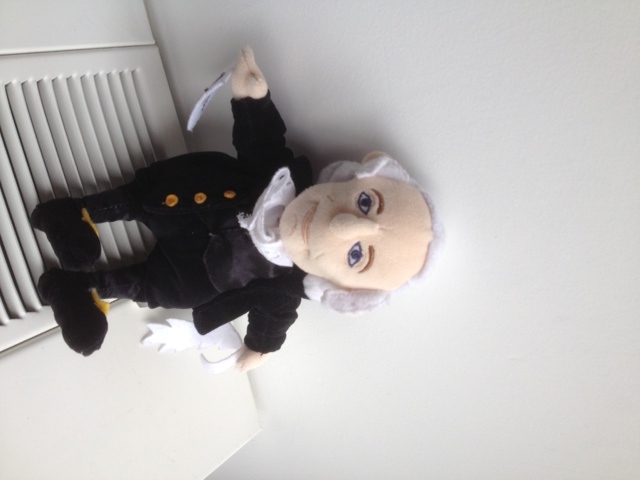
1) Hamilton plush doll/stuffed animal: I bought mine at the Trinity Church gift shop, but it is also available online.  My roommate in law school found this doll incredibly creepy, and as much as I love all things Hamilton, there is something a little unnerving about this particular piece.  I’d suggest sticking to the Bobblehead if you want a more accurate Hamilton.


2) Commemorative strands of Hamilton’s hair: History for Sale  has ten strands of Hamilton’s hair available from the “largest collector of famous hair,” as listed in the Guinness Book of World Records.  For just under $8,000, you can own ten strands of Hamilton’s hair, collected from various points of his life.  If you’re just looking for one or two strands, Ebay has deals ranging from $99-$495.  While I do love collectible Hamilton items, I’ve never found the appeal of collecting hair strands from two centuries ago. 

3) Alexander Hamilton Revolutionary Action Figure– The Alexander Hamilton American light infantry command action figure commemorates Hamilton’s position as Lieutenant Colonel of the Light Infantry Division that fought at Yorktown in 1781.  Hamilton’s heroic conduct in Yorktown brought him to Washington’s attention and Hamilton had extremely close relationships with Marquis de Lafayette and John Laurens, fellow commanders in the division.  The figure is available on Amazon, Sierra Toy Soldiers, and  The History Store 

Hamilton Is No David Petraeus

The intense publicity surrounding David Petraeus and his high-profile affair and resignation has led to comparisons between the Petraeus-Bradwell affair and Hamilton’s high profile affair with Maria Reynolds.  Articles include One Sex Scandal In American History That Tops The Petraeus Affair and Before David Petraeus, There Was Alexander Hamilton’s “Beauty in Distress”.  The New York Times also mentions Hamilton today in the article With Digital Trail, an End to the Hushed Affair.

The above sources lay out the sensational details of the affair: Hamilton became involved with Maria Reynolds in 1791, when she came to his home in Philadelphia and claimed that she was destitute and had been abandoned and abused by her husband.  Hamilton and Reynolds became involved immediately.  Maria’s husband, James Reynolds knew about the affair (and may have even pushed Maria to seduce Hamilton) and sought money from Hamilton.  James Reynolds was arrested for financial crimes and accused Hamilton of entering into monetary relationships with Reynolds for personal gain and abusing his position.  Reynolds accused Hamilton of being deeply concerned in speculation and frequently advancing money to Reynolds for these purposes.  The information came into the hands of Congressman Frederick A. Muhlenberg, who shared it with Senator James Monroe and Congressman Abraham Venable.  These three men confronted Hamilton in December 1792, and Hamilton immediately disclosed the affair and showed them letters from Reynolds in order to clear himself of the corruption charges.  The exchange concluded with the understanding that the three men would keep silent about the details of the affair.  The three men also gave a copy of the initial documents with information from Reynolds that was discredited by Hamilton to John Beckley, clerk of the  House of Representatives.  In 1793, Reynolds divorced her husband and Aaron Burr served as her divorce lawyer.  In 1795, Hamilton resigned as Treasury Secretary, where he had been making only $3,500 a year, and resumed private practice in New York, making around $11,000 a year.  In 1797, Beckley was fired as Clerk of the House and he turned over his copy of the documents to infamous Republican journalist James T. Callender.  Callender, without making any further investigation about truth of the claims, immediately published Beckley’s documents.  Scandal erupted and corruption accusations swirled.  Hamilton believed that his political enemy Monroe, who Washington had just recalled from his position as ambassador to France, was behind the documents being released.  The two men came to the brink of a duel, and Aaron Burr, Monroe’s would-be second, helped negotiate between the two parties and averted the duel.  In August 1797, Hamilton published a pamphlet with all of his correspondence with Reynolds, deciding that admitting to a sordid affair would be better than the stain of the public corruption allegations.  

When the pamphlet was published, Hamilton’s allies were shocked:

When the work appeared, Hamilton’s friends were appalled. “What shall we say …” Webster wrote, “of a man who has borne some of the highest civil and military employments, who could deliberately … publish a history of his private intrigues, degrade himself in the estimation of all good men, and scandalize a family, to clear himself of charges which no man believed. …” General Henry Knox wrote to General David Cobb, “Myself and most of his other friends conceive this confession humiliating in the extreme, and such a text as will serve his enemies.”

While the details of the affair are indeed scandalous, the most revealing and important part of the story is Hamilton’s response to it.  His decision is a perfect example of what makes him such an interesting and complex historical figure.  Hamilton was flawed and succeptible to temptation in his personal life, but he was doggedly honest in his professional life.  He ignored the personal consequences of admitting to the affair and made a full confession, something that few political figures of any period would do.  To Hamilton, even the unsubstantiated stirrings of corruption were unacceptable. 

Unlike David Petraeus and the countless other politicians involved in modern sex scandals, Hamilton did not make a public revelation out of necessity, but out of his sense of honor.  Even though Hamilton was no longer in office when news of the affair broke, he placed the sanctity of the position over his private interests and his own reputation.  If Hamilton had listened to his friends or had a modern day spin doctor, he would have allowed the rumors to live instead of feeding the fire with a full, dramatic revelation.  For better and for worse, Hamilton was a person who followed his own mind and lived by his own unbendable code with regard to his political life, even when his personal life fell short of that code. 

For a full account of the Reynolds affair, see The Notorious Affair of Mrs. Reynolds, a 1973 American Heritage article.

Hamilton, Croswell, and the Liberty of the Press

Gawker reported on Saturday that a journalism student at SUNY Oswego was suspended for asking questions as part of a class assignment to profile a public figure.  The student, Alex Myers, chose to profile hockey coach Ed Gosek.  As part of his research, he sent emails to rival coaches asking them for their perspective on Gosek.  Myers concluded his email by stating: “Be as forthcoming as you like, what you say about Mr Gosek does not have to be positive.”  The school charged him with dishonesty and with “disruptive behavior.”  Although Myers was spared a suspension, he was ordered to write letters of apology to Gosek and the coaches he contacted.  This instance is one of many in which citizens and journalists have been penalized for asking questions and trying to seek out the truth.  Prosecutors across the country have tried to charge people with wiretapping for videotaping police conduct.  While some courts and the Department of Justice have suggested that the First Amendment protects such conduct, prosecutions continue.

Mr. Myers’ story reminded me of Alexander Hamilton’s role in the 1803 case People v. Croswell, 3 Johns. Cas. 337 N.Y. 1804.  The defendant, Harry Croswell, was indicted for “being a malicious and seditious man, of a depraved mind and wicked and diabolical disposition, and also deceitfully, wickedly, and maliciously devising, contriving and intending, Thomas Jefferson, Esq., President of the United States of America, to detract from, scandalize, traduce, vilify” him.  Croswell was the editor of The Wasp, a Federalist publication, and accused Thomas Jefferson of paying people to make accusations against Washington, Adams, and other Federalists.  Croswell was convicted by the lower court and asked Hamilton to represent him on the appeal.  Hamilton threw himself into the case, culminating with a 6 hour oration to a standing room only.  In his argument, Hamilton stated that “the liberty of the press consists in the right to publish, with impunity, truth, with good motives, and for justifiable ends, whether it respects government, magistracy, or individuals.”  Despite Hamilton’s efforts, the court upheld the tradition, and Hamilton was bitterly disappointed.  He died the next year, before he got the chance to see the New York Legislature pass a law essentially codifying his argument and granting immunity for truthful speech. 

Throughout his life, Hamilton had an intimate and often complex relationship with liberty of the press.  In Federalist 84, Hamilton stated:

“On the subject of the liberty of the press, as much has been said, I cannot forbear adding a remark or two: In the first place, I observe that there is not a syllable concerning it in the constitution of this state, and in the next, I contend that whatever has been said about it in that of any other state, amounts to nothing. What signifies a declaration that “the liberty of the press shall be inviolably preserved?” What is the liberty of the press? Who can give it any definition which would not leave the utmost latitude for evasion? I hold it to be impracticable; and from this, I infer, that its security, whatever fine declarations may be inserted in any constitution respecting it, must altogether depend on public opinion, and on the general spirit of the people and of the government.”

Hamilton used newspapers as his primary means of public persuasion and published both the Federalist Papers and his arguments in support of the Revolution as newspaper pieces.  Hamilton also founded the New York Post in 1801 with a group of investors.  However, Hamilton was also the subject of brutally negative press coverage by Republican newspapers.  After his public confession of his affair with Maria Reynolds, Hamilton was the subject of persistent embarrassing coverage.  During the Adams administration, Hamilton also supported the Alien and Sedition Acts, and David Frothingham (printer for a Republican publication) was charged and convicted of criminal libel against Hamilton for making comments about his alleged corruption as Secretary of the Treasury.  Despite the complications of this relationship, the position Hamilton argued in Croswell was consistent throughout his life.  He believed that journalists should be free to find and publish truth.  Perhaps the journalism program at SUNY Oswego could learn from Hamilton’s example.

For a detailed overview of the Croswell case, see Morris Forkosch’s 1965 law review article “Freedom of the Press: Croswell’s Case.”