Hamil-Swag: Alexander Hamilton Vodka

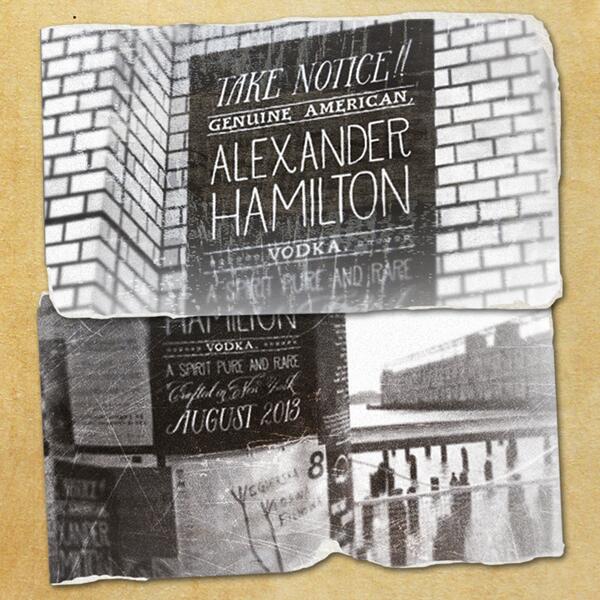
Old New York Spirits has just introduced Alexander Hamilton Vodka, which it bills as “a spirit pure and rare.”  The vodka is distilled from potatoes and is handcrafted in New York.

boxes.jpg

Designer Steven Bonner was brought in to design the bottle and packaging and states on his website that:

“I worked directly with the client to reflect its American heritage and took inspiration from a range of sources, not least Alexander Hamilton’s life and times as well as more stylised elements like some of the gravestones surrounding Hamilton’s resting place. A mix of classic and modern, the bottle is designed to appeal to a fashionable consumer who respects tradition and craft in a premium product.”

The brand has Twitter and Instagram accounts, and tweeted this announcement picture in July 2013.  If any one has tried this or seen it in stores, let me know!

Embedded image permalink

Lin-Manuel Miranda’s HAMILTON World Premiere Winter 2015

Exciting news: Lin-Manuel Miranda’s Hamilton will have it’s world premiere next winter at the Public Theater!  The New York Times reports that the production will be directed by Thomas Kail, who collaborated with Miranda on In The Heights and was nominated for a Tony.  Additionally, commercial producers Jeffrey Seller, Sander Jacobs, and Jill Furman, will be financially supporting the production.  Hamilton will begin performances on Tuesday, January 20, 2015 and run through Sunday, February 22, 2015.

The Public Theater’s press release states:

“HAMILTON, written by the Tony and Grammy Award-winning composer and lyricist Lin-Manuel Miranda, will have its world premiere next January as part of The Public’s 2014-15 season at Astor Place. Directed by his In The Heights collaborator Thomas Kail, this new musical features Miranda playing Alexander Hamilton, one of our country’s Founding Fathers and the first Secretary of the Treasury. ”
“Lin-Manuel Miranda is a marvel, but nothing could have prepared us for the astonishing achievement of  Hamilton,” said Artistic Director Oskar Eustis. “Alexander Hamilton was born in the West Indies, the only Founding Father who was an immigrant, and Lin’s genius is to tell the story of the birth of the United States as an immigrant’s story. The energy, the passion, joy, tragedy, and raw intelligence of this show are stunning.”
HAMILTON, featuring a cast of historical figures that includes George Washington, Aaron Burr, James Madison, and Thomas Jefferson,  Miranda performed a song from HAMILTON for President Obama and the First Family at the White House in 2009 during its first-ever White House Evening of Poetry & Spoken Word. Watch it here http://1.usa.gov/1bGCQbh. Inspired by the book Alexander Hamilton by Ron Chernow, HAMILTON is produced with the support of Jeffrey Seller, Sander Jacobs, and Jill Furman

The Public Theater website states:

The Public Theater is the only theater in New York that produces Shakespeare, the classics, musicals, contemporary and experimental pieces in equal measure. The Public continues the work of its visionary founder, Joe Papp, by acting as an advocate for the theater as an essential cultural force, and leading and framing dialogue on some of the most important issues of our day.  Creating theater for one of the largest and most diverse audience bases in New York City for nearly 60 years, today the company engages audiences in a variety of venues—including its landmark downtown home at Astor Place, which houses five theaters and Joe’s Pub; the Delacorte Theater in Central Park, home to its beloved, free Shakespeare in the Park; and the Mobile Unit, which tours Shakespearean productions for underserved audiences throughout New York City’s five boroughs. The Public’s wide range of programming includes Free Shakespeare in the Park, the bedrock of the company’s dedication to making theater accessible to all, new and experimental stagings at The Public at Astor Place, and a range of artist and audience development initiatives including its Public Forum series, which brings together theater artists and professionals from a variety of disciplines for discussions that shed light on social issues explored in Public productions.

Hamil-Swag: The Federalist Visionary Zinfandel

For all you wine drinkers out there, here’s a very handsome bottle: Terlato Wines International’s Federalist Visionary Zinfandel.

The Federalist Visionary Zinfandel, Dry Creek Valley, USA

The website’s explanation for the use of Hamilton’s image states:

The roots of Zinfandel began to take hold in the United States just as the Federalists were establishing our nation’s independence. This Dry Creek Valley Federalist Zinfandel is an ode to this noble grape, and a celebration of its decidedly American origin. The robust fruit, bright berry fruit character and lively acidity speak to the distinct characteristics of these bold, strong vines that are inseparably intertwined with the history of the United States itself

The Federalist Visionary Zinfandel, Dry Creek Valley, USA

The description of the wine states:

Our Dry Creek Federalist Zinfandel is hand-crafted to bring out the true individuality of the Zinfandel grape. The Dry Creek Valley has unique characteristics that make it especially well-suited for cultivation of this hearty, decidedly American grape. The valley receives pronounced afternoon heat, but our vines are also cooled by the night air that creeps up the Russian River Valley from the waters of the Pacific Ocean, producing evening and early morning fog. Our vineyard enjoys the luxury of extended “hang time,” which produces more mature fruit, and results in rich, full-bodied flavor characteristics. The Federalist Zinfandel has robust fruit with bright berry fruit character, and its lively acidity allows it to partner well with a wide variety of foods.

Here is a review of the wine from Notes from the Cellar.  Here is a website with information where you can find this wine near you.  I still haven’t tried it, but will report back when I do…if I can bring myself to open the bottle!

The company also makes two other Federalist variations: a Federalist chardonnay dedicated to John Adams, and a Dueling Pistols wine referencing the duel between Hamilton and Burr.  The description for the dueling pistols wine states:

Since dueling is no longer socially acceptable, we suggest solving differences over a glass of this “dual” of zinfandel and syrah.  This wine exhibits bright cherry jam aromas, with big fruit flavors enhanced by hints of spice and lively acidity.

Hamilton and The Morristown “Yarn Bomber”

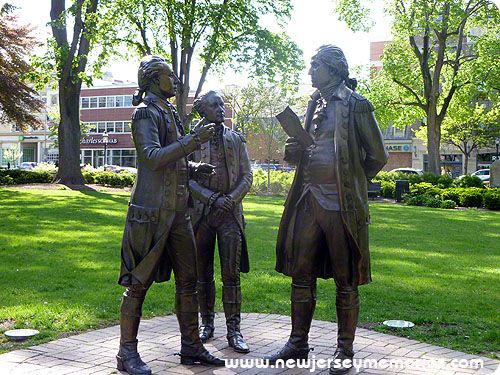
A mysterious “yarn bomber” has been putting contemporary winter clothes on the statues of Alexander Hamilton, George Washington, and the Marquis de Lafayette during this winter’s cold streak.

The Morristown Patch reports:

“Morristown residents have had the mystery of the so-called “Yarn Bomber” on their minds since a slew of knit items mysteriously appeared on the statues in and around the Morristown Green late last week. The harsh polar vortex conditions that settled into the area prompted a visitor to the Green to place modern winter weather gear on the statues of George Washington, Marquis de Lafayette and Alexander Hamilton.”

The anonymous yarn bomber, also described as a “fiber fairy,” left a note attached to each article of clothing stating: “If you need this to help keep you warm in this cold weather, then it is now yours. Life is good. Pass it on.”  She remains anonymous, butells the Patch that she will be back.

What exactly is yarn bombing?  According to the New York Times:

Yarn bombing takes that most matronly craft (knitting) and that most maternal of gestures (wrapping something cold in a warm blanket) and transfers it to the concrete and steel wilds of the urban streetscape. Hydrants, lampposts, mailboxes, bicycles, cars — even objects as big as buses and bridges — have all been bombed in recent years, ever so softly and usually at night.

It is a global phenomenon, with yarn bombers taking their brightly colored fuzzy work to Europe, Asia and beyond. In Paris, a yarn culprit has filled sidewalk cracks with colorful knots of yarn. In Denver, a group called Ladies Fancywork Society has crocheted tree trunks, park benches and public telephones. Seattle has the YarnCore collective (“Hardcore Chicks With Sharp Sticks”) and Stockholm has the knit crew Masquerade. In London, Knit the City has “yarnstormed” fountains and fences. And in Melbourne, Australia, a woman known as Bali conjures up cozies for bike racks and bus stops.

To record their ephemeral works (the fragile pieces begin to fray within weeks), yarn bombers photograph and videotape their creations and upload them to blogs, social networks and Web sites for all the world to see.”

Untapped Cities has recent images of yarn bombing from New York City.

According to the Morristown Tourism Board, the set of statues, collectively known as “The Alliance,” was unveiled at Morristown Green in 2007.

Here are the statues in warmer days

Morristown served as Washington’s headquarters during the winter of 1777.  It is the site of the “Schuyler-Hamilton House” where Alexander and Betsy courted before they were married.  For more information on Morristown, see All Things Hamilton.

After 1800: Hamilton and the Twelfth Amendment

I wrote earlier about Hamilton’ role in the Election of 1800, in which Thomas Jefferson and Aaron Burr received an equal number of electoral votes and Hamilton was the force behind Jefferson’s controversial victory in the Senate vote.  After the election, people immediately began calling for reform to prevent the events of 1800 from occurring in future elections.  Although Republicans ultimately embraced the reform, the impetus for inserting such a provision into the Constitution largely came from Hamilton and his fellow Federalists.

In Federalist No. 68, Hamilton noted that “the mode of appointment of the Chief Magistrate of the United States is almost the only part of the system, of any consequence, which has escaped without severe censure, or which has received the slightest mark of approbation from its opponents.”  He emphasized that “Nothing was more to be desired than that every practicable obstacle should be opposed to cabal, intrigue, and corruption.”

Hamilton recognized that the backdoor politics that came to the brink of creating a Burr presidency was contrary to the goals of the Constitution, and was a major supporter of the movement to pass a Twelfth Amendment to distinguish the positions of President and Vice President.  Henry Cabot Lodge identified Hamilton as the originator of the Twelfth Amendment.

In his 1901 Study of the Twelfth Amendment of the Constitution of the United StatesLolabel House noted that though the Twelfth Amendment was “finally passed as a Republican party measure, the earliest advocates of the principle involved were Federalists.  It was recommended first by the Federalist Legislature of New Hampshire, twice by the Federalist Legislature of South Carolina, unanimously in New York, where the majority was Federalist…”

Hamilton proposed the resolution to the Federalist-dominated New York State Legislature on January 29, 1802.

Resolved, as the sense of the Legislature, that the following amendments ought to be incorporated into the Constitution of the United States as a necessary safeguard in the choice of a President and Vice President against pernicious dissensions as the most eligible mode of obtaining a full and fair expression of the public will in such election.

Hamilton’s proposed version of the Twelfth Amendment:

1st. That Congress shall from time to time divide each State into Districts equal to the whole number of Senators and Representatives from such state in the Congress of the United States, and shall direct the mode of choosing an Elector of President and Vice President in each of the said Districts, who shall be chosen by Citizens who have the qualifications requisite for Electors of the most numerous branch of the State Legislature, and that the districts shall be formed, as nearly as may be, with an equal proportion of population in each, and of Counties and, if necessary, parts of Counties contiguous to each other, except when there may be any detached portion of territory not sufficient of itself to form a District which then shall be annexed to some other part nearest thereto.

2nd. That in all future elections of President and Vice President the persons voted for shall be particularly designated by declaring which is voted for as President and which as Vice President.

The version of the amendment that was ultimately passed by Congress differs from Hamilton’s proposal in that it did not adopt Hamilton’s proposed language regarding the role of districts.  The Twelfth Amendment was passed by Congress on December 9, 1803.  Interestingly, contemporary newspaper The Balance reported that was a movement in the Senate, “contrary to all precedent,” to get the bill signed by the President before sending it to the states.

12th Amendment


[The Balance, December 27, 1803]


This bill was ultimately voted down, and the amendment was sent to the states for ratification.  The Twelfth Amendment was finally ratified on June 15, 1804.

The Electors shall meet in their respective states, and vote by ballot for President and Vice-President, one of whom, at least, shall not be an inhabitant of the same state with themselves; they shall name in their ballots the person voted for as President, and in distinct ballots the person voted for as Vice-President, and they shall make distinct lists of all persons voted for as President, and all persons voted for as Vice-President and of the number of votes for each, which lists they shall sign and certify, and transmit sealed to the seat of the government of the United States, directed to the President of the Senate.

The President of the Senate shall, in the presence of the Senate and House of Representatives, open all the certificates and the votes shall then be counted.

The person having the greatest Number of votes for President, shall be the President, if such number be a majority of the whole number of Electors appointed; and if no person have such majority, then from the persons having the highest numbers not exceeding three on the list of those voted for as President, the House of Representatives shall choose immediately, by ballot, the President. But in choosing the President, the votes shall be taken by states, the representation from each state having one vote; a quorum for this purpose shall consist of a member or members from two-thirds of the states, and a majority of all the states shall be necessary to a choice. And if the House of Representatives shall not choose a President whenever the right of choice shall devolve upon them, before the fourth day of March next following, then the Vice-President shall act as President, as in the case of the death or other constitutional disability of the President.

The person having the greatest number of votes as Vice-President, shall be the Vice-President, if such number be a majority of the whole number of Electors appointed, and if no person have a majority, then from the two highest numbers on the list, the Senate shall choose the Vice-President; a quorum for the purpose shall consist of two-thirds of the whole number of Senators, and a majority of the whole number shall be necessary to a choice. But no person constitutionally ineligible to the office of President shall be eligible to that of Vice-President of the United States

Happy Birthday Hamilton Events in NYC

The AHA Society is hosting a series of events today and tomorrow throughout the city to celebrate Hamilton’s birthday. As part of those events, I’m giving a talk on the Croswell case and Hamilton’s role in the evolution of freedom of press in the early American Republic.  If you’re in town, come check it out today at 2:30 PM in Federal Hall (26 Wall Street) in Lower Manhattan.

Link to information on all the events: https://www.smore.com/jddf-happy-birthday-hamilton-2014

TALK: ALEXANDER HAMILTON AND THE EVOLUTION OF FREE SPEECH IN THE EARLY REPUBLIC: FROM ZENGER TO CROSWELL

WHEN: FRIDAY, JAN. 10TH, 2:30PM

WHERE: 26 WALL STREET, NEW YORK, NY

Pooja Nair, Harvard Law graduate and legal associate of Foley & Lardner LLP of Los Angeles, will be speaking on Alexander Hamilton’s role in establishing the precedent of free speech in the United States.During his work as a lawyer, Hamilton argued on behalf of journalist Harry Croswell (People v. Croswell) that truthful statements should not be considered libel. Though the judges deadlocked in trial, Hamilton’s arguments were written into New York law the following year. Learn more about the precedents that Alexander Hamilton set in the courtroom in Ms. Nair’s talk.

The talk will be held at Federal Hall National Memorial on Wall Street in Lower Manhattan.

Images of Hamilton: Update- Trumbull Portrait Now on Display in NYC

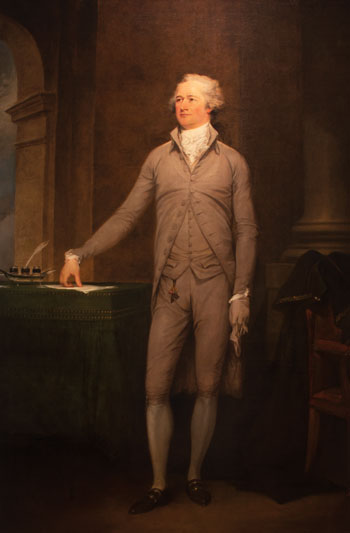
I had blogged earlier about John Trumbull’s iconic portrait of Hamilton, and about plans to house the painting for public display at Crystal Bridges Art Museum of American Art in Bentonville, Arkansas and the Metropolitan Museum of Art in New York City.  This week, the portrait was formally unveiled at the Met, so all the NYC Hamiltonians can go take a look at the full-length portrait in person!

John Trumbull, "Portrait of Alexander Hamilton," 1792, gift from Credit Suisse to Crystal Bridges and Metropolitan Museum

According to the Met’s press release:

An iconic life-size portrait by the celebrated Revolutionary-era painter John Trumbull of Alexander Hamilton, then Secretary of the Treasury under President George Washington, is now on view in The American Wing of The Metropolitan Museum of Art.  This is the painting’s first showing at the Metropolitan since it was donated, earlier this year, by the global wealth manager and investment bank Credit Suisse to both the Metropolitan Museum in New York and Crystal Bridges Museum of American Art in Bentonville, Arkansas. At the Metropolitan, the work—which is considered the greatest known portrait of Hamilton and one of the finest civic portraits from the Federal period—is on display in Gallery 755, “Faces of the Young Republic,” of the New Galleries for American Paintings, Sculpture, and Decorative Arts among portraits of other great heroes of the post-Revolutionary period.

Images of Hamilton: William Rimmer Statue in Boston

Visitors to Boston may have noticed a unique Hamilton statute on Commonwealth Avenue, between Arlington Street and Berkeley Street.  The statue, erected in 1865 was the first to appear on Commonwealth Avenue.  According to the iWalked Boston audio tour guide, the it is also the only stone structure on the Commonwealth Avenue Mall.  The statue was funded by Thomas Lee and designed by Dr. William Rimmer, who had a fascinating background as a physician and a sculptor.

Public Art Boston offers this description of the statue:

This sculpture by William Rimmer shows Hamilton with cloth draped over his Colonial-era outfit. The heavy folds of drapery bring to mind depictions of Greek and Roman leaders in ancient statuary. Through this anachronistic touch, Rimmer evoked the first democratic-style governments in ancient Greece, thereby emphasizing Hamilton’s formative role in the newly emerging American democracy. Interestingly, Rimmer was a physician before devoting himself to art. He did not use a model to create the statue, but instead employed his unique knowledge of human anatomy to chisel Hamilton’s body from a block of granite. Due to Rimmer’s unusual technique, this sculpture is particularly fragile and difficult to maintain.


Rimmer’s design was extremely controversial during his time, and

Massachusetts: A Guide to Its Places and People states:

“Rimmer had a theory, ahead of his time, of working impressionistically without models.  Though contemporary criticism was violently averse, the statue was admired by Hamilton’s own family for its graceful and somewhat aloof pose, characteristic of its subject.”

An 1895 issue of the New England Magazine describing Boston’s statues states:

“A curious work is the granite statue of Alexander Hamilton by Dr. William Rimmer, in Commonwealth Avenue.  It stands on a high and massive granite pedestal; and it was given to the city in 1865 by Thomas Lee, who also gave the Esther Monument.  There is little or no modeling, except about the head, and the appearance of the figure suggests a snow image which is partially melted.”

Take a look for yourself the next time you’re in Boston!

Happy Constitution Day!

Today, September 17, 2013, marks the 226th anniversary of the signing of the United States Constitution.  Given the endurance of the Constitution over the past 226 years, it is easy to see the acceptance of the Constitution almost as an inevitable part of American history.  However, the period leading up to the Constitutional Convention in Philadelphia, and the two years before ratification in 1789 were marked by turbulence and the clash of opinions over fundamental views of the American future.  Hamilton was instrumental in tipping the scale to push forward the Constitution.

Hamilton’s Impressions as to the New Constitution, written at some point in September 1787, highlights the uncertainty that pervaded the Republic during the two-year period before the states ratified the Constitution:

“The new Constitution has in favor of its success these circumstances: A very great weight of influence of the persons who framed it, particularly in the universal popularity of General Washington. The good-will of the commercial interest throughout the States, which will give all its efforts to the establishment of a government capable of regulating, protecting, and extending the commerce of the Union. The good-will of most men of property in the several States, who wish a government of the Union able to protect them against domestic violence, and the depredations which the democratic spirit is apt to make on property, and who are besides anxious for the respectability of the nation. The hopes of the creditors of the United States, that a general government possessing the means of doing it, will pay the debt of the Union. A strong belief in the people at large of the insufficiency of the present Confederation to preserve the existence of the Union, and of the necessity of the Union to their safety and prosperity; of course, a strong desire of a change, and a predisposition to receive well the propositions of the convention.

Against its success is to be put the dissent of two of three important men1 in the convention, who will think their characters pledged to defeat the plan; the influence of many inconsiderable men in possession of considerable offices under the State governments, who will fear a diminution of their consequence, power, and emolument, by the establishment of the general government, and who can hope for nothing there; the influence of some considerable men2 in office, possessed of talents and popularity, who, partly from the same motives, and partly from a desire of playing a part in a convulsion for their own aggrandizement, will oppose the quiet adoption of the new government (some considerable men out of office, from motives of ambition, may be disposed to act the same part). Add to these causes the disinclination of the people to taxes, and of course to a strong government; the opposition of all men much in debt, who will not wish to see a government established, one object of which is to restrain the means of cheating creditors; the democratical jealousy of the people, which may be alarmed at the appearance of institutions that may seem calculated to place the power of the community in few hands, and to raise a few individuals to stations of great pre-eminence; and the influence of some foreign powers, who, from different motives, will not wish to see an energetic government established throughout the States.

In this view of the subject it is difficult to form any judgment whether the plan will be adopted or rejected. It must be essentially matter of conjecture. The present appearances and all other circumstances considered, the probability seems to be on the side of its adoption.

But the causes operating against its adoption are powerful, and there will be nothing astonishing in the contrary.

If it do not finally obtain, it is probable the discussion of the question will beget such struggles, animosities, and heats in the community, that this circumstance, conspiring with the real necessity of an essential change in our present situation, will produce civil war. Should this happen, whatever parties prevail, it is probable governments very different from the present in their principles will be established. A dismemberment of the Union, and monarchies in different portions of it, may be expected. It may, however, happen that no civil war will take place, but several republican confederacies be established between different combinations of the particular States.

A reunion with Great Britain, from universal disgust at a state of commotion, is not impossible, though not much to be feared. The most plausible shape of such a business would be the establishment of a son of the present monarch in the supreme government of this country, with a family compact.

If the government be adopted it is probable General Washington will be the President of the United States. This will ensure a wise choice of men to administer the government, and a good administration. A good administration will conciliate the confidence and affection of the people, and perhaps enable the government to acquire more consistency than the proposed constitution seems to promise for so great a country. It may then triumph altogether over the State governments, and reduce them to an entire subordination, dividing the larger States into smaller districts. The organs of the general government may also acquire additional strength.

If this should not be the case in the course of a few years, it is probable that the contests about the boundaries of power between the particular governments and the general government, and the momentum of the larger States in such contests, will produce a dissolution of the Union. This, after all, seems to be the most likely result.

But it is almost arrogance in so complicated a subject, depending so entirely on the incalculable fluctuations of the human passions, to attempt even a conjecture about the event.

It will be eight or nine months before any certain judgment can be formed respecting the adoption of the plan.”

Even after the Constitution was signed, Hamilton faced a maddeningly uncertain two-year period that saw him turn to negotiations, persuasion, and sheer charisma to convince the states that ratification was in their best interests.  Ultimately, the signing of the Constitution was merely the first step to a long ratification process.  Hamilton was instrumental in every stage of the Constitution, from conception to ratification.

(Apologies for the infrequency of recent posts.  I’ve been working on a new Hamilton project…more details to follow soon).

Pop Culture Watch: Hamilton Mixtapes Tonight!

The sold out performances of the Hamilton Mixtapes by Lin-Manuel Miranda will be performed at Vassar College’s Powerhouse Theater tonight, Saturday, July 27 at 1pm and 5pm.   Unfortunately, the free tickets ran out almost immediately after their release, so I won’t be going.  If anyone sees the performance today, please let us know how it was!   I’m holding out hope that the popularity of the show will lead to a longer run in the future!

For those of us who won’t be seeing the play tonight, here’s a preview of his performance at Lincoln Center for their American Songbook series!

Also note, Lin-Manuel Miranda will be performing with Freestyle Love Supreme at Joe’s Pub in NYC in August and September.  August tickets are already sold out, but tickets are still available for September 5-6.