Lincoln Park Zoo in Chicago has been making headlines for naming its baby Bactrian camel Alexander Camelton, in honor of our own Mr. Hamilton. The naming announcement, made earlier this week by the zoo, has drawn attention from across the nation. Reuters describes the month-old baby camel as a “social media star.” According to Chicago Tonight, there are fewer than 1,000 Bactrian camels living in the wild and the species is classified as critically endangered. Camelton’s birth was the first successful camel birth at the zoo in 16 years!
Lincoln Park Zoo is proud to announce a baby Bactrian camel! The new arrival made its official debut on May 18, but it actually entered the world in a public manner on May 9, with mom Nasan giving birth in the species’ outdoor yard at the Antelope & Zebra Area.
The camel calf spent the time between bonding with mom behind the scenes but will now be visible with the rest of the herd, which includes its parents and two additional adult females. The little one is the first successful offspring for Nasan and her mate, Scooter, and is also the first camel calf born at Lincoln Park Zoo since 1998.
While the baby was 4 feet tall and 81 pounds at birth, adult Bactrian camels can reach 7 feet in height and weigh up to 1,500 pounds. The species’ thick, brown coat changes with the seasons; in winter it thickens to provide insulation while large chunks of fur are shed in the summer months. Both male and female Bactrian camels have two large humps on their backs (as opposed to one-humped dromedary camels) that serve as a reservoir for energy-rich fat that the camel can metabolize if food is scarce in the wild.
Today, Treasury Secretary Jack Lew made a much anticipated announcement about the future of the $10 and $20 bills. He stated: “The front of the new $10 will continue to feature Alexander Hamilton, our nation’s first Treasury Secretary and the architect of our economic system.” The back of the bill will now “honor the story and the heroes of the women’s suffrage movement against the backdrop of the Treasury building.” Harriet Tubman will replace Andrew Jackson as the new face of the $20 bill.
The full text of Secretary Lew’s open letter is available via Medium.
I’ve posted previously about the enmity and bitterness that John Adams felt towards Alexander Hamilton, even after Hamilton’s death. Amanda Norton of the Massachusetts Historical Society, has a great blog post summarizing some of the highlights of Abigail Adams’ choice words about Hamilton, which focused on what she saw as his unbounded ambition, his influence over prominent statesmen, and his failed marriage vows. I’ve included some quotes from Adams’ letters below.
In a December 31, 1796 letter to her husband, Abigail wrote:
“You may recollect, that I have often said to you, H. is a Man ambitious as Julius Ceasar. A subtle intriguer, his abilities would make him dangerous if he was to espouse a wrong side. His thirst for Fame is insatiable. I have ever kept my Eye upon him. He has obtaind a great influence over some of the most worthy and amiable of our acquaintance whom I could name.”
On January 28, 1797, a few months before the Adams administration began, Abigail wrote to John complaining of Hamilton’s cunning in trying to influence the 1796 election. She remarked about Hamilton’s “wicked eyes,” claiming that “the very devil is in them.”
Mr. Black told me the other day on his return from Boston that Col. H. was loosing ground with his Friends in Boston, On what account I inquired. Why for the part he is said to have acted in the late Election. Aya what was that? Why they say that he tried to keep out both Mr. A–s and J–n, and that he behaved with great duplicity. He wanted to bring in Pinckney that he himself might be the dictator. So you see according to the old adage, Murder will out. I despise a Janus tho I do not feel a disposition to rail at or condemn the conduct of those who did not vote for you, because it is my firm belief that if the people had not been imposed upon by false reports and misrepresentations, the vote would have been nearly unanimous. H–n dared not risk his popularity to come out openly in opposition, but he went secretly cunningly as he thought to work, and as his influence is very great in the N England States, he imposed upon them. Ames you know has been his firm friend. I do not believe he suspected him, nor Cabot neither whom I believe he play’d upon. Smith of S C was duped by him I suspect. Beware of that spair Cassius, has always occured to me when I have seen that cock sparrow. O I have read his Heart in his wicked Eyes many a time. The very devil is in them. They are laciviousness itself, or I have no skill in Physiognomy.
Pray burn this Letter. Dead Men tell no tales. It is really too bad to survive the Flames. I shall not dare to write so freely to you again unless you assure that you have complied with my request.
In a January 12, 1799 letter, Abigail described the idea of Hamilton having a top ranking position in the army in the Adams administration. She complained that Hamilton’s nomination to such a position would “ill suit[]” the New England stomach. She also alluded to his public affair with Maria Reynolds, stating that he was damned to “everlasting Infamy.”
“The Idea which prevails here, is that Hamilton will be first in command, as there is very little Idea that Washington will be any thing more than, Name as to actual Service, and I am told that it ill suits the N EnglandStomack. They say He is not a Native, and beside He has so damnd himself to everlasting Infamy, that He ought not to be Head of any thing. The Jacobins Hate him and the Federilists do not Love him. Serious people are mortified; and every Uriah must tremble for his Bathsheba”
In 2010, Caroline A. Hamilton wrote “The Erotic Charisma of Alexander Hamilton” in the Journal of American Studies. I’ve included a short excerpt from Hamilton’s article below, and the full article PDF is available here, via the University of Pittsburgh. Pretty interesting stuff- share your thoughts in the comments below!
“Hamilton was the youngest, best-looking, most controversial, and arguably the most brilliant of the major founders. He was almost fifty years younger than Benjamin Franklin, twenty-three years younger than Washington (rumored to be his father), twenty years younger than Adams, fourteen years younger than Jefferson, and four years younger than Madison. At the time of his death in the famous duel, Hamilton was the age Barack Obama was in 2009. Aaron Burr lived another thirty-two years after the duel, dying at the age of eighty. Adams and Jefferson outlived Hamilton by twenty-two years, with Adams surviving to ninety-one and Jefferson to eighty-three. Madison died in 1836 at the age of eighty-five. As Ron Chernow has observed, Hamilton’s premature demise gave his political opponents a chance to shape, and to distort, his reputation and legacy. Hamilton’s life story is as improbable and seductive as his financial work – assumption of the debt, sinking funds, protectionism, taxation, a national bank – is dry and daunting.
Hamilton was a Romantic avant la lettre. He fought with both the pen and the sword. He led a dramatic life before Byron supplied the model for literary characters like Pushkin’s Eugene Onegin and Lermontov’s Pechorin (Pushkin and Lermontov were killed in duels). Born on a Caribbean island far from any center of power, Hamilton fought on the battlefields of a revolution, rose to the peak of national power and international fame, was ensnared in the first sex scandal in American politics, fell from power because of a tragic flaw in his temperament (an excess of candor, his friends said), and died a violent, premature death. He made lifelong, devoted friends and bitter, ruthless enemies. His story is the stuff of tragedy.”
In 1795, Thomas Jefferson complained bitterly about Hamilton’s campaign to support the Jay Treaty after its provisions were made known to the public in 1795. Jeffersonians took up the cry: “Damn John Jay! Damn every one that won’t damn John Jay! Damn every one that won’t put lights in his windows and sit up all night damning John Jay!!!”
Hamilton risked his popularity, and even his safety to defend Jay’s Treaty. In fact, a mob attempted to stone Hamilton at a public meeting in New York for his defense of the treaty. However, as noted in Henry Cabot Lodge’s edition of the Works of Alexander Hamilton, Hamilton’s Camillus letters “did more to check an apparently irresistible popular feeling and turn it the other way, than anything else.”
On August 3, 1795, Jefferson wrote to Madison about Hamilton’s activities in support of the treaty:
You will percieve by the inclosed that Hamilton has taken up his pen in support of the treaty. [Return it to me.] He spoke on it’s behalf in the meeting at New York, and his party carried a decision in favor of it by a small majority. But the Livingstonians appealed to stones and clubs and beat him and his party off the ground. This from a gentleman just from Philadelphia. Adieu.
P.S. Richmond has decided against the treaty. It is said that not even Carrington undertakes to defend it.
On September 21, 1795, Jefferson wrote to Madison about the state of the Federalist Party and his fears that Hamilton’s singular talents with the pen were a viable threat to the Jeffersonian Republicans despite the fact that the Federalists were outnumbered.
Hamilton is really a colossus to the antirepublican party. Without numbers, he is an host within himself. They have got themselves into a defile, where they might be finished; but too much security on the Republican part, will give time to his talents & indefatigableness to extricate them. We have had only midling performances to oppose to him. In truth, when he comes forward, there is nobody but yourself who can meet him. His adversaries having begun the attack, he has the advantage of answering them, & remains unanswered himself. A solid reply might yet completely demolish what was too feebly attacked, and has gathered strength from the weakness of the attack.
Jefferson implored Madison to take action and draft a sufficient reply to Hamilton’s words.
The merchants were certainly (except those of them who are English) as open-mouthed at first against the treaty as any. But the general expression of indignation has alarmed them for the strength of the government. They have feared the shock would be too great, and have chosen to tack about & support both treaty & government, rather than risk the government: thus it is that Hamilton, Jay &c in the boldest act they ever ventured on to undermine the constitution have the address to screen themselves & direct the hue & cry against those who wished to drag them into light. A bolder party-stroke was never struck. For it certainly is an attempt of a party which finds they have lost their majority in one branch of the legislature to make a law by the aid of the other branch, & of the executive, under color of a treaty, which shall bind up the hands of the adverse branch from ever restraining the commerce of their patron-nation. There appears a pause at present in the public sentiment, which may be followed by a revulsion. This is the effect of the desertion of the merchants, of the President’s chiding answer to Boston & Richmond, of the writings of Curtius & Camillus, and of the quietism into which the people naturally fall, after first sensations are over. For god’s sake take up your pen, and give a fundamental reply to Curtius & Camillus.
“Laurens, I like you a lot.” (Hamilton, “My Shot”)
Cold in my professions, warm in ⟨my⟩ friendships, I wish, my Dear Laurens, it m⟨ight⟩ be in my power, by action rather than words, ⟨to⟩ convince you that I love you. I shall only tell you that ’till you bade us Adieu, I hardly knew the value you had taught my heart to set upon you. Indeed, my friend, it was not well done. You know the opinion I entertain of mankind, and how much it is my desire to preserve myself free from particular attachments, and to keep my happiness independent on the caprice of others. You sh⟨ould⟩ not have taken advantage of my sensibility to ste⟨al⟩ into my affections without my consent. But as you have done it and as we are generally indulgent to those we love, I shall not scruple to pardon the fraud you have committed, on condition that for my sake, if not for your own, you will always continue to merit the partiality, which you have so artfully instilled into ⟨me⟩. – Hamilton writing to John Laurens in April 1779.
“Will you relish being a poor man’s wife? Unable to provide for your life?” (Hamilton to Eliza, “That Would Be Enough”)
“But now we are talking of times to come, tell me my pretty damsel have you made up your mind upon the subject of housekeeping? Do you soberly relish the pleasure of being a poor mans wife? Have you learned to think a home spun preferable to a brocade and the rumbling of a waggon wheel to the musical rattling of a coach and six? Will you be able to see with perfect composure your old acquaintances flaunting it in gay life, tripping it along in elegance and splendor, while you hold an humble station and have no other enjoyments than the sober comforts of a good wife? Can you in short be an Aquileia and chearfully plant turnips with me, if fortune should so order it? If you cannot my Dear we are playing a comedy of all in the wrong, and you should correct the mistake before we begin to act the tragedy of the unhappy couple.” – Hamilton writing to Elizabeth Schuyler in August 1780.
“Hamilton’s a host unto himself. As long as he can hold a pen, he’s a threat.” (Jefferson to Madison, “Adams Administration”)
“Hamilton is really a colossus to the anti-Republican party. Without numbers, he is a host within himself.” – Jefferson writing to Madison on September 21, 1795.
“Jefferson has beliefs. Burr has none.” (Hamilton, “Election of 1800”)
“There is no doubt but that upon every virtuous and prudent calculation Jefferson is to be preferred. He is by far not so dangerous a man and he has pretensions to character.
As to Burr there is nothing in his favour. His private character is not defended by his most partial friends. He is bankrupt beyond redemption except by the plunder of his country.” – Hamilton writing to Oliver Wolcott, Jr. on December 16, 1800. For more of Hamilton’s thoughts on Jefferson v. Burr, see my post here.
Fishs Eddy offers this dueling gift box of Aaron Burr and Alexander Hamilton shot glasses on their website for $12. I received these as a Christmas present this year, and love them! They are very sturdy and well made (but be warned, they pour pretty large shots).
Cafe Press offers this Fight Club Hamilton shot glass, combining A. Ham + one of my favorite movies, for $13.99.
Cafe Press also offers this I Love Federalists shot glass for $13.99.
And if you’re looking for something to put into these shot glasses, food writer Casey Barber has an exciting recipe for an Alexander Hamilton cocktail she named “My Shot” on Good Food Stories. She writes:
As the Hamilton musical grows into more of a phenomenon, I feel compelled to celebrate its genius. I don’t have an acre of land, a troop to command, or a dollop of fame, but I can make a damn good cocktail. So here’s my way of adding my voice to the narrative: a boozy homage to the checkered, complex life of Alexander Hamilton, using spirits—rum, whiskey, cider, pimento dram, and applejack—that were popular during Hamilton’s lifetime.
I’ve written before about Hamilton’s pivotal role in the the Election of 1800. Below are some excerpts from Hamilton’s letters in December 1800 on the presidential contest between Jefferson and Burr.
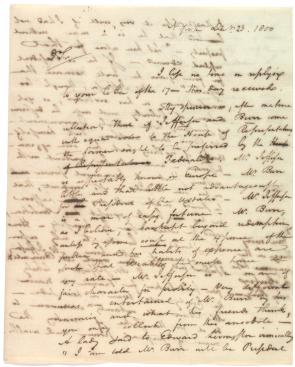
On December 23, 1800, Hamilton wrote to Harrison Gray Otis, a prominent Boston Federalist expressing his fears about Burr’s character and boundless ambition:
Burr loves nothing but himself; thinks of nothing but his own aggrandizement, and will be content with nothing, short of permanent power in his own hands. No compact that he should make with any passion in his breast, except ambition, could be relied upon by himself. How then should we be able to rely upon any agreement with him. Jefferson, I suspect, will not dare much. Burr will dare every thing, in the sanguine hope of effecting every thing.
A digitized image of Hamilton’s original letter to Gray is available via the Gilder Lehrman Collection.
In December 1800, Hamilton wrote to Oliver Wolcott, Jr., President Adams’ Secretary of Treasury (who would resign from the position days later) with the purpose of dissuading him from favoring Burr’s candidacy. Wolcott, Jr. and other Federalists were so opposed to Jefferson’s policies that many saw Burr as a more palatable alternative. Hamilton fiercely resisted this position:
There is no circumstance which has occurred in the course of our political affairs that has given me so much pain as the idea that Mr. Burr might be elevated to the Presidency by the means of the Fderalists. I am of opinion that this party has hitherto solid claims of merit with the public and so long as it does nothing to forfeit its title to confidence I shall continue to hope that our misfortunes are temporary and that the party will ere long emerge from its depression. But if it shall act a foolish or unworthy part in any capital instance, I shall then despair.
Such without doubt will be the part it will act, if it shall seriously attempt to support Mr. Burr in opposition to Mr. Jefferson. If it fails, as after all is not improbable, it will have rivetted the animosity of that person, will have destroyed or weakened the motives to moderation which he must at present feel and it will expose them to the disgrace of a defeat in an attempt to elevate to the first place in the Government one of the worst men in the community. If it succeeds, it will have done nothing more nor less than place in that station a man who will possess the boldness and daring necessary to give success to the Jacobin system instead of one who for want of that quality will be less fitted to promote it.
Let it not be imagined that Mr. Burr can be won to the Federal Views. It is a vain hope. Stronger ties, and stronger inducements than they can offer, will impel him in a different direction. His ambition will not be content with those objects which virtuous men of either party will allot to it, and his situation and his habits will oblige him to have recourse to corrupt expedients, from which he will be restrained by no moral scruples. To accomplish his ends he must lean upon unprincipled men and will continue to adhere to the myrmidons who have hitherto seconded him. To these he will no doubt add able rogues of the Federal party; but he will employ the rogues of all parties to overrule the good men of all parties and to prosecute projects which wise men of every description will disapprove.
These things are to be inferred with moral certainty from the character of the man. Every step in his career proves that he has formed himself upon the model of Catiline, and he is too coldblo[o]ded and too determined a conspirator ever to change his plan.
On December 16, 1800, Hamilton wrote to Wolcott again:
“There is no doubt but that upon every virtuous and prudent calculation Jefferson is to be preferred. He is by far not so dangerous a man and he has pretensions to character.
As to Burr there is nothing in his favour. His private character is not defended by his most partial friends. He is bankrupt beyond redemption except by the plunder of his country. His public principles have no other spring or aim than his own aggrandisement per fas et nefas. If he can, he will certainly disturb our institutions to secure to himself permanent power and with it wealth. He is truly the Cataline of America—& if I may credit Major Wilcocks,he has held very vindictive language respecting his opponents.”
In both letters to Wolcott, Hamilton describes Burr as the Catiline of America, referring to a Roman Senator of the 1st Century BC who attempted to overthrow the Senate and the Roman Republic, but was stopped by Cicero and then exiled.
On December 24, 1800, Hamilton wrote to Gouverneur Morris:
Another subject—Jefferson or Burr?—the former without all doubt. The latter in my judgment has no principle public or private—could be bound by no agreement—will listen to no monitor but his ambition; & for this purpose will use the worst part of the community as a ladder to climb to perman[en]t power & an instrument to crush the better part. He is bankrupt beyond redemption except by the resources that grow out of war and disorder or by a sale to a foreign power or by great peculation. War with Great Brita[i]n would be the immediate instrument. He is sanguine enough to hope every thing—daring enough to attempt every thing—wicked enough to scruple nothing. From the elevation of such a man heaven preserve the Country!
He followed this up with a second letter to Morris two days later on December 26, 1800, stating:
“That on the same ground Jefferson ought to be preferred to Burr.
I trust the Federalists will not finally be so mad as to vote for the latter. I speak with an intimate & accurate knowlege of character. His elevation can only promote the purposes of the desperate and proflicate. ⟨If t⟩here be ⟨a man⟩ in the world I ought to hate it is Jefferson. With Burr I have always been personally well. But the public good must be paramount to every private consideration. My opinion may be freely used with such reserves as you shall think discreet.”
The Program of Exercises Attending the Unveiling of the Statute of Alexander Hamilton, available from US Archives includes the following statement on Hamilton’s life and legacy:
ALEXANDER HAMILTON was born in the island of Nevis, West Indies, on January 1 1, 1757, and died in New York July 12, 1804. At the age of 12 years it was necessary for him to earn his own living as clerk in a counting house at Saint Croix, but his genius being soon recognized funds were raised by his friends to enable him to come to America to finish his education. He arrived here in 1772 and in 1774 entered college where he made a brilliant record as a student. In March, 1776, he secured a commission in the Continental Army and participated in important battles of the Revolution, displaying skill and courage. He also served as aid-de- camp on the staff of Washington. At the close of the war he was but 24 years of age, but was even then considered one of the great men of the day. He was elected to the Continental Congress from New York October 1, 1782, but resigned in 1783 and returned to the practice of law. He took an active part in the preparation of the Constitution of which he was a signer. When Congress in 1789 established a Treasury Department, Washington at once made Hamilton its first Secretary, where his great ability was devoted to organizing the Department and inaugurating a successful national financial policy. The Encyclopedia Americana in its biography of this great public character says “American history presents no more striking character than Alexander Hamilton. He was not popular, nor did he strive after popularity, but after 100 years his name still holds a noble eminence. He lived for the public good. Eloquent and refined, able and brilliant, the embodiment of devotion, integrity and courage, he has left as deep a mark upon our political institutions as any other statesman our country has produced.”
Funds for the statue were raised by the Alexander Hamilton Association, which was established in February 1908 “for the purpose of raising, by public or private subscription, the money necessary to erect a suitable memorial in the form of a monument or statue to perpetuate the memory and commemorate the public achievements of Alexander Hamilton.” The president of the association was Supreme Court Justice John Marshall Harlan, the lone dissenter in the Plessy v. Ferguson case who famously wrote:
“Our constitution is color-blind, and neither knows nor tolerates classes among citizens. In respect of civil rights, all citizens are equal before the law. The humblest is the peer of the most powerful. The law regards man as man, and takes no account of his surroundings or of his color when his civil rights as guaranteed by the supreme law of the land are involved.”
After Justice Harlan’s death, the presidency was taken over by Justice Josiah A. Van Orsdel, who presided over the final unveiling of the statue. Congress appropriated $10,000 for the statute, and the other funds were furnished by the Alexander Hamilton Association and private donors.
The statue is inscribed on three sides. The front inscription reads:
ALEXANDER HAMILTON
1757 — 1804
FIRST SECRETARY OF THE TREASURY
SOLDIER, ORATOR, STATESMAN
CHAMPION OF CONSTITUTIONAL UNION,
REPRESENTATIVE GOVERNMENT AND
NATIONAL INTEGRITY
“He smote the rock of the national resources and abundant streams of revenue gushed forth. He touched the dead corpse of the public credit and it sprang upon its feet.”
By March of 1780, Alexander Hamilton and Elizabeth Schuyler were engaged. The wedding date was set for December of that year, and as Hamilton continued his duties as General Washington’s aide-de-campe, he wrote her several letters expressing his sentiments. Although most of Elizabeth’s friends affectionately called her Eliza, Hamilton referred to her as his Betsey. The letters excerpted below are from the period July 1780 to October 1781, and are all available via the National Archives’ Founders Online.
I love you more and more every hour. The sweet softness and delicacy of your mind and manners, the elevation of your sentiments, the real goodness of your heart, its tenderness to me, the beauties of your face and person, your unpretending good sense and that innocent simplicity and frankness which pervade your actions; all these appear to me with increasing amiableness and place you in my estimation above all the rest of your sex.
July 31, 1780– Because Eliza’s letters have never been found, we don’t know what the back and forth exchange was between the two, but it appears that Hamilton was reassuring Eliza about his feelings for her.
Since my last I have received three letters from you,the sweetest ever dictated by a fond heart. Banish your uneasiness my love; I discard for ever, every idea injurious to your tenderness which every thing convinces me is without an equal but in mine. I have no time to indulge my heart by dwelling on those assurances which it delights to be ever giving you of its admiration, of its esteem of its love. My life shall be a continued proof of the unbounded affection of your
In August of 1780, a few months before they were to be married, Hamilton playfully questioned whether Eliza would be able to handle the challenges of her new uncertain financial situation after the two were married. He asks her to think seriously about whether she can adjust to a lifestyle of financial uncertainty and be satisfied with it even when she sees her friends and acquaintances living far grander lifestyles:
But now we are talking of times to come, tell me my pretty damsel have you made up your mind upon the subject of housekeeping? Do you soberly relish the pleasure of being a poor mans wife? Have you learned to think a home spun preferable to a brocade and the rumbling of a waggon wheel to the musical rattling of a coach and six? Will you be able to see with perfect composure your old acquaintances flaunting it in gay life, tripping it along in elegance and splendor, while you hold an humble station and have no other enjoyments than the sober comforts of a good wife? Can you in short be an Aquileia and chearfully plant turnips with me, if fortune should so order it? If you cannot my Dear we are playing a comedy of all in the wrong, and you should correct the mistake before we begin to act the tragedy of the unhappy couple.
I propose you a set of new questions my lovely girl; but though they are asked with an air of levity, they merit a very serious consideration, for on their being resolved in the affirmative stripped of all the colorings of a fond imagination our happiness may absolutely depend. I have not concealed my circumstances from my Betsey; they are far from splendid; they may possibly even be worse than I expect, for every day brings me fresh proof of the knavery of those to whom my little affairs are entrusted. They have already filed down what was in their hands more than one half, and I am told they go on diminishing it, ’till I fear they will reduce it below my former fears. An indifference to property enters into my character too much, and what affects me now as my Betsey is concerned in it, I should have laughed at or not thought of at all a year ago. But I have thoroughly examined my own heart. Beloved by you, I can be happy in any situation, and can struggle with every embarrassment of fortune with patience and firmness. I cannot however forbear entreating you to realize our union on the dark side and satisfy, without deceiving yourself, how far your affection for me can make you happy in a privation of those elegancies to which you have been accustomed. If fortune should smile upon us, it will do us no harm to have been prepared for adversity; if she frowns upon us, by being prepared, we shall encounter it without the chagrin of disappointment. Your future rank in life is a perfect lottery; you may move in an exalted you may move in a very humble sphere; the last is most probable; examine well your heart. And in doing it, dont figure to yourself a cottage in romance, with the spontaneous bounties of nature courting you to enjoyment. Dont imagine yourself a shepherdess, your hair embroidered with flowers a crook in your hand tending your flock under a shady tree, by the side of a cool fountain, your faithful shepherd sitting near and entertaining you with gentle tales of love. These are pretty dreams and very apt to enter into the heads of lovers when they think of a connection without the advantages of fortune. But they must not be indulged. You must apply your situation to real life, and think how you should feel in scenes of which you may find examples every day. So far My Dear Betsey as the tenderest affection can compensate for other inconveniences in making your estimate, you cannot give too large a credit for this article. My heart overflows with every thing for you, that admiration, esteem and love can inspire. I would this moment give the world to be near you only to kiss your sweet hand. Believe what I say to be truth and imagine what are my feelings when I say it. Let it awake your sympathy and let our hearts melt in a prayer to be soon united, never more to be separated.
On December 14, 1780, Alexander and Eliza were married at the Schuyler Mansion in Albany. Shortly afterwards, Hamilton returned to his post and wrote letters about the pain of being separated from his new wife.
I impatiently long to hear from you the state of your mind since our painful separation. Be as happy as you can, I entreat you, my amiable, my beloved wife. But let not absence deprive me of the least particle of your affection. Always remember those tender proofs I have so frequently given you of mine and preserve for me unabated the only blessing which can make life of any value to me.
Constantly uppermost in my thoughts and affections, I am happy only when my moments are devoted to some office that respects you. I would give the world to be able to tell you all I feel and all I wish, but consult your own heart and you will know mine. What a world will soon be between us!
October 12, 1781– Hamilton chastised Eliza for not writing him enough letters, but then expressed how his annoyance melted away when he thought of the impending birth of his child.
You complain of me my love, for not writing to you more frequently, but have I not greater reason to complain of you? Since I left Kings ferry, I have received three letters from you, that is three in seven weeks. You have no occupations to prevent your writing; I am constantly employed. Yet I am sure I have written to you during that period more than twenty letters. Don’t imagine that this neglect will go unpunished. I hope to see you in three or four weeks from this time, and you may then expect to be called to a severe account. I know you rely upon your power over me. You expect that your usual blandishments will have the usual charm. You think you have only to smile and caress and you will disarm my resentment; but you are mistaken. The crime is of too serious nature to be forgiven; except with one atonement which I am sure it will not be easy for you to make. This is to love me better than ever. If upon deliberate examination you should find this impossible, I may compound for one substitute. You shall engage shortly to present me with a boy. You will ask me if a girl will not answer the purpose. By no means. I fear, with all the mothers charms, she may inherit the caprices of her father and then she will enslave, tantalize and plague one half ⟨the⟩ sex, out of pure regard to which I protest against a daughter. So far from extenuating your offence this would be an aggravation of it.The idea of a smiling infant in my Betseys arms calls up all the father in it. In imagination I embrace the mother and embrace the child a thousand times. I can scarce refrain from shedding tears of joy. But I must not indulge these sensations; they are unfit for the boisterous scenes of war and whenever they intrude themselves make me but half a soldier.




 It's Hamiltime!

