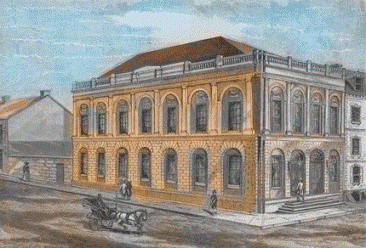
The Bank of New York and the Museum of American Finance

The Bank of New York was the first bank in New York City, founded by Alexander Hamilton and opened on June 9, 1784.  Hamilton was the chief architect of the new bank.  Hamilton wrote the constitution of the bank and was one of the original 13 directors.  He also made the decision that the bank should be based on specie (gold and silver) rather than land.  Hamilton’s constitution was used as the “model upon which all the bank charters granted in New York were framed prior to 1825.”  Hamilton’s voting structure restricted the power of larger shareholders, rather than a one share-one vote scheme.

http://www.nps.gov/ner/hagr/parknews/images/Bank-of-New-York7.gif

In Alexander Hamilton and the Growth of the New Nation, John Chester Miller described Hamilton’s attachment to the Bank he founded:

Hamilton’s concern for the welfare of the Bank of New York cannot be left out of account.  He might have said of the institution that although it was a small bank, there were those who loved it.

By the time Hamilton became Treasury Secretary, he instructed the bank cashier to sell his stocks, despite losing significant profits as the Bank’s stock rose dramatically.  Hamilton felt that the political consequences of having a stake in a bank would compromise his position and eschewed the profitable stocks in favor of maintaining his political reputation.

Currently, the Bank of New York building is home to the Museum of American Finance.  Summer is a great time for museum hopping in NYC and the museum is offering a Groupon deal for 50% off admission!  The museum is located at 48 Wall Street and is open to the public on Tuesday – Saturday, from 10 am – 4 pm..  If you go, make sure to check out the Hamilton Room, focusing specifically on Hamilton’s legacy.

Alexander Hamilton Room
Picture from http://www.moaf.org/exhibits/hamilton/index

Also note, MOAF is hosting a Hamilton vs. Jefferson Debate next Thursday, July 11th from 5:30-7 pm, as part of the Alexander Hamilton Awareness Society’s Celebrate Hamilton 2013 events.  The description of the event from the event flyer is below:

National Hamilton Scholar Dr. William G. Chrystal will become Alexander Hamilton for the evening to both entertain and educate attendees in a “debate” with Thomas Jefferson. After the presentation, a Q&A session will be held, followed by a reception.
Register to attend the debate here.  I’ll be there!

Hamilton’s Views on Race and Slavery: Jay’s Treaty and the Camillus Letters

One of the most unpopular positions that Hamilton took in his political career was his outspoken defense of the Jay Treaty. The provisions of the treaty were made public in the spring of 1795, and chaos erupted in response.   Jeffersonians took up the cry: “Damn John Jay! Damn every one that won’t damn John Jay!  Damn every one that won’t put lights in his windows and sit up all night damning John Jay!!!”

Hamilton risked his popularity, and even his safety to defend Jay’s Treaty.  He was the sole voice to publicly support the treaty amidst a flood of negative sentiment.  In fact, a mob attempted to stone Hamilton at a public meeting in New York for his defense of the treaty.

One specific aspect of Hamilton’s Camillus letters deals with the issue of slavery and natural law.  During the Revolution, the British had issued Lord Dunmore’s proclamation, offering freedom to slaves who left their masters and joined the British army.  According to Michael D. Chan, the actions of the British “infuriated southern slaveholders, especially because many of them were groaning under the weight of debts owed to British citizens.”  These Southerners insisted that any treaty with Britain include a provision for either returning the slaves or compensating the slaveowners for their loss.

File:Jay's-treaty.jpg

However, as Colleen A. Sheehan states: “The Jay Treaty provided for neither restoration of nor compensation for the slaves carried away.  This was a bitter pill for many Americans not only because of financial loss, but because of how the matter had been handled by the British from the state.”

Hamilton addressed the issue in his Camillus letters as follows:

  • IV.—The stipulation relates to “negroes or other property of the American inhabitants”; putting negroes on the same footing with any other article. The characteristic of the subject of the stipulation being property of American inhabitants, whatever had lost that character could not be the object of the stipulation. But the negroes in question, by the laws of war, had lost that character; they were therefore not within the stipulation.Why did not the United States demand the surrender of captured vessels, and of all other movables, which had fallen into the hands of the enemy? The answer is, because common sense would have revolted against such a construction. No one could believe that an indefinite surrender of all the spoils or booty of a seven-years’ war was ever intended to be stipulated; and yet the demand for a horse, or an ox, or a piece of furniture, would have been as completely within the terms “negroes and other property,” as a negro; consequently, the reasoning which proves that one is not included, excludes the other.The silence of the United States as to every other article is therefore a virtual abandonment of that sense of the stipulation which requires the surrender of negroes.
  • V.—In the interpretation of treaties, things odious or immoral are not to be presumed. The abandonment of negroes, who had been induced to quit their masters on the faith of official proclamation, promising them liberty, to fall again under the yoke of their masters, and into slavery, is as odious and immoral a thing as can be conceived. It is odious, not only as it imposes an act of perfidy on one of the contracting parties, but as it tends to bring back to servitude men once made free. The general interests of humanity conspire with the obligation which Great Britain had contracted towards the negroes, to repel this construction of the treaty, if another can be found.

Hamilton’s response to the issue of the British freeing of slaves during the war was nothing short of radical.   Using the framework of the laws of war, Hamilton put forth salient and controversial points relating to the morality of slavery.  Hamilton challenged the idea that freed slaves could be properly grouped with other types of “property” referred to in the treaty.  Additionally, Hamilton called the idea of returning freed slaves to slavery “odious” and “immoral,” despite the fact that slavery was prevalent throughout the Union.

Hamilton’s fearless defense of a treaty he believed in, even at the height of its unpopularity, demonstrates to me Hamilton’s commitment to stand for something, no matter what the personal or political cost.

Read the full Camillus letters here.

Hamilton’s Lighthouses

As Secretary of Treasury, Hamilton worked diligently to create a network of federally funded lighthouses throughout the country.  Hamilton was the first head of the Lighthouse Services.

According to the National Park Service, “on August 7, 1789, President George Washington signed the ninth act of the United States Congress which provided that the states turn over their lighthouses, including those under construction and those proposed, to the central government. In creating the U.S. Lighthouse Establishment, aids to navigation became the responsibility of the Secretary of the Treasury.”

Once the law was passed, Hamilton began the task of placing each existing lighthouse under federal control.  Hamilton also saw the Lighthouse Services as something properly in the domain of his Treasury Department.  He “urged Congress to dispense with dues levied on passing ships, believing the move would encourage commerce and that the Treasury Department could handle the financial responsibility of navigational aids entirely on its own.”

Cape Henry in Virginia was the first new lighthouse built from federal government funds through Hamilton’s program.  In March 1791, the Government signed a contract with John McComb to build and equip a lighthouse for $17,500.  Once the structure was completed, Hamilton and Washington personally handled many of the minute details of selecting light keepers and funding repairs.   Ron Chernow characterizes the process of building lighthouses as “an administrative routine that stifled the two men with maddening minutiae.”  The first lighthouse keeper selected by Washington, William Lewis, was a former soldier in Washington’s army and was hired in October 1792.

The lighthouse below, at Cape Hatteras in North Carolina, was built on a spot that Hamilton passed as a 17-year old on his first journey from the West Indies to New York.  Reportedly, the ship carrying Hamilton, the Thunderbolt, caught fire and nearly sank a few miles away from the cape.  In 1794, Hamilton, who dubbed Diamond Shoals, the “Graveyard of the Atlantic,” recommended establishing a lighthouse on the Hatteras Sand Banks to Congress.  On July 10, 1797, Congress authorized $44,000 for constructing a lighthouse at Cape Hatteras.

During the early years of the American Republic, Hamilton’s work with the Coast Guard and the Lighthouse Services both facilitated commerce and strengthened the power of the federal government.

Cape Hatteras Lighthouse


Images of Hamilton: A New Home for Hamilton Portrait

Earlier, I wrote a post about John Trumbull’s images of Hamilton .   Today, we got some exciting news about one of Trumbull’s most iconic Hamilton portraits!  Credit Suisse, the owner of the portrait,  announced that it will be gifted to two institutions: Crystal Bridges Museum of American Art in Arkansas and the Metropolitan Museum of Art in New York City.  This split ownership arrangement will allow the painting to be seen by audiences in two very different parts of the country.  Credit Suisse had put the painting on view at public institutions for short periods of time, but it decided that the painting should be permanently accessible to the public.  The painting was acquired by Credit Suisse as part of its takeover of another investment bank, DLJ.  The painting had been part of DLJ’s corporate art collection.

CEO Brady Dougan stated:  “Donating this well-known and highly regarded 1792 portrait of Alexander Hamilton by John Trumbull to both Crystal Bridges Museum of American Art and The Metropolitan Museum of Art ensures that the widest possible American and international audiences can enjoy and study this historic piece of fine art for perpetuity”

The New York Times description of the portrait’s history states:

The painting’s history is very much a New York story. In 1791 five New York merchants representing the Chamber of Commerce commissioned Trumbull to paint a full-length portrait of Hamilton, President Washington’s secretary of the Treasury.

For Trumbull the assignment was trickier than it seemed. He and his subject were friends, and Hamilton was vocal in wishing his portrait to appear “unconnected with any incident of my political life.” But the men who commissioned the painting wanted it to hang in a public building. How then could Trumbull please his clients, who said they envisioned a work stately enough to be on public view, and the sitter, who shunned anything remotely official?

Taking his inspiration from European Grand Manner portraiture, the artist posed Hamilton standing, one hand on a table that is empty except for an ink stand and papers, devoid of any political references. In the background is an archway on one side and an architectural column on the other, along with a chair with a robe causally thrown over it.

Hamilton’s warm expression reflects the artist’s obvious affection for his subject. Trumbull called Hamilton’s fatal duel with Aaron Burr in 1804, “the unhappy event which deprived the United States of two of their most distinguished citizens.”

Hamil-Swag: More T-Shirts

Can you ever have too many Hamilton t-shirts?  Happy Monday!

1) Hipster Hamilton from Zazzle

Hipster Hamilton Tshirt

2) Olde School (featuring Henry, Franklin, Jefferson, and Hamilton) from Zazzle

Olde School T-shirt

3) Capitalism Rocks! from Cafe Press

Women's Fitted T-Shirt (dark)

4) AH Quote shirt from Zazzle: Featuring the quote: “A sacred respect for the constitutional law is the vital principle, the sustaining energy of a free government. ”

Alexander Hamilton Quote Shirts

The Romantic Hamilton

In honor of Valentine’s Day, here are some of my favorite snippets of Hamilton’s writing to/about his wife Elizabeth.  Of course, Hamilton wasn’t always the perfect husband- he was away from his family often at the peak of his political career, and he had a much-publicized affair with Maria Reynolds, but :

From a July 2, 1780 letter:

“I love you more and more every hour.  The sweet softness and delicacy of your mind and manners, the elevation of your sentiments, the real goodness of your heart- it’s tenderness to me- the beauties of your face and person- your unpretending good sense and that innocent symplicity and frankness which pervade your actions, all these appear to me with increasing amiableness, and place you in my estimation above all the rest of your sex.”

From an October 1780 letter

“I have told you, and I told you truly that I love you too much. You engross my thoughts too intirely to allow me to think of any thing else. You not only employ my mind all day; but you intrude upon my sleep. I meet you in every dream—and when I wake I cannot close my eyes again for ruminating on your sweetnesses. ‘Tis a pretty story indeed that I am to be thus monopolized, by a little nut-brown maid like you—and from a statesman and a soldier metamorphosed into a puny lover. I believe in my soul you are an inchantress; but I have tried in vain, if not to break, at least, to weaken the charms—you maintain your empire in spite of all my efforts—and after every new one, I make to withdraw myself from my allegiance my partial heart still returns and clings to you with increased attachment.

Among other causes of uneasiness, I dread lest you should imagine, I yield too easily to the barrs, that keep us asunder; but if you have such an idea you ought to banish it and reproach yourself with injustice. A spirit entering into bliss, heaven opening upon all its faculties, cannot long more ardently for the enjoyment, than I do my darling Betsey, to taste the heaven that awaits me in your bosom. Is my language too strong? it is a feeble picture of my feeling:?no words can tell you how much I love and how much I long—you will only know it when wrapt in each others arms we give and take those delicious caresses which love inspires and marriage sanctifies….”

Excerpts from a November 1798 letter:

Indeed, my Betsey, you need never fear a want of anxious attention to you, for you are now dearer than ever to me.  Your happiness is the first and sweetest object of my wishes and cares.  How can it be otherwise?  You are all that is charming in my estimation and the more I see of your sex the more I become convinced of the judiciousness of my choice.

Hamil-Swag: Pop Culture Meets Art Meets Awesome- “American Iconomics”

Check out these super creative renditions of currency with inspiration drawn from the worlds of film, art, and popular culture.  These images were created by artists Akira Beard and James Charles as part of a 2011 show at the Shooting Gallery in San Francisco entitled: American Iconomics.   Some of these awesome pieces are still on sale, for $600 a piece.  You should check out the full collection of images here– you’ll find Andrew Jackson as Ronald McDonald, Ulysses S. Grant as Mr. T, and other awesome iconic images.

Here are my favorite Hamilton images from the show.

Willy Wonka (coincidentally one of my favorite movies)- Hamilton as Wonka and a very distinguished Oompa Loompa

Star Wars– Yoda and Princess Leia

Akira Beard and James Charles : James Charles

Akira Beard and James Charles : James Charles

Van Gogh

Johnny Cash

Akira Beard and James Charles : James Charles

Note: all images were taken from the Shooting Gallery American Iconomics site.

Hamilton’s Views on Race and Slavery: The New York Manumission Society

Following the American Revolution, the issue of slavery came into focus for many Northerners.  The rhetoric of slavery and liberty had been used frequently during the Revolution, but in its aftermath, the protection property rights and the maintenance of existing state economies, particularly in the South, prevented any full-scale national movements towards abolition.  In this landscape, the state of slavery in the Northern states became more contentious.  Robin Blackburn describes the importance of New York in the slave landscape:

New York and New Jersey “together accounted for three quarters or all slaves outside of the South,” and slavery in both states “survived constitutional and legislative challenges in the revolutionary and immediate post-revolutionary period.”

On February 4, 1785, the New York Manumission Society was formed.  Historian Catherine O’Donnell Kaplan characterized the Society as “the site of concerted efforts to unite dreams of human perfectibility to the practical labor of effecting change.”  Hamilton was the first vice president and his friend and fellow Federalist John Jay was the first president, staying in that office for five years.  Hamilton served as president for one year in 1788 before moving to Philadelphia to take up his position as Secretary of the Treasury.

The Quaker Friends Society newsletter recounted a 1786 petition that Jay, Hamilton, and other members of the society sent to New York that began:

“Your memorialists being deeply affected by the situation of those, who, although free by the laws of God, are held in slavery by the laws of the state…”

The stated goals of the Society were noble, but they were also decidedly moderate- limited to the state of New York and reflecting the fact that many of the founders of the organization were slaveholders:

“1st to effect, if possible, the abolition of slavery in this state, by procuring gradual legislative enactments; 2dly to protect from a second slavery such persons as had been liberated in the state of New York, or elsewhere, and who were liable to be kidnapped, and sold to slave dealers in other places; and 3dly to provide means for educating children of color of all classes.”

While Hamilton consistently supported the Society and was an active member whenever he was living in New York, he also pushed its members to points of discomfort by proposing more radical plans for abolition than many of his fellow members were comfortable with.  For example, Ron Chernow describes the 1785 proposal of the Society’s ways-and-means committee headed by Hamilton to require members to commit to freeing some of their own slaves immediately, and younger slaves within 5 years.  Hamilton’s proposal would have caused financial harm to members, and was quickly rejected as being too sudden.

The 2004 Senate Concurrent Resolution 123– Recognizing and Honoring the Life and Legacy of Alexander Hamilton on the Bicentennial of His Death Because of His Standing as One of the Most Influential Founding Fathers of the United States notes:

“…as a private citizen Alexander Hamilton served many philanthropic causes and was a co-founder of the New York Manumission Society, the first abolitionist organization in New York and a major influence on the abolition of slavery from the State…Alexander Hamilton was a strong and consistent advocate against slavery and believed that Blacks and Whites were equal citizens and equal in their mental and physical faculties.”

Hamilton lived to see New York embark on a path of very slow, gradual abolition, as Pennsylvania had done earlier.  In 1788, the slave trade was abolished and aspects of the slave code were softened.  In 1799, the legislature passed An Act for the Gradual Abolition of Slavery,  which “allowed masters to keep their younger slaves in bondage for their most productive years, to recoup their investment. The law freed all children born to slave women after July 4, 1799, but only after they had reached their mid-twenties.  Hamilton’s bolder vision of emancipation was never reached, but the efforts of the New York Manumission Society were instrumental in building acceptance of a free, multicultural society to New York.

Hamilton on Jury Nullification

Jury nullification, or the ability of a jury to find a defendant not guilty because they disagree with law has been an important part of American history, and was successfully used by both William Penn and John Peter Zenger against British laws in the pre-Revolution period.  The most influential instance of jury nullification was in the 1735 trial of John Peter Zenger, who was charged with printing seditious libels against the British government of New York.  Under the law in the colonies, truth was not a defense to libel (the same law that Hamilton argued against in the Croswell case).  Zenger’s lawyer, Andrew Hamilton (no relation to Alexander) urged the jury to reach their own conclusions about the legal issue, notwithstanding the judge’s firm instruction.  The jury did so and acquitted Zenger completely, much to the chagrin of the British government.

In the Croswell case, Hamilton argued the case on behalf of a publisher who was charged with libel for publishing information about Thomas Jefferson.  Under the laws of New York at the time, libel was a crime regardless of the truth of the statement.  However, Hamilton argued that this interpretation of the law was incorrect and unethical.  Hamilton’s outline is interesting, both because of the points about libel and because of its focus on the jury’s responsibility to follow their conscience rather than the letter of the law.

Hamilton’s entire brief outline is below, with the passages about the power of the jury bolded :

I.—The liberty of the press consists in the right to publish with impunity truth, with good motives, for justifiable ends, though reflecting on government, magistracy, or individuals.
II.—That the allowance of this right is essential to the preservation of free government—the disallowance of it, fatal.
III.—That its abuse is to be guarded against by subjecting the exercise of it to the animadversion and control of the tribunals of justice; but that this control cannot safely be intrusted to a permanent body of magistracy, and requires the effectual co-operation of court and jury.
IV.—That to confine the jury to the mere question of publication and the application of terms, without the right of inquiry into the intent or tendency, referring to the court the exclusive right of pronouncing upon the construction, tendency, and intent of the alleged libel, is calculated to render nugatory the function of the jury; enabling the court to make a libel of any writing whatsoever, the most innocent or commendable.
V.—That it is the general rule of criminal law, that the intent constitutes the crime, and that it is equally a general rule that the intent, mind, or quo animo, is an inference of fact to be drawn by the jury.
VI.—That if there are exceptions to this rule, they are confined to cases in which not only the principal fact, but its circumstances can be and are specifically defined by statute or judicial precedent.
VII—That in respect to libel there is no such specific and precise definition of facts and circumstances to be found, that consequently it is difficult, if not impossible, to pronounce that any writing is per se and exclusive of all circumstances libellous; that its libellous character must depend on intent and tendency, the one and the other being matter of fact.
VIII.—That the definitions or descriptions of libels to be found in the books predicate them upon some malicious or mischievous intent or tendency, to expose individuals to hatred or contempt, or to occasion a disturbance or breach of the peace.
IX—That in determining the character of a libel, the truth or falsehood is in the nature of things a material ingredient, though the truth may not always be decisive, but being abused, may still admit of a malicious and mischievous intent which may constitute a libel.
X—That in the Roman law, one source of the doctrine of libel, the truth in cases interesting to the public, may be given in evidence. That the ancient statutes probably declaratory of the common law, make the falsehood an ingredient of the crime. That ancient precedents in the courts of justice correspond, and that these precedents to this day charge a malicious intent.
XI.—That the doctrine of excluding the truth as immaterial originated in a tyrannical and polluted source, the court of Star Chamber, and that though it prevailed a considerable length of time, yet there are leading precedents down to the Revolution, and even since, in which a contrary practice prevailed.
XII.—That this doctrine being against reason and natural justice, and contrary to the original principles of the common law enforced by statutory provisions, precedents which support it deserve to be considered in no better light than as malus usus which ought to be abolished.
XIII.—That in the general distribution of powers in our system of jurisprudence, the cognizance of law belongs to the court, of fact to the jury; that as often as they are not blended, the power of the court is absolute and exclusive. That in civil cases it is always so, and may rightfully be so exerted. That in criminal cases the law and fact being always blended, the jury, for reasons of a political and peculiar nature, for the security of life and liberty, is intrusted with the power of deciding both law and fact.
XIV.—That this distinction results: 1, from the ancient forms of pleading in civil cases, none but special pleas being allowed in matter of law; in criminal, none but the general issue; 2, from the liability of the jury to attaint in civil cases, and the general power of the court as its substitute in granting new trials, and from the exemption of the jury from attaint in criminal cases, and the defect of power to control their verdicts by new trials, the test of every legal power being its capacity to produce a definitive effect liable neither to punishment nor control.
XV.—That in criminal cases, nevertheless, the court are the constitutional advisers of the jury in matter of law; who may compromit their conscience by lightly or rashly disregarding that advice, but may still more compromit their consciences by following it, if exercising their judgments with discretion and honesty they have a clear conviction that the charge of the court is wrong.

Jury nullification, and the influence of the jury as an institution has been on the decline.  Currently, less than 1% of criminal and civil cases actually go before a jury.  Courts routinely tell juries that they have no power to disregard or interpret the law.  This discouragement makes sense in most cases: after all, allowing juries to decide cases purely on their emotions can lead to irrational appeals and decisions made from bias.  While jury nullification may help protect defendants from unfair laws, it may also have the unwanted effect of empowering community biases and racism.

However, despite these concerns, Hamilton’s vision of the jury and their power of conscience is a powerful one.

The Economist Blog  ran a story last year about the continuing right of nullification:

Juries do not only decide guilt or innocence; they can also serve as checks on unjust laws. Judges will not tell you about your right to nullify—to vote not guilty regardless of whether the prosecution has proven its case if you believe the law at issue is unjust. They may tell you that you may only judge the facts of the case put to you and not the law. They may strike you from a jury if you do not agree under oath to do so, but the right to nullify exists. There is reason to be concerned about this power: nobody wants courtroom anarchy. But there is also reason to wield it, especially today: if you believe that nonviolent drug offenders should not go to prison, vote not guilty.

New Hampshire passed a law last June that went into effect on January 1, 2013.  This law states:

“[A] Right of Accused. In all criminal proceedings the court shall permit the defense to inform the jury of its right to judge the facts and the application of the law in relation to the facts in controversy.”

Notwithstanding the New Hampshire legislation, the overwhelming trend of cases across the country is to limit jury nullification and discharge jurors who openly state they disagree with the law.  While this may maintain uniformity and a sense of law and order, I wonder if there should still be a place for Hamilton’s vision, in instances where jurors fundamentally feel that the law creates unjust results.

Hamil-Swag: Hamilton + Superheroes = Awesome

Aslan Malik, a German artist, has come up out with a Justice League 2013, featuring a currency redesign.  The project takes the bill designs and re-envisions them as comic book characters.  Hamilton is Batman, Lincoln is Flash, Franklin is the Green Lantern, and Andrew Jackson is Wonder Woman.  I’m a huge comic book/superhero fan (although Spider-Man is my favorite, and he is not a DC character and therefore is not part of the Justice League universe..note to Aslan- I bet Hamilton would make a convincing Spider-Man).

Check out the rest of Malik’s designs here.

And for comparison, here’s the Justice League: