Hamilton and the Fiscal Cliff

On Friday, Scott Bomboy at Constitution Daily published an interesting piece on how Alexander Hamilton would view the debt ceiling.  He generally describes the financial crisis that Hamilton faced when he took over the Treasury Department and how he accomplished his almost impossible mission to pull the new republic out of financial oblivion, create a national debt, and ensure that the new nation develop good credit.

Bomboy describes the odds stacked against Hamilton and America’s economic success:

In 1789, when President Washington took office, the United States was broke; it had about $75 million to $80 million in public debt; and it wasn’t in a position to trade well in a global economy.

The United States’ economic problems after the Revolution were a direct impetus to call the Constitutional Convention of 1787, where delegates from 12 states met in Philadelphia to overhaul the Articles of Confederation and give the new nation a sound political and economic footing.

In addition, Hamilton single-handedly faced two powerful political opponents from Virginia who were opposed to his policies: future presidents Thomas Jefferson and James Madison.

So in comparison to the current financial situation in Washington, Hamilton seems to have been in a much tougher spot in 1789.

Hamilton’s approach to fixing these epic problems was that the government of the United States had to possess excellent credit, before anything else could happen. Getting there would be a monumental task, since the nation had virtually no credit in 1789, despite its abundant resources.

Simon Johnson and James Kwak published an interesting analysis of Hamilton’s success and how it compared to the debt ceiling debate in the Vanity Fair article Debt and Dumb

In just five years, Hamilton—with Washington’s support—had laid the foundation of American fiscal policy. The federal government would always honor its debt. After the War of 1812, the Civil War, World War I, and World War II, this principle remained unquestioned. By the late 19th century, the government could raise large amounts of money on short notice—which made possible, among other things, rapid mobilizations to fight two World Wars.

Government bonds also became a crucial part of the financial system—the paradigmatic global risk-free asset, the universally accepted collateral on which everything else depends. What makes those bonds as good as cash is that the federal government has the power to levy and collect taxes in order to pay them off.

Hamilton’s scheme has succeeded at a scale unimaginable in 1790. Elsewhere, we have questioned Hamilton’s affection for large, powerful banks, but his contribution to American fiscal policy is undisputed. The good credit of the federal government has allowed us to amass trillions of dollars of debt, run the largest peacetime deficits in history, and still borrow money at historically low interest rates. But that has not made everyone happy.

Several authors have recently written about Hamilton and the debt ceiling, including the New York Times

Here are some of Hamilton’s words in Federalist No. 30, about the need for a country to demonstrate that it could credibly return loans:

In the modern system of war, nations the most wealthy are obliged to have recourse to large loans. A country so little opulent as ours must feel this necessity in a much stronger degree. But who would lend to a government that prefaced its overtures for borrowing by an act which demonstrated that no reliance could be placed on the steadiness of its measures for paying? The loans it might be able to procure would be as limited in their extent as burdensome in their conditions. They would be made upon the same principles that usurers commonly lend to bankrupt and fraudulent debtors, with a sparing hand and at enormous premiums.

At the same time, Hamilton was a firm believer that we needed some form of a national debt in order to grow as a nation, as he stated in his April 30, 1781 letter to James Duane.

A national debt, if it is not excessive, will be to us a national blessing. It will be a powerful cement of our Union. It will also create a necessity for keeping up taxation to a degree which, without being oppressive, will be a spur to industry, remote as we are from Europe, and shall be from danger. It were otherwise to be feared our popular maxims would incline us to too great parsimony and indulgence. We labor less now than any civilized nation of Europe; and a habit of labor in the people is as essential to the health and vigor of their minds and bodies, as it is conducive to the welfare of the state. We ought not to suffer our self-love to deceive us in a comparison upon these points.

All Things Hamilton has a more comprehensive list of Hamilton’s quotes on the national debt.  I feel that the issue is a key one for our time, but is also one in which interpretation of Hamiltonian philosophy can take us in different directions.

January 11th- Happy Birthday Hamilton!

Today, January 11th, marks Alexander Hamilton’s 256th (0r 258th) birthday!

I find it amazing to think about where Hamilton came from and what he accomplished.   Hamilton was born in Nevis, 1,3000 miles from New York and worlds away.  He was born out of wedlock at a time where illegitimacy was considered a moral failing, and was shunned by other children because of his status.   Hamilton’s father James became bankrupt and abandoned the family.  Hamilton’s mother died of yellow fever in 1768, and the Hamilton brothers were taken in by a cousin, Peter Lytton, who committed suicide 17 months later.   Hamilton had all the odds stacked against him, but with a combination of brilliance and luck, he not only made his way to America, he helped make America.


Hamilton’s own words in Federalist No. 36 seem fitting:

“There are strong minds in every walk of life that will rise superior to the disadvantages of situation, and will command the tribute due to their merit, not only from the classes to which they particularly belong, but from the society in general. The door ought to be equally open to all…”


If you happen to be in either Nevis or New York, check out the birthday events that the AHA Society has organized.  The events include a blessing at Trinity Church, a simultaneous cake cutting in New York and Nevis, and events at Hamilton Grange and the Museum of American Finance.  Looks like a great program.

Images of Hamilton: Alexander Hamilton Memorial Statue in Chicago

If you’ve visited Chicago, you may have noticed a gilded statue of Alexander Hamilton in Lincoln Park.

The sculpture was commissioned by Chicago heiress Kate Sturgis Buckingham and designed by British sculptor John Angel.    Kate was the daughter of Ebenezer Buckingham, who made his fortune in grain elevators.   She never married and devoted her time to philanthropy and public art projects for the city, including the famous Buckingham Fountain.

Time Magazine stated in a 1951 article that Buckingham had “two consuming interests: art and Alexander Hamilton.”  Buckingham considered Hamilton “one of the least appreciated great Americans.”  She felt that “Hamilton had secured the nation’s financial future, making it possible for her own family to make a fortune.”   Prior to her death, Hamilton commissioned the statue from Angel and envisioned a massive setting.  She commissioned artist Eliel Saarinen to design a massive, 80 foot column to go behind the statue.  However, this proposal was not well-received and the setting was never completed.

Saarinen’s proposal (courtesy of Flickr user Chernobyl.Skies):

Buckingham died in 1937 before the statue was completed, but she left $1 million in her will to the Art Institute specifically to create and maintain the Hamilton Memorial.  The Art Institute trustees were not particularly keen to complete the work according to Buckingham’s vision, and Buckingham’s trustees eventually had to take them to court in 1951 to have the statue and setting completed.  The court ordered the completion of the monument by 1953, and the Art Institute commissioned Samuel A. Marx to create the setting.  

Original memorial with setting created by Marx (from the Art Institute of Chicago):

The statue stood like this for 40 years, but then engineering studies revealed design flaws in the setting.  The setting was demolished in 1993, and the statue has stood in its current form since then.  If you go to Lincoln Park today, this is what you’ll see:

Hamilton Statue in Chicago

For a more detailed description of the history of the Chicago memorial from an architectural point of view, see Andrew Raimist’s blog, Architectural Ruminations.  And for more images of Hamilton, check out the AHA Society’s Hamilton desk calendar.

Happy New Year!

Happy New Year from It’s Hamiltime!  Apologies for the long posting hiatus- work and the holidays have been pretty busy!  Thanks so much for reading this blog since I started it.  I have some big plans for 2013, including upcoming posts on Hamilton and the fiscal cliff, more installments in the race and slavery series, and more!

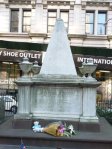
As we go into 2013, I was thinking about what I want to accomplish in the new year, and it brought to mind Hamilton’s headstone at Trinity Church

14246_808941273074_7595730_n

The PATRIOT of incorruptible INTEGRITY
The SOLDIER of approved VALOR
The STATESMAN of consummate WISDOM
Whose TALENTS and VIRTUES will be admired
Long after this MARBLE shall have mouldered into
DUST

Incredible accomplishments in just 47 years…

Hamilton and Gates: Hamilton’s “Valley Forge” Moment

The end of 1777 was both an exciting and dark time for Hamilton.  As Washington’s aide, Hamilton was exposed to the darker side of the Continental Congress.  He also experienced the struggle of American soldiers and foreign allies against a bitter winter with limited supplies.  Hamilton found this period, when the American victory was far from certain and when factions within Congress and the Continental Army were turning against General Washington, to be extremely frustrating.  However, the lessons he learned in this time shaped his political philosophy and his distrust of some of the institutions of the pre-Constitution government.

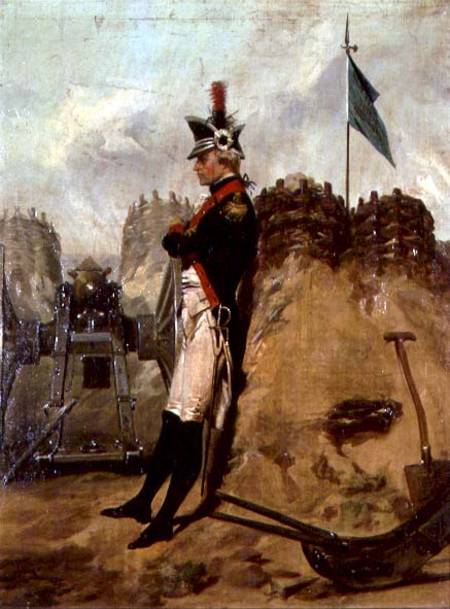
File:Alexander Hamilton 1757 1804 hi.jpg

Alexander Hamilton in the Uniform of the New York Artillery” by Alonzo Chappel (1828-1887)

In November 1777, a month before the planned moved to the Valley Forge encampment, Washington sent Hamilton on a sensitive diplomatic mission to General Horatio Gates.  Washington wanted Hamilton to borrow a “sizable body of troops” for an attack upon British forces in New York or Philadelphia.   Washington trusted Hamilton’s discretion and gave his young aide a tremendous amount of power.  Washington gave a letter to Hamilton to show Gates, which laid out “the absolute necessity that there is for [Gates] detaching a very considerable part of the army at present under [Gates’s] command.”  However, Gates had no intention of cooperating with Washington. Prior to Hamilton’s arrival, Gates had won a series of important battles, culminating in the September and October 1777 battles at Saratoga in which he defeated British General John Burgoyne.  As Gates grew more famous, Washington suffered a series of defeats and struggled to hold major cities.  Gates was entrenched as the hero of the Eastern States while Washington was being criticized for his inability to protect the North.

Nineteenth Century historian John William Wallace sets this scene:

“In short,  it could not be reasonably doubted that Gates, who of necessity, was sufficiently acquainted with the great need which Washington had of reinforcements, meant to retard as much as possible the possession by him of such knowledge concerning operations as the North as would authorize a second demand by him for reinforcements for the benefit of Fort Mifflin.  The matter could no longer be trifled with, and on the 30th of October 1777…Washington…send the man whose wonderful ability he early discovered and ever confided in–Alexander Hamilton, then at the age of twenty years–direct to the new-made hero of the North, with instructions, obviously of a very strong kind, and which Hamilton omitted to carry out in their full extent only from a conviction of the power and malignity of the cabal–to forward an immediate reinforcement from the northern army.”

In a letter to Washington upon his arrival in Albany, Hamilton described his first encounter with Gate:

 “I arrived here yesterday, at noon, and waited upon General Gates immediately, on the business of my mission ; but was sorry to find his ideas did not correspond with yours for drawing off the number of troops you directed. I used every argument in my power to convince him of the propriety of the measure ; but he was inflexible in the opinion, that two brigades, at least, of Continental troops should remain in and near this place.

….

…all I could effect, was to have one brigade despatched, in addition to those already marched. I found myself infinitely embarrassed, and was at a loss how to act. I felt the importance of strengthening you as much as possible ; but, on the other hand, I found insuperable inconveniences in acting diametrically opposite to the opinion of a gentleman, whose successes have raised him into the highest importance.”

Given Gates’s hero status in the East, Hamilton felt that any attempt he made to strong-arm Gates on Washington’s behalf would result in an embarrassment for Washington because it would not be enforced.  In fact, such an attempt could further weaken Washington’s position as commander-in-chief.

Imagine Hamilton’s frustration!  Gates’s refusal to supply Washington with troops at a critical moment was characterized by Wallace as a major cause in the fall of Fort Mifflin the same month.

Wallace stated:

“No reinforcements ever came in time to be of value in saving Fort Mifflin- it fell on the night of the 15th of November….The delay in the arrival of certain of the troops was owing to the imbecility of General Putnam; but there is no ground to suppose that it was his purpose to cause the fall of the fort.  Had Gates wished to aid Washington there would have been little trouble in the case.  But if Washington could drive Howe from Philadelphia and reduce him to where General Burgoyne was, what became of the immeasurable superiority of Gates what of the sublime wisdom which characterized Conway and his fellow-conspirators in their estimate of Washington?  They all had, therefore, a specific problem to prove, and that Fort Mifflin should fall was a necessary thing to get their Q.E.D.  IT did fall, as Gates intended that it should.”

After Hamilton returned from his meeting with Gates, he fell violently ill and had to take bedrest for a few weeks before he joined Washington at Valley Forge for the rest of the winter.  Hamilton’s experience trying to push Congress to provide supplies for the hungry, weary, and cold soldiers stationed there shaped his frustration with Congress and his view that an energetic central government, rather than a confederacy of states was required to maintain stability.  (More on this soon!)

I think of Hamilton’s struggle with Gates as a “Valley Forge” moment, a moment of adversity and embarrassment, that ultimately made him more attuned to the political machinations around him and ultimately contributed to his political beliefs.

Images of Hamilton: John Trumbull

[Note: I am certainly no art historian, but I very much appreciate images of Hamilton as you can tell by my Facebook group: Alexander Hamilton: The Hotness Never Dies.  I’m going to use this series to focus on a few of the painters and sculptors who depicted Hamilton, and show some of the images of Hamilton I think do him the most justice.]

The Sierra Star recently published a piece on John Trumbull entitled “A Revolutionary Painter.”   Trumbull was an active participant in the revolution, and a military comrade of Hamilton.  He briefly served as an aide to Washington, and was involved in politics as he pursued his artistic career.  Trumbull produced some of the most iconic images of the Revolution and the Early Republic.  Trumbull painted several pictures of Hamilton, and featured him prominently in his group paintings of the Constitutional Convention and the Revolutionary War. 

Interestingly, Trumbull dined with both Hamilton and Burr on July 4, 1804.   In his autobiography, Trumbull recollected the event:

“On the 4th of July, I dined with the Society of the Cincinnati, my old military comrades, and then met, among others Gen. Hamilton and Col. Burr.  The singularity of their manner was observed by all, but few had any suspicion of the cause. Burr, contrary to his wont, was silent, gloomy, sour ; while Hamilton entered with glee into all the gaiety of a convivial party, and even sang an old military song.  A few days only passed, when the wonder was solved by that unhappy event which deprived the United States of two of their most distinguished citizens.”

Trumbull had planned to pursue his career in Boston, but found that the market for his services was too crowded by other artists.  He instead returned to New York, and was commissioned by the city government to paint whole length portraits of Jay and Hamilton.  Trumbull states that he created the portrait using the bust created by Ceracchi (and later bought by Jefferson to display in Monticello) as inspiration for those portraits.

This was painted in 1805, the year after Hamilton’s death, and Trumbull used various accumulated drawings as its basis.  This portrait is the basis for the design of the Ten Dollar bill. 

By John Trumbull, 1805. Courtesy National Portrait Gallery, Smithsonian Institute, Washington, DC 

(The best bill!  Image found here)

This 1792 portrait has Hamilton standing at his desk “an inkwell with quill at hand-the heroic pose of a writer and thinker at the pinnacle of his career.”

This 1832 portrait was copied from an original that Trumbull had painted in Washington in 1792. 

From the Yale University Art Gallery eCatalogue

Trumbull is an interesting historical figure in his own right.  If you’re interested in reading more about him, I suggest looking at his Autobiography or John Trumbull : a brief sketch of his life, to which is added a catalogue of his works (1901) by John Ferguson Weir.

Hamilton on His Son

I wrote earlier about Philip Hamilton’s untimely death at age 19 in a duel at the Weehawken Dueling Grounds.  I came across this letter from Hamilton to his friend Richard Kidder Meade, dated August 27, 1782, describing his seven month old son.

“You reproach me with not having said enough about our little stranger.  When I wrote last I was not sufficiently acquainted with him to give you his character…He is truly a very fine young gentleman, the most agreeable in his conversation and manners of any I ever knew–nor less remarkable for his intelligence and sweetness of temper.  You are not to imagine by my beginning with his mental qualifications that he is defective in personal.  It is agreed on all hands, that he is handsome, his features are good, his eye is not only sprightly and expressive but it is fully of benignity.  His attitude in sitting is by connoisseurs esteemed graceful and he has a method of waving his hands that announces the future orator.  He stands however rather awkwardly and his legs have not all the delicate slimness of his fathers.  It is feared He may never excel as much in dancing which is probably the only accomplishment in which he will not be a model.  If he has any fault in manners, he laughs too much.  He has now passed his Seventh Month.”

And here’s an illustration of Hamilton and his son from Tumblr

Hamilton’s Views on Race and Slavery: The Haitian Revolution

Haiti has a tumultuous and fascinating history, and was the focus of a clash of opinions between Jefferson and the Federalists from 1799-1806. Hamilton supported the Haitian revolution and the government established under Toussaint L’Ouverture, a former slave. He helped draft Haiti’s constitution and advocated open trade with the new nation. On the other hand, Jefferson and his southern constituency were horrified by the idea of a free black republic.

Haiti was first discovered and conquered by Columbus and claimed for the Spanish as Hispaniola in 1492. The Spanish used it as a trading port and maintained control of the island until 1625, when the Spanish lost control due to Dutch resistance and retreated from most of the island. The French began establishing their presence on the island in the 1620s and in 1664, the French West India Company claimed the western part of the island. The French began to import large numbers of African slaves and set up a plantation economy focused on the production of sugar and coffee. Slave rebellions were frequent because of brutal conditions, so in 1685, King Louis XIV enacted the Code Noir, which served as the basis of the law of slavery in Saint- Domingue and the other French plantation colonies. Although the Code Noir legalized manumission of slaves and provided some rights for free blacks, it also created “a rigorously punitive scheme for the discipline of slave labor.” As time passed, the government began to pass laws restricting the rights of the large free black population, the gens de couleur. The combination of oppression towards slaves and towards the free black population created a tinderbox situation. In 1789, Vincent Ogé, a wealthy member of the gens de couleur petitioned the colonial government for equal rights for free people of color in Haiti. When his demands were rejected, he tried to lead an uprising, but was unsuccessful. In 1791, more slave rebellions occured, and successfully overthrew the government. Toussaint L’Ouverture emerged as the leader of the movement and the unofficial leader of the government. France officially ended slavery in its colonies in 1794, prompting L’Ouverture to support the French against the Spanish. Then, the British attempted to invade the island, but L’Ouverture drove them out in 1798 and took control of the government.

Now, the American government had to decide what to do with this new, unique political situation of slaves rebelling and actually controlling the government and military.

In Nation Among Nations, Thomas Bender describes the Haiti debate:

“Haiti heightened the partisan division. Much of the debate over American policy towards Haiti was framed within the larger debate between France and Britain, as Britain maneuvered to take advantage of troubles on the island. But, as Linda Kerber has observed, the debate about foreign policy “kept sliding into the subject of slavery.” When Federalists talked about the profits of trade, southern Republicans- Jefferson’s core constituency- saw only the question of American recognition of a black republic.”

Ted Widmer states: Under the Washington and Adams administrations, “a policy of quiet indifference [towards Haiti] gradually turned into commercial and even military support– support without which it would have been impossible for the experiment in black democracy to survive. ”

Hamilton understood the complicated political landscape surrounding the decision and on February 9, 1799 wrote:

…as in every thing else, we must unite caution with decision. The United States must not be committed on the independence of St. Domingo. No guaranty—no formal treaty—nothing that can rise up in judgment. It will be enough to let Toussaint be assured verbally, but explicitly, that upon his declaration of independence a commercial intercourse will be opened, and continue while he maintains it, and gives due protection to our vessels and property. I incline to think the declaration of independence ought to precede.

In June 1799, Adams issued a proclamation regarding Commerce with St. Domingo and allowed US ships to trade with Haiti. Hamilton worked closely with his friend and Adams’ Secretary of State, Timothy Pickering to develop this support. While some historians have inaccurately characterized this collaboration as occurring behind Adams’ back, Adams was in fact fully aware of these events and told Pickering that the negotiations with L’Ouverture “enjoyed his fullest approbation.” Hamilton was impressive in his “active sympathy for Haiti.” Hamilton and Pickering worked to have Hamilton’s close boyhood friend Edward Stevens deployed as Consul General of the United States at Cape-Francais in 1799. Hamilton also drafted the Haitian Constitution.

However, when Jefferson came to power, he immediately tried to recalled Stevens and embargoed trade with Haiti. As Bender states:

“Unlike Adams, [Jefferson] was widely recognized for his support of revolutions, even the French one. In defense of its turn to violence, he observed that ‘the tree of liberty must be refreshed from time to time with the blood of patriots and tyrants.’ But was what tolerable in Paris was not so in Cap Haitien. The revolution there terrified Jefferson.”

Jefferson’s complete resistance to the events in Haiti was a direct product of his racism and his desire to help his constituents maintain a slave system in the South. He feared that the example of a black republic would encourage resistance in the South. Ironically, the Louisiana Purchase was made possible only because Napoleon’s defeat in Haiti made a French empire in America pointless. Henry Adams described the acquisition of that territory and the prevention of French invasion as a debt owed by the American people “to the desperate courage of five hundred thousand Haytian negroes who would not be enslaved.” Clearly, Jefferson never saw it that way. After Hamilton’s death, American foreign policy became increasingly proslavery, and in 1806, a stiff embargo was placed on Haitian trade. Napoleon captured Toussaint L’Ouverture, who died in captivity. For a complete background of the Haitian revolution and the response of the Founding Fathers, see Gordon S. Brown’s Toussaint’s Clause: The Founding Fathers and the Haitian Revolution.

Hamil-Swag: Clothes

1) Children’s Alexander Hamilton Costume: aka how I will dress my future child.  Available from Buffalo Breath Costumes.

Click here to view larger image

2) T-Shirts: Cafe Press and Zazzle have a variety of designs to choose from.  My friend Morgan had a Hamilton shirt custom made for me, which was awesome.  Here are some of my favorites:

     – Foxiest of the Federalists (from Zazzle)

Alexander Hamilton- Foxiest of the Federalists T-shirt

– I ❤ Alexander Hamilton (Cafe Press has several color and design options)

Shirt

3) Baseball Cap- “In my previous life I was Alexander Hamilton.”

PL Alexander Hamilton Baseball Cap

Feel free to chime in with your favorite Hamil-Swag clothing!

Hamilton’s Views on Race and Slavery: Enlisting Black Soldiers in the Continental Army

In a March 14, 1779 letter to John Jay, then-president of the Continental Congress, Hamilton advocated a proposal to raise three or four battalions of black soldiers.  This was a project that Hamilton and his friend and fellow abolitionist John Laurens came up with together, and John Laurens delivered the letter to Jay.  In the letter, Hamilton stated:

The contempt we have been taught to entertain for the blacks, makes us fancy many things that are founded neither in reason nor experience; and an unwillingness to part with property of so valuable a kind will furnish a thousand arguments to show the impracticability or pernicious tendency of a scheme which requires such a sacrifice. But it should be considered, that if we do not make use of them in this way, the enemy probably will; and that the best way to counteract the temptations they will hold out will be to offer them ourselves. An essential part of the plan is to give them their freedom with their muskets. This will secure their fidelity, animate their courage, and I believe will have a good influence upon those who remain, by opening a door to their emancipation. This circumstance, I confess, has no small weight in inducing me to wish the success of the project; for the dictates of humanity and true policy equally interest me in favour of this unfortunate class of men.

In the book Black Patriots and Loyalists, Alan Gilbert describes the role of black soldiers in both the Loyalist and patriot cause.  The British actively recruited black soldiers, with Lord Dunmore’s November 1775 proclamation.  The proclamation stated that all indentured servants and slaves “free” who were “able and willing to wear arms.”  While black soldiers had been part of the colonial militias, Washington had refused to accept them into the official Continental Army.  However, Lord Dunmore’s proclamation prompted Washington’s decision to finally accept black soldiers in the army on December 31, 1775.  In 1781, during the Battle of Yorktown, when Hamilton was commanding a battalion of troops under Lafayette, Lieutenant Colonel de Gimat’s battalion was composed of a majority of black soldiers.

According to the Freedom Trail Foundation:

By 1779, 15% of the Continental Army and colonial militias were made of men of African decent. They saw action in every single major battle including Ticonderoga, Monmouth, Valley Forge, Princeton, and Washington’s Delaware crossing.

Despite the opposition of his contemporaries, and Washington’s initial refusal, Hamilton and Laurens persisted in advocating for the acceptance of black soldiers into the Continental Army.  Hamilton’s responses to the racist views of his contemporaries foreshadowed his lifelong commitment to the cause of abolition.  In sharp contrast to the blatant racism of “Enlightenment” thinker Jefferson, Hamilton never wavered on his philosophical opposition to slavery.