Happy birthday to the founding father without a father! On January 11, 1757, Alexander Hamilton was born in uncertain circumstances on the island of Nevis in the West Indies. However, by sheer brilliance, luck, and a relentless drive and ambition, Hamilton became (among many other accomplishments) an influential Revolutionary thinker, invaluable aide-de-camp to General Washington, creator of the Federalist Paper, Secretary of Treasury, and a celebrated lawyer
When Hamilton was 12, he wrote to his friend Edward Stevens who was studying in King’s College and described the extent to which his ambition made him unable to accept the circumstances of his birth as something that could limit him to a menial position for the rest of his life:
“my Ambition is prevalent that I contemn the grov’ling and condition of a Clerk or the like, to which my Fortune &c. condemns me and would willingly risk my life tho’ not my Character to exalt my Station. Im confident, Ned that my Youth excludes me from any hopes of immediate Preferment nor do I desire it, but I mean to prepare the way for futurity. Im no Philosopher you see and may be jusly said to Build Castles in the Air. My Folly makes me ashamd and beg youll Conceal it, yet Neddy we have seen such Schemes successfull when the Projector is Constant I shall Conclude saying I wish there was a War.”
In describing Hamilton’s ambition to John Adams in September of 1798, George Washington stated:
“By some he is considered as an ambitious man, and therefore a dangerous one.—That he is ambitious I shall readily grant, but it is of that laudable kind which prompts a man to excel in whatever he takes in hand.—He is enterprising,—quick in his perceptions,—and his judgment intuitively great:—qualities essential to a great military character, and therefore I repeat, that his loss will be irreparable.”
In his script for Hamilton, Lin-Manuel Miranda merges the American Founding with the tenor of modern America, such that history is both relived and reimagined. The characters in Hamilton recite excerpts from historical documents such as Washington’s Farewell Address and Hamilton’s History of the United States for the Year 1796, In Which the Charge of Speculation against Alexander Hamilton, Late Secretary of the Treasury, is Fully Refuted (aka The Reynolds Pamphlet). Miranda also weaves in fragments of real quotes from Hamilton and his contemporaries, effortlessly fitting them into the fabric of the whole production.
Below are a few lines that jumped out at me along with excerpts of the historic primary source documents that contain either the exact phrase or are very similar. (Note that this short list is by no means exhaustive and is entirely based on my memory from seeing the show in previews- if you think of others, add them into the comments section!)
“…my ambition is vigilant, so I continue the groveling condition of a clerk, or the like to which my fortune condemns me, and would willingly risk my life, though not my character, to exalt my station. … I shall conclude by saying I wish there was a war.” – Letter from Hamilton to his friend Edward “Ned” Stevens dated November 11, 1769 (reprinted in Reminisces of James A. Hamilton, available here through Google Books).
At the time of this letter, Hamilton was still in St. Croix working as a clerk. Hamilton realized that in order to rise up and advance his station in life, something dramatic would need to happen and he expressed his willingness to take any risks that would not endanger his honor.
“I’m just saying, If you really loved me, you would share him!” (Angelica to Eliza)
“…by my Amiable you know that I mean your Husband, for I love him very much and if you were as generous as the old Romans, you would lend him to me for a little while, but do not be jealous, my dear Eliza, since I am more solicitous to promote his laudable ambition, than any person in the world…” – Letter from Angelica Church to Elizabeth Hamilton, July 30, 1794 (Reprinted in the Intimate Life of Alexander Hamilton by Allan Mclane Hamilton, available on Google Books)
“Best of wives and best of women.” (Hamilton to Eliza before the duel)
“Fly to the bosom of your God and be comforted. With my last idea; I shall cherish the sweet hope of meeting you in a better world.
Adieu best of wives and best of Women. Embrace all my darling Children for me.
Ever yours. AH” – Letter from Alexander Hamilton to Eliza Hamilton written July 4, 1804
Hamilton gave this letter to Nathaniel Pendleton, his second in the duel, as part of his efforts to put his affairs in order prior to his interview with Aaron Burr at Weehawken on July 11, 1804. (Reprinted in the Papers of Alexander Hamilton, available here via Google Books). Interestingly, Hamilton and Burr had dinner together with a group of fellow former Revolutionary War officers just days before the duel.
On December 22, 1799, a young woman named Elma Sands disappeared from her New York City boarding house and was found 11 days later at the bottom of a well owned by Aaron Burr’s Manhattan Company. Sands’ suspected lover and killer, Levi Weeks, was defended in court by co-defense counsel Alexander Hamilton, Aaron Burr, and Brockholst Livingston. The case, which was America’s first recorded murder trial, has been the subject of several non-fiction and fictional accounts. In preparation for my talk at Federal Hall on July 13, 2015, I read several of these accounts as well as the newspaper accounts and transcripts of the trial.
One account I particularly enjoyed was Eve Karlin’s historical fiction novel City of Liars and Thieves. Karlin’s book presents the story of Elma’s disappearance and the subsequent high profile murder trial through the lens of Catherine Ring, Elma’s cousin and close friend. By putting the story through the eyes of a character who would normally be relegated to the historical background, Karlin offers a fresh new perspective on a historical mystery. The novel provides insight into the turmoil and unrest in New York in 1799, after the city was recovering from a yellow fever epidemic, reeling from the news of George Washington’s death in December 1799, and struggling to provide clean water for its citizens. Amidst all of these events, Elma Sands’ murder prompted a massive outpouring of public sympathy and fascination.
Image from Amazon
The death of Elma Sands brought the entire City of New York to a standstill and prompted an unprecedented degree of national curiosity. Karlin weaves historical facts in with a richly imagine backstory of conspiracy, mystery, and tragedy for a gripping read. The trial of Levi Weeks, her supposed lover and son of a prominent builder who had connections with three of the most prominent lawyers of the day, led to throngs of people flocking to New York’s City Hall.
Urban legend tells us that at the conclusion of the trial, after Levi Weeks was affected, Catherine Ring pointed in the direction of counsel’s table and cursed Hamilton that if he should die a natural death there would be no justice in heaven. The formal trial transcripts don’t capture this aside, but Karlin’s novel imagines the need for answers and sense of helplessness that the victim’s friends and family may have suffered.
The ebook is available from Amazon for $2.99. If you’ve read it, share your thoughts in the comments section!
The infamous Manhattan well where Elma Sands was found (now located at a COS store in SoHo) and the site of the trial (Federal Hall National Memorial) are both accessible to the public, so if you’re in New York and interested in the historical mystery, I encourage you to visit both!
Fisher Ames, an influential Massachusetts Federalist and famed orator, gave a speech about Hamilton’s life and legacy immediately after his death. Ames entered Harvard University at age 12, and graduated by 16. He was well known both for his oratorical skills and his deep resistance to Jeffersonian democracy.
Interestingly, before the election of 1800, Ames sent Hamilton a series of letters urging him not to split the Federalist Party and put Jefferson in power (which is exactly what happened).
“…the only chance to prevent the triumph of the Jacobins is to unite and vote according to the compromise made at Philadelphia for the two candidates. That this gives an equal chance and a better than we would freely give to one of them. But strong as our objections are, and strongly as we could and are willing to urge them to the public we refrain, because the effect of urging them would be to split the Federalists and Absolutely to ensure Mr. Jefferson’s success.”
Hamilton broke with Ames and many of his other fellow Federalists by supporting Jefferson over Burr in the Senate tiebreaker in the election of 1800. Nevertheless, Ames delivered a heartfelt oration after Hamilton’s death, describing his unique role in creating the nation, the universal grief surrounding his death, and the impact of his legacy.
Ames delivered these remarks to a private group of friends immediately after Hamilton’s death. It was later published in July 1804 in the Repertory newspaper, and was included in a compilation of his works. The full text is available here via Google Books, and excerpts are below with my commentary. (If you read the original, you’ll notice that I’ve modernized the spelling and some of the punctuation to make it easier to read.)
Ames described how the news of Hamilton’s passing had paralyzed the nation.
“Since the news of his death, the novel and strange events of Europe have succeeded each other unregarded; the nation has been enchained to its subject, and broods over tis grief, which is more deep than eloquent, which though dumb, can make itself felt without utterance, and which does not merely pass, but like an electrical shock, at the same instant smites and astonishes, as it passes from Georgia to New Hampshire.”
….
“Alas! The great man who was, at all times, so much the ornament of our country, and so exclusively fitted, in its extremity, to be its champion, is withdrawn to a purer and more tranquil region. We are left to endless labors and unavailing regrets.”
Throughout the oration, Ames draws on references to ancient Greek and Roman philosophy and mythology. In one section he states:
“It is not as Apollo, enchanting the shepherds with his lyre, that we deplore him; it is as Hercules, treacherously slain in the midst of his unfinished labors, leaving the world overrun with monsters.”
In contrast to other eulogies and orations delivered after Hamilton’s death, Ames directly tackled the Republican rumors surrounding Hamilton’s corruption and the consequences of his “frankness” in writing the Reynolds Pamphlet in 1797. Ames suggested that Hamilton’s talent was so immense that it inspired the suspicion of his enemies and they attributed motions of corruption despite lack of cause.
“No man ever more disdained duplicity, or carried frankness further than he. This gave to his political opponents some temporary advantages, and currency to some popular prejudices, which he would have lived down, if his death had not prematurely dispelled them.”
….
“It was impossible to deny, that he was a patriot, and such a patriot, as, seeking neither popularity nor office, without artifice, without meanness, the best Romans in their best days would have admitted to citizenship and to the consulate. Virtue, so rare, so pure, so bold, by its very purity and excellence, inspired suspicion, as a prodigy. His enemies judged of him by themselves: so splendid and arduous were his services, they could not find it in their hearts to believe, that they were disinterested.”
Ames concluded by imploring his fellow citizens to keep the memory of Hamilton’s legacy alive:
“The most substantial glory of a country, is in its virtuous great men: its prosperity will depend on its docility to learn from their example. That nation is fated to ignominy and servitude, for which such men have lived in vain. … The name of Hamilton would have honored Greece, in the age of Aristides. May heaven, the guardian of our liberty, grant that our country may be fruitful of Hamiltons, and faithful to their glory.”
On Monday, July 13, 2015, I’ll be speaking on the Manhattan Well Murder trial, in which Alexander Hamilton and Aaron Burr successfully defended Levi Weeks from the charge of murdering his alleged lover, Elma Sands. The case is interesting for several reasons: the ongoing mystery surrounding the murder itself, the rare courtroom collaboration between Hamilton and Burr, and the insight it provides into the criminal justice system in New York in 1800. The murder and trial are the subject of two recent historical fiction novels: City of Liars and Thieves by Eve Karlin, and Duel with the Devil by Paul Collins.
The talk will be at 12-1:30 pm at Federal Hall on Monday July 13, 2015 and admission is free.
Federal Hall (where the trial of Levi Weeks as held in 1800) is located at 26 Wall Street. The talk is free, and is part of the series of Celebrate Hamilton events put on by the Alexander Hamilton Awareness Society.
After Hamilton’s death on July 12, 1804, his long-time friend Gouverneur Morris delivered a funeral oration on July 14, 1804, addressed to the people of New York, on a temporary stage erected in the portico of Trinity Church. Morris was accompanied by four of Hamilton’s surviving sons, ranging in age from 6 to 16. The New York Post published the text of Morris’s remarks (full text available here via Founders Online), which are excerpted below. Morris’s oration highlighted Hamilton’s multi-faceted contributions and impact on several different sectors of New York society:
Far from attempting to excite your emotions, I must try to repress my own, and yet I fear that instead of the language of a public speaker, you will hear only the lamentations of a bewailing friend. But I will struggle with my bursting heart, to pourtray that Heroic Spirit, which has flown to the mansions of bliss.
…
At the time when our government was organised, we were without funds, though not without resources. To call them into action, and establish order in the finances, Washington sought for splendid talents, for extensive information, and, above all, he sought for sterling, incorruptible integrity—All these he found in Hamilton. The system then adopted has been the subject of much animadversion. If it be not without a fault, let it be remembered that nothing human is perfect. Recollect the circumstances of the moment—recollect the conflict of opinion—and above all, remember that the minister of a republic must bend to the will of the people. The administration which Washington formed, was one of the most efficient, one of the best that any country was ever blest with. And the result was a rapid advance in power and prosperity, of which there is no example in any other age or nation. The part which Hamilton bore is universally known.
—
Brethren of the Cincinnati—There lies our chief! Let him still be our model. Like him, after a long and faithful public service, let us cheerfully perform the social duties of private life. Oh! he was mild and gentle. In him there was no offence; no guile. His generous hand and heart were open to all.
Gentlemen of the Bar—You have lost your brightest ornament. Cherish and imitate his example. While, like him, with justifiable, with laudable zeal, you pursue the interests of your clients, remember, like him, the eternal principles of justice.
Fellow Citizens—You have long witnessed his professional conduct, and felt his unrivalled eloquence. You know how well he performed the duties of a Citizen—you know that he never courted your favour by adulation, or the sacrifice of his own judgment. You have seen him contending against you, and saving your dearest interests, as it were, in spite of yourselves. And you now feel and enjoy the benefits resulting from the firm energy of his conduct. Bear this testimony to the memory of my departed friend. I charge you to protect his fame—It is all he has left—all that these poor orphan children will inherit from their father. But, my countrymen, that Fame may be a rich treasure to you also. Let it be the test by which to examine those who solicit your favour. Disregarding professions, view their conduct and on a doubtful occasion, ask, Would Hamilton have done this thing?
On July 11, 1804, Alexander Hamilton and Aaron Burr began their fatal duel in Weehawken. After Hamilton was mortally wounded, he was taken by boat back to New York City, where he passed away the following day. In a letter to William Coleman (Hamilton’s friend and the editor of the New York Post), Dr. David Hosack, Hamilton’s attending physician, described Hamilton’s moments after the duel. Dr. Hosack’s full account is available from Founders Online.
Dr. Hosack first described calling out to Hamilton and finding him after he had been shot. Dr. Hosack determined that the only chance that Hamilton had to survive would be to get onto a boat and go to New York City immediately for treatment.
When called to him, upon his receiving the fatal wound, I found him half sitting on the ground, supported in the arms of Mr. Pendleton. His countenance of death I shall never forget. He had at that instant just strength to say, “This is a mortal wound, Doctor;” when he sunk away, and became to all appearance lifeless. I immediately stripped up his clothes, and soon, alas! ascertained that the direction of the ball must have been through some vital part.* His pulses were not to be felt; his respiration was entirely suspended; and upon laying my hand on his heart, and perceiving no motion there, I considered him as irrecoverably gone. I however observed to Mr. Pendleton, that the only chance for his reviving was immediately to get him upon the water. We therefore lifted him up, and carried him out of the wood, to the margin of the bank, where the bargemen aided us in conveying him into the boat, which immediately put off.
As the party approached the shore, Hamilton gave Dr. Hosack instructions as to how to break the news to his wife, Eliza.
Perceiving that we approached the shore, he said, “Let Mrs. Hamilton be immediately sent for—let the event be gradually broken to her; but give her hopes.” Looking up we saw his friend Mr. Bayard standing on the wharf in great agitation. He had been told by his servant that Gen. Hamilton, Mr. Pendleton, and myself, had crossed the river in a boat together, and too well he conjectured the fatal errand, and foreboded the dreadful result. Perceiving, as we came nearer, that Mr. Pendleton and myself only sat up in the stern sheets, he clasped his hands together in the most violent apprehension; but when I called to him to have a cot prepared, and he at the same moment saw his poor friend lying in the bottom of the boat, he threw up his eyes and burst into a flood of tears and lamentation. Hamilton alone appeared tranquil and composed. We then conveyed him as tenderly as possible up to the house. The distresses of this amiable family were such that till the first shock was abated, they were scarcely able to summon fortitude enough to yield sufficient assistance to their dying friend.
In his last hours, Hamilton spent time with his wife and children, and expressed his anxiety for their future and their grief.
During the night, he had some imperfect sleep; but the succeeding morning his symptoms were aggravated, attended however with a diminution of pain. His mind retained all its usual strength and composure. The great source of his anxiety seemed to be in his sympathy with his half distracted wife and children. He spoke to me frequently of them—“My beloved wife and children,” were always his expressions. But his fortitude triumphed over his situation, dreadful as it was; once, indeed, at the sight of his children brought to the bed-side together, seven in number, his utterance forsook him; he opened his eyes, gave them one look, and closed them again, till they were taken away. As a proof of his extraordinary composure of mind, let me add, that he alone could calm the frantic grief of their mother. “Remember, my Eliza, you are a Christian,” were the expressions with which he frequently, with a firm voice, but in pathetic and impressive manner, addressed her. His words, and the tone in which they were uttered, will never be effaced from my memory. At about two o’clock, as the public well knows, he expired.
Incorrupta fides—nudaque veritas
Quando ullum invenient parem?
Multis ille quidem flebilis occidit.
The powerful Latin phrase Dr. Hosack quoted in the letter is translated below:
The below excerpt from The Beauties of the Hon. Daniel Webster, published in 1839, captures some of Daniel Webster’s legendary respect for Alexander Hamilton and his sense
“How can I stand here to speak of the Constitution of the United States, of the wisdom of its provisions, of the difficulties attending its adoption, of the evils from which it rescued the country, and of the prosperity and power to which it has raised it, and yet pay no tribute to those who were highly instrumental in accomplishing the work? While we are here to rejoice, that it yet stands firm and strong; while we congratulate one another that we live under its benign influence, and cherish hopes of its long duration; we cannot forget who they were, that in the day of our national infancy, in the times of despondency and despair, mainly assisted to work out our deliverance. I should feel that I disregarded the strong recollections which the occasion presses upon us, that I was not true to gratitude, nor true to patriotism, nor true to the living or the dead, not true to your feelings or my own, if I should forbear to make mention of ALEXANDER HAMILTON.”
In 1831, Webster gave a speech in New York, later quoted in Bartleby’s regarding Hamilton’s contributions to the financial system.
He smote the rock of the national resources, and abundant streams of revenue gushed forth. He touched the dead corpse of the Public Credit, and it sprung upon its feet. The fabled birth of Minerva, from the brain of Jove, was hardly more sudden or more perfect than the financial system of the United States, as it burst forth from the conceptions of Alexander Hamilton.
After the announcement on Wednesday about the Treasury Department’s decision to replace Alexander Hamilton with a woman as the face of the $10 bill, while leaving Andrew Jackson on the $20, I thought it would be appropriate to briefly compare these men’s respective legacies in terms of the financial system.
As the first Secretary of Treasury, Hamilton was the architect of creating a national financial system and establishing the constitutionality of a national bank. Hamilton faced an uphill battle, with ardent opposition from Jefferson and Madison, and a lukewarm reaction from President Washington. However, he cajoled, persuaded, and politicked in order to birth the new financial system.
Elizabeth Hamilton described Hamilton’s commitment to the Bank in a quote to a journalist years after Hamilton’s death, as quoted by Michael Newton:
“He made your Government! He made your Bank. I sat up all night with him to help him do it. Jefferson thought we ought not to have a Bank, and President Washington thought so. But my husband said, ‘We must have a Bank.’ I sat up all night, copied out his writing, and the next morning he carried it to President Washington, and we had a Bank.
Hamilton believed that a national bank would help establish public credit and place the new nation on the solid footing that would be necessary to secure its future.
In a 1781 letter to Robert Morris, Hamilton wrote:
The tendency of a national bank is to increase public and private credit. The former gives power to the state for the protection of its rights and interests, and the latter facilitates and extends the operations of commerce among individuals. Industry is increased, commodities are multiplied, agriculture and manufactures flourish, and herein consist the true wealth and prosperity of a state.
He clung to this opinion despite significant opposition, and established the federal debt and the national bank through sheer force of will. The financial system that Hamilton set up during his tenure as Secretary of Treasury outlasted him and left a legacy that shaped institutions for years to come.
As Albert Gallatin, Jefferson’s Secretary of Treasury noted in a letter to Hamilton’s son:
“I have found the most perfect system ever formed. Any change that should be made in it would injure it. Hamilton made no blunders, committed no frauds. He did nothing wrong.”
In contrast, Jackson despised the idea of a central bank, and believed the very existence of a National Bank was contrary to his narrow interpretation of constitutional powers. Jackson relished the idea of being able to destroy the bank by vetoing its charter, and engaged in the famous “Bank Wars,” taking on Henry Clay and Nicholas Biddle (then-president of the National Bank)
In November 1829, Jackson wrote to Nicholas Biddle:
“I find it right to be perfectly frank with you. I do not think that the power of Congress extends to charter a bank out of the ten-mile square. I do not dislike your bank any more than all banks. But ever since I read the history of the “South Sea Bubble” I have been afraid of banks.”
In his Bank Veto Message of 1832, Jackson stated:
The present corporate body, denominated the president, directors, and company of the Bank of the United States, will have existed at the time this act is intended to take effect twenty years. It enjoys an exclusive privilege of banking under the authority of the General Government, a monopoly of its favor and support, and, as a necessary consequence, almost a monopoly of the foreign and domestic exchange. The powers, privileges, and favors bestowed upon it in the original charter, by increasing the value of the stock far above its par value, operated as a gratuity of many millions to the stockholders….
This pro-Jackson cartoon about Jackson’s destruction of the central bank is actually entitled “the Downfall of Mother Bank.”
In light of Hamilton and Jackson’s respective impact and beliefs on the financial system, replacing Hamilton while leaving Jackson on currency is highly problematic. Removing the spiritual father of the Treasury Department while continuing to allow one of its sworn enemies to retain a place of honor shows a blatant disregard for history.
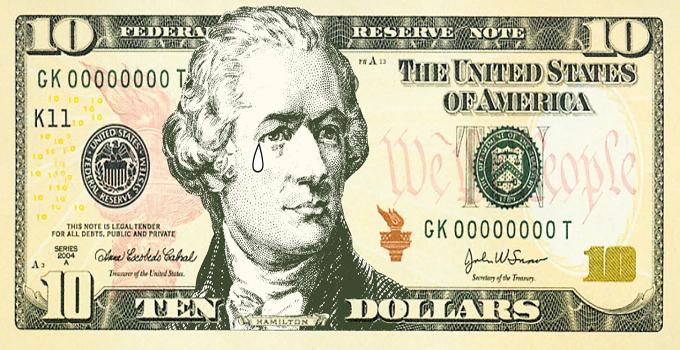
Yesterday, Jack Lew announced that the $10 bill would be undergoing a complete redesign to feature a woman on the currency.
The Fact Sheet released by the Treasury Department states that: “Secretary Lew has made clear that the image of Alexander Hamilton will remain part of the $10 note.” However, no specifics about what position Hamilton’s image would have has been released yet.
The Treasury Department website about the New Ten asks for the public to provide them with ideas and feedback and states:
In exercising the responsibility to select currency features and design, Treasury Secretary Jack Lew has made clear that the public’s input is an important and valuable part of the process for the redesign of the $10 note. Treasury wants to hear from the American people and engage in a public dialogue about how we can use the new $10 note to best represent the values of our inclusive democracy. Treasury staff will also seek public comment through other forums including round tables, and open houses. Share your ideas, symbols, designs or any other feedback that can inform the Secretary as he considers options for the $10 redesign.
Chris Matthews of Fortune called Lew’s decision to redesign the $10, rather than removing Andrew Jackson from the $20 “the worst decision Jack Lew has made.” I believe that it is a fundamental mistake for the Treasury Department to abandon its spiritual father by removing Hamilton from the $10 bill. Without Hamilton, the Treasury Department and a national currency would not exist.
At the same time, I am fully supportive of the idea of removing Andrew Jackson from the $20 and replacing him with a woman. Jackson spent his career fighting the idea of paper money and a central banking system. Even the movement asking for a woman to appear on currency has been focused on putting a woman on the $20, and over 600,000 people (myself included) voted on candidates to replace Jackson on the bill at the website http://www.womenon20s.org/.
Alexander Hamilton is uniquely qualified to retain a prominent place on American currency. Hamilton fought vigorous opposition from Jefferson and other contemporaries to establish a national bank. He single-handedly established the economic foundations of the young nation. Hamilton also made significant, game-changing contributions to the Revolutionary War and had a major role in establishing Constitution and the foundations of our government.
Michael Newton posted several quotes from Hamilton’s contemporaries about his role in developing the foundation of the American financial system, including Daniel Webster’s statement that Hamilton:
“…smote the rock of the national resources, and abundant streams gushed forth. He touched the dead corpse of the public credit, and it sprung to its feet. The fabled birth of Minerva from the brain of Jove was hardly more sudden or more perfect than the financial system of the United States as it burst forth from the conception of Alexander Hamilton.”
Secretary Lew’s statement made clear that the Treasury Department is seeking public input on the redesign. If you are passionate about this issue, I urge you to participate in public forums, send comments and letters to Treasury, and use your social media presence to ensure that Hamilton’s image continues to be the face of the $10 bill.


 It's Hamiltime!
