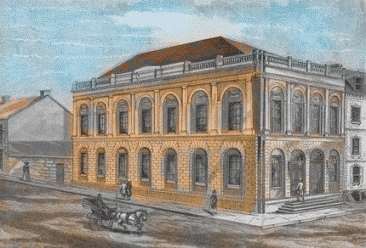
Hamilton on the Hudson

Hi all, sorry for the lack of posting recently.  I’m in New York City and working on some Hamilton research and will share details here in the next few weeks.

I wanted to bring your attention to some great Hamilton events going on this weekend (July 26-28, 2013) in Upstate New York.  The events are sponsored by the AHA Society to honor the 225th anniversary of the ratification of the US Constitution in New York (July 26, 1788).  The ratification of the Constitution in New York was a dramatic, tumultuous event.  When the debates began, the consensus of the delegates was to vote strongly against the Constitution.  However, by the time the final votes were counted, Hamilton’s persuasive skills had secured a 30-27 vote in favor of ratification, thus making New York the 11th state to join the Union.

Some highlights from the many great events include:

  •  Friday from 7:30-9 in Poughkeepsie- A talk by Professor Andrew Shankman from Rutgers University entitled, The Gentleman and the Democrat: Alexander Hamilton, Melancton Smith, and the Battle over the US Constitution.” 
  • Saturday at 11:30 in Garrison- A narrated walk tracing the steps of Benedict Arnold’s escape route/Hamilton’s chase route down to the Hudson River.
  • Sunday at 3 pm in Newburgh- a lecture series about George Washington and his aide-de-camp Alexander Hamilton in the Hudson Valley. The speakers for the afternoon include Hamilton scholar Michael Newton, AHA Society President Rand Scholet, and Johanna Porr, Director of the Historical Society of Newburgh. The lectures will take place at the Newburgh Heritage Center, also known as the Old Courthouse.

For a full listing of the events, see here.

See here for a record of the debates surrounding the New York Ratification Convention.
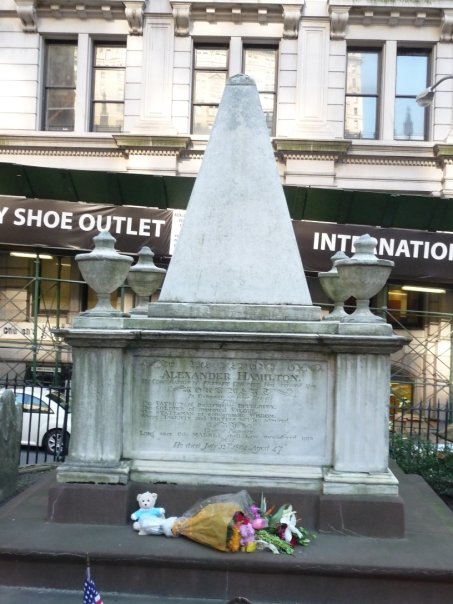
 

Hamilton’s Legacy


Today, July 12, 2013 marks the 209th anniversary of Alexander Hamilton’s death at age 47.  Hamilton died at a significantly younger age than his fellow political luminaries: Jefferson survived until age 83, Madison lived to 85, Adams to 90, and Burr to 80.  However, in his 47 years, he fundamentally shaped America’s political and financial foundations.  Hamilton rose from obscurity in Nevis and, without a formal education or financial backing, became an influential revolutionary thinker, a military hero, Washington’s most influential aide, the driving force of the Federalist Papers and the push for the Constitution, the architect of America’s financial future as the first Secretary of Treasury, and so much more.

The inscription at Hamilton’s grave site says it well:

The patriot of incorruptible integrity.

The soldier of approved valour.

The statesman of consummate wisdom.

Whose talents and virtues will be admired by grateful posterity long after this marble shall have mouldered into dust.

I also love this excerpt from the Eulogy on General Alexander Hamilton by the citizens of Boston written by Harrison G. Otis:

But in the man whose loss we deplore, the interval between manhood and death was so uniformly filled by a display of the energies of his mighty mind, that this world has scarcely paused to enquire into the story of his infant or puerile years.  He was a planet, the dawn of which was not perceived; which rose with full splendor, and emitted a constant stream of glorious light, until the hour of its sudden and portentous eclipse.

If you’re in New York, come join the series of exciting events throughout NYC today to commemorate Hamilton’s passing.  If you’re not in the city, check out the live stream of Thomas Fleming’s author talk at Trinity Church here.

Duelversary

Today, July 11, marks the 209th anniversary of the fatal duel between Alexander Hamilton and Aaron Burr.  I think a lot of popular knowledge of Hamilton is shaped by the duel, which is unfortunate considering the far-reaching scope of his legacy, but understandable given the drama surrounding the duel.  The duel between prominent politicians captivated the popular imagination and stirred up popular hatred of Burr.  Two careers were ruined in the course of the duel- Hamilton’s by an untimely death, and Burr’s by a descent into humiliation and treason.

Burr - Hamilton Duel

Here’s the initial firsthand account by the two seconds to the duel, Nathaniel Pendleton and William Van Ness:

Col Burr arrived first on the ground as had been previously agreed. When Genl Hamilton arrived the parties exchanged salutations and the Seconds proceeded to make their arrangements. They measured the distance, ten full paces, and cast lots for the choice of position as also to determine whom the word should be given, both of which fell to the Second of Genl Hamilton. They then proceeded to load the pistols in each others presence, after which the parties took their stations. The Gentleman who was to give the word, then explained to the parties the rules which were to govern them in firing which were as follows:

The parties being placed at their stations – The Second who gives the word shall ask them whether they are ready – being answered in the affirmative, he shall say “present” after which the parties shall present & fire when they please. If one fires before the opposite shall say one, two, three, fire, and he shall fire or loose his fire.

And asked if they were prepared, being answered in the affirmative, he gave the word present as had been agreed on. And both of the parties took aim & fired in succession. The intervening time is not expressed as the seconds do not precisely agree on that point. The pistols were discharged within a few seconds of each other and the fire of Col Burr took effect; Genl Hamilton almost instantly fell, Col Burr then advanced toward Genl H—n with a manner and gesture that appeared to Genl Hamilton’s friend to be expressive of regret, but without Speaking turned about & withdrew….

The August 11, 1804 Coroner’s Report stated:

Aaron Burr…not having the fear of God before his eyes, but being moved and seduced by the Instigation of the devil, on the eleventh day of July in the year last aforesaid, which force and Arms…feloniously wilfully and of his Malice aforethought, did make an Assault, and…Mortal[ly] Wound…the said Alexander Hamilton.

For further reading, check out this article on Dueling as Politics by Joanne B. Freeman in the New York Journal of American History.

Reminder- if you’re in or near New York City, come out to the AHA Society’s series of events in NYC and Northern New Jersey starting today and going through Sunday!   Tonight is a  debate between Jefferson and Hamilton at the Museum of American Finance.  Register here.  Hope to see you all there!

The Bank of New York and the Museum of American Finance

The Bank of New York was the first bank in New York City, founded by Alexander Hamilton and opened on June 9, 1784.  Hamilton was the chief architect of the new bank.  Hamilton wrote the constitution of the bank and was one of the original 13 directors.  He also made the decision that the bank should be based on specie (gold and silver) rather than land.  Hamilton’s constitution was used as the “model upon which all the bank charters granted in New York were framed prior to 1825.”  Hamilton’s voting structure restricted the power of larger shareholders, rather than a one share-one vote scheme.

http://www.nps.gov/ner/hagr/parknews/images/Bank-of-New-York7.gif

In Alexander Hamilton and the Growth of the New Nation, John Chester Miller described Hamilton’s attachment to the Bank he founded:

Hamilton’s concern for the welfare of the Bank of New York cannot be left out of account.  He might have said of the institution that although it was a small bank, there were those who loved it.

By the time Hamilton became Treasury Secretary, he instructed the bank cashier to sell his stocks, despite losing significant profits as the Bank’s stock rose dramatically.  Hamilton felt that the political consequences of having a stake in a bank would compromise his position and eschewed the profitable stocks in favor of maintaining his political reputation.

Currently, the Bank of New York building is home to the Museum of American Finance.  Summer is a great time for museum hopping in NYC and the museum is offering a Groupon deal for 50% off admission!  The museum is located at 48 Wall Street and is open to the public on Tuesday – Saturday, from 10 am – 4 pm..  If you go, make sure to check out the Hamilton Room, focusing specifically on Hamilton’s legacy.

Alexander Hamilton Room
Picture from http://www.moaf.org/exhibits/hamilton/index

Also note, MOAF is hosting a Hamilton vs. Jefferson Debate next Thursday, July 11th from 5:30-7 pm, as part of the Alexander Hamilton Awareness Society’s Celebrate Hamilton 2013 events.  The description of the event from the event flyer is below:

National Hamilton Scholar Dr. William G. Chrystal will become Alexander Hamilton for the evening to both entertain and educate attendees in a “debate” with Thomas Jefferson. After the presentation, a Q&A session will be held, followed by a reception.
Register to attend the debate here.  I’ll be there!

The Founders Online Project from the National Archives

The National Archives has released the beta version of The Founders Online.  This site provides the public with open access to the correspondence and other writings of six major Founders: Hamilton, Wasington, Franklin, Adams, Jefferson, and Madison.  The collection includes over 6,000 Alexander Hamilton documents and will be an important resource for anyone interested in the Founding period.  Although some of the material has already been digitized, this is the first time that they are all available in one place and accessible to the public at no charge.

The Founders Online project was originally proposed to Congress in April 2008 by Allen Weinstein, the Archivist of the United States, as a response to Public Law 110-161- Division D- Financial Services and General Government and Appropriations Acts, 2008, Title V, which stated:

The Appropriations Committees are concerned about the lengthy amount of time currently required to complete the publication of the Founding Fathers historical papers projects.  These projects began in the 1960s and are expected to continue two or more decades until completion. Mindful of the technologies and tools currently available, the Committees believe the Archivist should accelerate the process for delivering the papers of the Founding Fathers to the American people. Therefore, the Archivist is directed, as Chairman of the NHPRC, to develop a comprehensive plan for the online electronic publication, within a reasonable timeframe, of the papers of the Founding Fathers and to submit this plan to the Committees on Appropriations no later than 90 days after the enactment of this Act.

Weinstein’s report to the Appropriations Committee laid out the initial plan to provide open, free access to the fully annotated Founding Era papers.  In the report, Weinstein stated:

The plan discussed here would, over several years, help accelerate digitization and online access to 1) copies of all the available original source documents, 2) transcriptions of those documents as they become available, and 3) the existing print volumes that contain annotated and edited transcripts of the documents. In addition, as further volumes are completed, these authoritative editions would then replace the raw transcriptions. This collection would be a kind of work-in-progress that students, scholars, and the general public could use through the Internet.

The Hamilton papers included in the Founders Online are the Papers of Alexander Hamilton published by Harold C. Styrett as part of a Columbia University project that lasted from 1955-1987.

The Founders Online has plans to keep expanding the papers available to the public.  The website states:

In its initial phase, Founders Online contains nearly 120,000 fully searchable documents. Soon we will be adding more documents drawn from the print editions and additional transcriptions of documents. As work continues on each of the ongoing publishing projects, newly annotated and edited records will be added. When it is complete, Founders Online will include approximately 175,000 documents in this living monument to America’s Founding Era.


Hamilton’s Views on Race and Slavery: Jay’s Treaty and the Camillus Letters

One of the most unpopular positions that Hamilton took in his political career was his outspoken defense of the Jay Treaty. The provisions of the treaty were made public in the spring of 1795, and chaos erupted in response.   Jeffersonians took up the cry: “Damn John Jay! Damn every one that won’t damn John Jay!  Damn every one that won’t put lights in his windows and sit up all night damning John Jay!!!”

Hamilton risked his popularity, and even his safety to defend Jay’s Treaty.  He was the sole voice to publicly support the treaty amidst a flood of negative sentiment.  In fact, a mob attempted to stone Hamilton at a public meeting in New York for his defense of the treaty.

One specific aspect of Hamilton’s Camillus letters deals with the issue of slavery and natural law.  During the Revolution, the British had issued Lord Dunmore’s proclamation, offering freedom to slaves who left their masters and joined the British army.  According to Michael D. Chan, the actions of the British “infuriated southern slaveholders, especially because many of them were groaning under the weight of debts owed to British citizens.”  These Southerners insisted that any treaty with Britain include a provision for either returning the slaves or compensating the slaveowners for their loss.

File:Jay's-treaty.jpg

However, as Colleen A. Sheehan states: “The Jay Treaty provided for neither restoration of nor compensation for the slaves carried away.  This was a bitter pill for many Americans not only because of financial loss, but because of how the matter had been handled by the British from the state.”

Hamilton addressed the issue in his Camillus letters as follows:

  • IV.—The stipulation relates to “negroes or other property of the American inhabitants”; putting negroes on the same footing with any other article. The characteristic of the subject of the stipulation being property of American inhabitants, whatever had lost that character could not be the object of the stipulation. But the negroes in question, by the laws of war, had lost that character; they were therefore not within the stipulation.Why did not the United States demand the surrender of captured vessels, and of all other movables, which had fallen into the hands of the enemy? The answer is, because common sense would have revolted against such a construction. No one could believe that an indefinite surrender of all the spoils or booty of a seven-years’ war was ever intended to be stipulated; and yet the demand for a horse, or an ox, or a piece of furniture, would have been as completely within the terms “negroes and other property,” as a negro; consequently, the reasoning which proves that one is not included, excludes the other.The silence of the United States as to every other article is therefore a virtual abandonment of that sense of the stipulation which requires the surrender of negroes.
  • V.—In the interpretation of treaties, things odious or immoral are not to be presumed. The abandonment of negroes, who had been induced to quit their masters on the faith of official proclamation, promising them liberty, to fall again under the yoke of their masters, and into slavery, is as odious and immoral a thing as can be conceived. It is odious, not only as it imposes an act of perfidy on one of the contracting parties, but as it tends to bring back to servitude men once made free. The general interests of humanity conspire with the obligation which Great Britain had contracted towards the negroes, to repel this construction of the treaty, if another can be found.

Hamilton’s response to the issue of the British freeing of slaves during the war was nothing short of radical.   Using the framework of the laws of war, Hamilton put forth salient and controversial points relating to the morality of slavery.  Hamilton challenged the idea that freed slaves could be properly grouped with other types of “property” referred to in the treaty.  Additionally, Hamilton called the idea of returning freed slaves to slavery “odious” and “immoral,” despite the fact that slavery was prevalent throughout the Union.

Hamilton’s fearless defense of a treaty he believed in, even at the height of its unpopularity, demonstrates to me Hamilton’s commitment to stand for something, no matter what the personal or political cost.

Read the full Camillus letters here.

Pop Culture Watch: Lin-Manuel Miranda’s The Hamilton Mixtape Live this Summer!

Apologies for the long posting hiatus!  I’m just coming off a very intense period of time at work.  Back in action now and should be posting regularly!

The Powerhouse Theater at Vassar College announced that Lin-Manuel Miranda will be presenting his show, The Hamilton Mixtape this summer.  Miranda is best known for composing and starring in the Tony Award-winning show “In the Heights.”

Broadway World states:  The Hamilton Mixtape is a hip-hop song cycle about the life and death of Alexander Hamilton and showcases a fusion of Miranda’s signature Latin, hip-hop and classic Broadway styles.

The world got its first taste of the Hamilton Mixtape in May 2009, when Miranda performed at the White House Poetry Jam.   In January 2012, he performed a one-night only preview of the Hamilton Mixtape at Lincoln Center.

Click here for a January 2012 New York Times profile on Lin-Maunel Miranda and his Hamilton Mixtape project.

Images of Hamilton: A New Home for Hamilton Portrait

Earlier, I wrote a post about John Trumbull’s images of Hamilton .   Today, we got some exciting news about one of Trumbull’s most iconic Hamilton portraits!  Credit Suisse, the owner of the portrait,  announced that it will be gifted to two institutions: Crystal Bridges Museum of American Art in Arkansas and the Metropolitan Museum of Art in New York City.  This split ownership arrangement will allow the painting to be seen by audiences in two very different parts of the country.  Credit Suisse had put the painting on view at public institutions for short periods of time, but it decided that the painting should be permanently accessible to the public.  The painting was acquired by Credit Suisse as part of its takeover of another investment bank, DLJ.  The painting had been part of DLJ’s corporate art collection.

CEO Brady Dougan stated:  “Donating this well-known and highly regarded 1792 portrait of Alexander Hamilton by John Trumbull to both Crystal Bridges Museum of American Art and The Metropolitan Museum of Art ensures that the widest possible American and international audiences can enjoy and study this historic piece of fine art for perpetuity”

The New York Times description of the portrait’s history states:

The painting’s history is very much a New York story. In 1791 five New York merchants representing the Chamber of Commerce commissioned Trumbull to paint a full-length portrait of Hamilton, President Washington’s secretary of the Treasury.

For Trumbull the assignment was trickier than it seemed. He and his subject were friends, and Hamilton was vocal in wishing his portrait to appear “unconnected with any incident of my political life.” But the men who commissioned the painting wanted it to hang in a public building. How then could Trumbull please his clients, who said they envisioned a work stately enough to be on public view, and the sitter, who shunned anything remotely official?

Taking his inspiration from European Grand Manner portraiture, the artist posed Hamilton standing, one hand on a table that is empty except for an ink stand and papers, devoid of any political references. In the background is an archway on one side and an architectural column on the other, along with a chair with a robe causally thrown over it.

Hamilton’s warm expression reflects the artist’s obvious affection for his subject. Trumbull called Hamilton’s fatal duel with Aaron Burr in 1804, “the unhappy event which deprived the United States of two of their most distinguished citizens.”

Hamil-Swag: More T-Shirts

Can you ever have too many Hamilton t-shirts?  Happy Monday!

1) Hipster Hamilton from Zazzle

Hipster Hamilton Tshirt

2) Olde School (featuring Henry, Franklin, Jefferson, and Hamilton) from Zazzle

Olde School T-shirt

3) Capitalism Rocks! from Cafe Press

Women's Fitted T-Shirt (dark)

4) AH Quote shirt from Zazzle: Featuring the quote: “A sacred respect for the constitutional law is the vital principle, the sustaining energy of a free government. ”

Alexander Hamilton Quote Shirts

Hamil-Swag: Pop Culture Meets Art Meets Awesome- “American Iconomics”

Check out these super creative renditions of currency with inspiration drawn from the worlds of film, art, and popular culture.  These images were created by artists Akira Beard and James Charles as part of a 2011 show at the Shooting Gallery in San Francisco entitled: American Iconomics.   Some of these awesome pieces are still on sale, for $600 a piece.  You should check out the full collection of images here– you’ll find Andrew Jackson as Ronald McDonald, Ulysses S. Grant as Mr. T, and other awesome iconic images.

Here are my favorite Hamilton images from the show.

Willy Wonka (coincidentally one of my favorite movies)- Hamilton as Wonka and a very distinguished Oompa Loompa

Star Wars– Yoda and Princess Leia

Akira Beard and James Charles : James Charles

Akira Beard and James Charles : James Charles

Van Gogh

Johnny Cash

Akira Beard and James Charles : James Charles

Note: all images were taken from the Shooting Gallery American Iconomics site.