Happy Birthday Hamilton Events in NYC

The AHA Society is hosting a series of events today and tomorrow throughout the city to celebrate Hamilton’s birthday. As part of those events, I’m giving a talk on the Croswell case and Hamilton’s role in the evolution of freedom of press in the early American Republic.  If you’re in town, come check it out today at 2:30 PM in Federal Hall (26 Wall Street) in Lower Manhattan.

Link to information on all the events: https://www.smore.com/jddf-happy-birthday-hamilton-2014

TALK: ALEXANDER HAMILTON AND THE EVOLUTION OF FREE SPEECH IN THE EARLY REPUBLIC: FROM ZENGER TO CROSWELL

WHEN: FRIDAY, JAN. 10TH, 2:30PM

WHERE: 26 WALL STREET, NEW YORK, NY

Pooja Nair, Harvard Law graduate and legal associate of Foley & Lardner LLP of Los Angeles, will be speaking on Alexander Hamilton’s role in establishing the precedent of free speech in the United States.During his work as a lawyer, Hamilton argued on behalf of journalist Harry Croswell (People v. Croswell) that truthful statements should not be considered libel. Though the judges deadlocked in trial, Hamilton’s arguments were written into New York law the following year. Learn more about the precedents that Alexander Hamilton set in the courtroom in Ms. Nair’s talk.

The talk will be held at Federal Hall National Memorial on Wall Street in Lower Manhattan.

Happy Constitution Day!

Today, September 17, 2013, marks the 226th anniversary of the signing of the United States Constitution.  Given the endurance of the Constitution over the past 226 years, it is easy to see the acceptance of the Constitution almost as an inevitable part of American history.  However, the period leading up to the Constitutional Convention in Philadelphia, and the two years before ratification in 1789 were marked by turbulence and the clash of opinions over fundamental views of the American future.  Hamilton was instrumental in tipping the scale to push forward the Constitution.

Hamilton’s Impressions as to the New Constitution, written at some point in September 1787, highlights the uncertainty that pervaded the Republic during the two-year period before the states ratified the Constitution:

“The new Constitution has in favor of its success these circumstances: A very great weight of influence of the persons who framed it, particularly in the universal popularity of General Washington. The good-will of the commercial interest throughout the States, which will give all its efforts to the establishment of a government capable of regulating, protecting, and extending the commerce of the Union. The good-will of most men of property in the several States, who wish a government of the Union able to protect them against domestic violence, and the depredations which the democratic spirit is apt to make on property, and who are besides anxious for the respectability of the nation. The hopes of the creditors of the United States, that a general government possessing the means of doing it, will pay the debt of the Union. A strong belief in the people at large of the insufficiency of the present Confederation to preserve the existence of the Union, and of the necessity of the Union to their safety and prosperity; of course, a strong desire of a change, and a predisposition to receive well the propositions of the convention.

Against its success is to be put the dissent of two of three important men1 in the convention, who will think their characters pledged to defeat the plan; the influence of many inconsiderable men in possession of considerable offices under the State governments, who will fear a diminution of their consequence, power, and emolument, by the establishment of the general government, and who can hope for nothing there; the influence of some considerable men2 in office, possessed of talents and popularity, who, partly from the same motives, and partly from a desire of playing a part in a convulsion for their own aggrandizement, will oppose the quiet adoption of the new government (some considerable men out of office, from motives of ambition, may be disposed to act the same part). Add to these causes the disinclination of the people to taxes, and of course to a strong government; the opposition of all men much in debt, who will not wish to see a government established, one object of which is to restrain the means of cheating creditors; the democratical jealousy of the people, which may be alarmed at the appearance of institutions that may seem calculated to place the power of the community in few hands, and to raise a few individuals to stations of great pre-eminence; and the influence of some foreign powers, who, from different motives, will not wish to see an energetic government established throughout the States.

In this view of the subject it is difficult to form any judgment whether the plan will be adopted or rejected. It must be essentially matter of conjecture. The present appearances and all other circumstances considered, the probability seems to be on the side of its adoption.

But the causes operating against its adoption are powerful, and there will be nothing astonishing in the contrary.

If it do not finally obtain, it is probable the discussion of the question will beget such struggles, animosities, and heats in the community, that this circumstance, conspiring with the real necessity of an essential change in our present situation, will produce civil war. Should this happen, whatever parties prevail, it is probable governments very different from the present in their principles will be established. A dismemberment of the Union, and monarchies in different portions of it, may be expected. It may, however, happen that no civil war will take place, but several republican confederacies be established between different combinations of the particular States.

A reunion with Great Britain, from universal disgust at a state of commotion, is not impossible, though not much to be feared. The most plausible shape of such a business would be the establishment of a son of the present monarch in the supreme government of this country, with a family compact.

If the government be adopted it is probable General Washington will be the President of the United States. This will ensure a wise choice of men to administer the government, and a good administration. A good administration will conciliate the confidence and affection of the people, and perhaps enable the government to acquire more consistency than the proposed constitution seems to promise for so great a country. It may then triumph altogether over the State governments, and reduce them to an entire subordination, dividing the larger States into smaller districts. The organs of the general government may also acquire additional strength.

If this should not be the case in the course of a few years, it is probable that the contests about the boundaries of power between the particular governments and the general government, and the momentum of the larger States in such contests, will produce a dissolution of the Union. This, after all, seems to be the most likely result.

But it is almost arrogance in so complicated a subject, depending so entirely on the incalculable fluctuations of the human passions, to attempt even a conjecture about the event.

It will be eight or nine months before any certain judgment can be formed respecting the adoption of the plan.”

Even after the Constitution was signed, Hamilton faced a maddeningly uncertain two-year period that saw him turn to negotiations, persuasion, and sheer charisma to convince the states that ratification was in their best interests.  Ultimately, the signing of the Constitution was merely the first step to a long ratification process.  Hamilton was instrumental in every stage of the Constitution, from conception to ratification.

(Apologies for the infrequency of recent posts.  I’ve been working on a new Hamilton project…more details to follow soon).
Hamilton’s Legacy


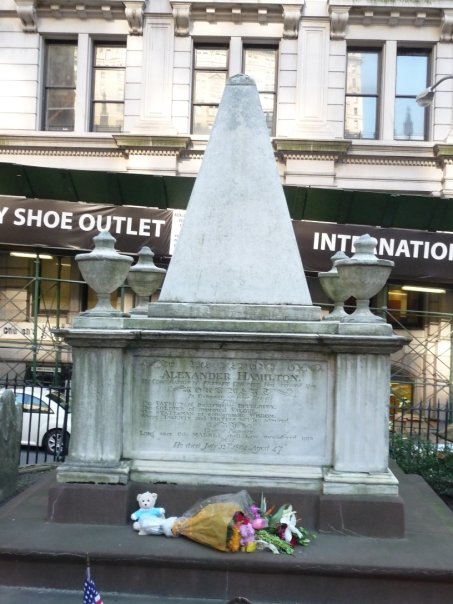
Today, July 12, 2013 marks the 209th anniversary of Alexander Hamilton’s death at age 47.  Hamilton died at a significantly younger age than his fellow political luminaries: Jefferson survived until age 83, Madison lived to 85, Adams to 90, and Burr to 80.  However, in his 47 years, he fundamentally shaped America’s political and financial foundations.  Hamilton rose from obscurity in Nevis and, without a formal education or financial backing, became an influential revolutionary thinker, a military hero, Washington’s most influential aide, the driving force of the Federalist Papers and the push for the Constitution, the architect of America’s financial future as the first Secretary of Treasury, and so much more.

The inscription at Hamilton’s grave site says it well:

The patriot of incorruptible integrity.

The soldier of approved valour.

The statesman of consummate wisdom.

Whose talents and virtues will be admired by grateful posterity long after this marble shall have mouldered into dust.

I also love this excerpt from the Eulogy on General Alexander Hamilton by the citizens of Boston written by Harrison G. Otis:

But in the man whose loss we deplore, the interval between manhood and death was so uniformly filled by a display of the energies of his mighty mind, that this world has scarcely paused to enquire into the story of his infant or puerile years.  He was a planet, the dawn of which was not perceived; which rose with full splendor, and emitted a constant stream of glorious light, until the hour of its sudden and portentous eclipse.

If you’re in New York, come join the series of exciting events throughout NYC today to commemorate Hamilton’s passing.  If you’re not in the city, check out the live stream of Thomas Fleming’s author talk at Trinity Church here.

Prescience on National Security

In the Federalist No. 8, Hamilton stated:

Safety from external danger is the most powerful director of national conduct. Even the ardent love of liberty will, after a time, give way to its dictates. The violent destruction of life and property incident to war, the continual effort and alarm attendant on a state of continual danger, will compel nations the most attached to liberty to resort for repose and security to institutions which have a tendency to destroy their civil and political rights. To be more safe, they at length become willing to run the risk of being less free.

Federalist No. 8 was written in the context of warning against hostilities between the states, but Hamilton makes a compelling, highly relevant point about what people in society are willing to give up in order to protect our security in times of danger.  I have been thinking about Hamilton’s statement a lot in the context of the Edward Snowden/NSA domestic spying story.  The Electronic Frontier Foundation published a detailed guide to how the NSA Domestic Spying programs works.  Under the program, the Government can monitor every American’s call history and internet activity without a warrant.  Different aspects of the program are continuing to come to light, but Hamilton’s observations on the effect of a state of alarm on the value of liberty remain extremely prescient.

The Founders Online Project from the National Archives

The National Archives has released the beta version of The Founders Online.  This site provides the public with open access to the correspondence and other writings of six major Founders: Hamilton, Wasington, Franklin, Adams, Jefferson, and Madison.  The collection includes over 6,000 Alexander Hamilton documents and will be an important resource for anyone interested in the Founding period.  Although some of the material has already been digitized, this is the first time that they are all available in one place and accessible to the public at no charge.

The Founders Online project was originally proposed to Congress in April 2008 by Allen Weinstein, the Archivist of the United States, as a response to Public Law 110-161- Division D- Financial Services and General Government and Appropriations Acts, 2008, Title V, which stated:

The Appropriations Committees are concerned about the lengthy amount of time currently required to complete the publication of the Founding Fathers historical papers projects.  These projects began in the 1960s and are expected to continue two or more decades until completion. Mindful of the technologies and tools currently available, the Committees believe the Archivist should accelerate the process for delivering the papers of the Founding Fathers to the American people. Therefore, the Archivist is directed, as Chairman of the NHPRC, to develop a comprehensive plan for the online electronic publication, within a reasonable timeframe, of the papers of the Founding Fathers and to submit this plan to the Committees on Appropriations no later than 90 days after the enactment of this Act.

Weinstein’s report to the Appropriations Committee laid out the initial plan to provide open, free access to the fully annotated Founding Era papers.  In the report, Weinstein stated:

The plan discussed here would, over several years, help accelerate digitization and online access to 1) copies of all the available original source documents, 2) transcriptions of those documents as they become available, and 3) the existing print volumes that contain annotated and edited transcripts of the documents. In addition, as further volumes are completed, these authoritative editions would then replace the raw transcriptions. This collection would be a kind of work-in-progress that students, scholars, and the general public could use through the Internet.

The Hamilton papers included in the Founders Online are the Papers of Alexander Hamilton published by Harold C. Styrett as part of a Columbia University project that lasted from 1955-1987.

The Founders Online has plans to keep expanding the papers available to the public.  The website states:

In its initial phase, Founders Online contains nearly 120,000 fully searchable documents. Soon we will be adding more documents drawn from the print editions and additional transcriptions of documents. As work continues on each of the ongoing publishing projects, newly annotated and edited records will be added. When it is complete, Founders Online will include approximately 175,000 documents in this living monument to America’s Founding Era.


Hamilton’s “Hypomanic Edge?”

I recently came across a 2005 business psychology book by John D. Gartner entitled The Hypomanic Edge: The Link Between (A Little) Craziness and (A Lot Of) Success in America.

Gartner states:

Hypomania is a mild form of mania, often found in the relatives of manic depressives. Hypomanics are brimming with infectious energy, irrational confidence, and really big ideas. They think, talk, move, and make decisions quickly. Anyone who slows them down with questions “just doesn’t get it.” Hypomanics are not crazy, but “normal” is not the first word that comes to mind when describing them. Hypomanics live on the edge, betweeen normal and abnormal.

The Harvard Mental Health Newsletter states:

The formal DSM-IV diagnostic criteria for hypomania require at least three of the following symptoms for at least four days: inflated self-esteem or grandiosity; decreased need for sleep; increased talkativeness; racing thoughts or ideas; marked distractibility; agitation or increased activity; excessive participation in activities that are pleasurable but invite personal or fiscal harm (shopping sprees, sexual indiscretions, impulsive business investments, and the like).

Gartner’s theory is that “America has an extraordinarily high number of hypomanics,” and that a majority of successful entrepreneurs and innovators have hypomanic characteristics. Gartner also states that hypomania creates a situation in which:

“the drives that motivate behavior surge to a screaming pitch, making the urgency of action irresistible. There isn’t a minute to waste– this is going to be huge– just do it! This pressure to act creates overachievers, but it also leads to impulsive behavior…”

Hamilton is featured prominently in the book as Gartner attempts to analyze Hamilton’s life “through the eyes of a clinician.” Gartner’s theory is that “Hamilton was bipolar, but more important, that if he hadn’t been, he couldn’t have led the charge to launch a nation. Hamilton’s hypomania was an essential ingredient in his accomplishments.” Gartner finds examples of hypomanic behavior throughout Hamilton’s career: his willingness to lead his troops into dangerous battle, his relentless energy in pushing forward the Constitution, and his vision for the Department of Treasury. Gartner states that Hamilton’s grandiose vision was transferred to his “radical and unswerving vision” of America. Gartner points to Hamilton’s unstoppable energy and ability to work on very little sleep for long, intense periods as symptomatic of hypomania.

Gartner has an interesting take, but I don’t fully buy the idea of applying a psychiatric diagnosis to any individual without any firsthand observation.

The first chapter of the book is available here, via the New York Times.

High-Tech Authorship Detection and the Federalist Papers

Researchers at the University of Adelaide in Southern Australia recently published an article in PLOS ONE (an awesome open access, peer-reviewed science journal)  entitled Automated Authorship Attribution Using Advanced Signal Classification Techniques.  The research team worked for over 10 years on developing an automatic authorship detection system that would determine authorship based on commonly used words.

Here’s the abstract from the fascinating article:

In this paper, we develop two automated authorship attribution schemes, one based on Multiple Discriminant Analysis (MDA) and the other based on a Support Vector Machine (SVM). The classification features we exploit are based on word frequencies in the text. We adopt an approach of preprocessing each text by stripping it of all characters except a-z and space. This is in order to increase the portability of the software to different types of texts. We test the methodology on a corpus of undisputed English texts, and use leave-one-out cross validation to demonstrate classification accuracies in excess of 90%. We further test our methods on theFederalist Papers, which have a partly disputed authorship and a fair degree of scholarly consensus. And finally, we apply our methodology to the question of the authorship of theLetter to the Hebrews by comparing it against a number of original Greek texts of known authorship. These tests identify where some of the limitations lie, motivating a number of open questions for future work. An open source implementation of our methodology is freely available for use at https://github.com/matthewberryman/autho​r-detection.

In order to test their research, the team first applied it to English texts with known authors, and found an accuracy rate of over 90%.  Then, they applied it to the twelve disputed essays in the Federalist Papers:

The Federalist Papers are a series of 85 political essays published under the name ‘Publius’ in 1788. At first, the real author(s) were a guarded secret, but scholars now accept that Alexander Hamilton, James Madison, and John Jay are the authors. After a while Hamilton and then Madison provided their own lists declaring the authorship [31][32]. The difference between these two lists is that there are 12 essays that both Madison and Hamilton claimed individually for themselves. So 73 texts might be considered to have known author(s) while 12 are of disputed authorship. These 12 disputed authorship texts are essay numbers 49–58, 62 and 63. An early study carried out by Mosteller and Wallace (1964) concluded that all of the disputed essays were written by Madison, with the possible exception that essay number 55 might be written by Hamilton [10][33]. Not all researchers agree with this conclusion. Some scholars also suggest that essay number 64, which is normally attributed to Jay, is written by Madison[31], so we also consider essay number 64 as a disputed text. In total, this gives us 13 disputed essays and 72 undisputed essays. Amongst the undisputed texts, 51 essays are written by Hamilton, 14 essays are written by Madison, and 4 essays are written by Jay. Three essays (numbers 18, 19, and 20) are products of collaboration between Hamilton and Madison[34][35].

The texts are obtained from the Project Gutenberg Archives [28]. We put aside the three essays with collaborative authorship and take the remaining 69 essays as the training dataset. The same function word list (see Table 4) is used for our MDA and SVM classifiers. Because there are three authors, MDA produces two discriminant functions, that are shown in Figure 4. For the Federalist Papers of undisputed authorship, the LOO-CV accuracy is 97.1%, close to the LOO-CV accuracy for the SVM, 95.6%. In both methods the number of function words required to achieve the highest accuracy is 75 words.

Figure 4 Canonical discriminant functions for the Federalist Papers.

The program found that “there is a relatively high likelihood that Essay 62 was written by Madison.”  However, it was not certain about the authorship of several of the other disputed essays.  A possible reason for this is that these essays were “the products of a greater degree of collaboration between the authors, and this remains an open question for future investigation.”

Read the complete article here, and a summary here.

The Romantic Hamilton

In honor of Valentine’s Day, here are some of my favorite snippets of Hamilton’s writing to/about his wife Elizabeth.  Of course, Hamilton wasn’t always the perfect husband- he was away from his family often at the peak of his political career, and he had a much-publicized affair with Maria Reynolds, but :

From a July 2, 1780 letter:

“I love you more and more every hour.  The sweet softness and delicacy of your mind and manners, the elevation of your sentiments, the real goodness of your heart- it’s tenderness to me- the beauties of your face and person- your unpretending good sense and that innocent symplicity and frankness which pervade your actions, all these appear to me with increasing amiableness, and place you in my estimation above all the rest of your sex.”

From an October 1780 letter

“I have told you, and I told you truly that I love you too much. You engross my thoughts too intirely to allow me to think of any thing else. You not only employ my mind all day; but you intrude upon my sleep. I meet you in every dream—and when I wake I cannot close my eyes again for ruminating on your sweetnesses. ‘Tis a pretty story indeed that I am to be thus monopolized, by a little nut-brown maid like you—and from a statesman and a soldier metamorphosed into a puny lover. I believe in my soul you are an inchantress; but I have tried in vain, if not to break, at least, to weaken the charms—you maintain your empire in spite of all my efforts—and after every new one, I make to withdraw myself from my allegiance my partial heart still returns and clings to you with increased attachment.

Among other causes of uneasiness, I dread lest you should imagine, I yield too easily to the barrs, that keep us asunder; but if you have such an idea you ought to banish it and reproach yourself with injustice. A spirit entering into bliss, heaven opening upon all its faculties, cannot long more ardently for the enjoyment, than I do my darling Betsey, to taste the heaven that awaits me in your bosom. Is my language too strong? it is a feeble picture of my feeling:?no words can tell you how much I love and how much I long—you will only know it when wrapt in each others arms we give and take those delicious caresses which love inspires and marriage sanctifies….”

Excerpts from a November 1798 letter:

Indeed, my Betsey, you need never fear a want of anxious attention to you, for you are now dearer than ever to me.  Your happiness is the first and sweetest object of my wishes and cares.  How can it be otherwise?  You are all that is charming in my estimation and the more I see of your sex the more I become convinced of the judiciousness of my choice.

Hamilton and the US Postal Service

On February 6, 2013, the US Post Office announced that it plans to halt its Saturday mail delivery service in a move to cut costs.   In the face of an $11.5 billion loss in 2012, many sources have been pointing to this development as a the beginning of the end of the USPS.  I think they’re being a little hasty to dismiss an enduring institution, but time will tell.  [Disclaimer: I LOVE the post office.  Stamps, getting mail, postcards, checking the mailbox- I love it all!  Also, Miracle on 34th Street.]

The history of the USPS is tied closely to the history of America.  It was first signed into law by the Second Continental Congress on July 26, 1775, almost a year before the Declaration of Independence!  Benjamin Franklin was selected as the first Postmaster General.  (This was really a continuation of work that Franklin had done under the British regime in Philadelphia.  He had begun the modernization of the system in some areas, but was removed from the position by the British in 1774 because of his revolutionary activities).  When he became President, Washington appointed New Yorker Samuel Osgood (who would go on to form the bank that evolved into Citibank) to be the first Postmaster General under the Constitution.  The Founders recognized the post office as an important tool of innovation, and one that would help modernize the economy and unite the country.

The post office was also part of a political struggle between Hamilton and Jefferson.  Hamilton wanted the agency to be placed within the Treasury Department, while Jefferson wanted it to be placed within the State Department.  The deadlock led to the post office being separated from other executive agencies, and considered a hybrid until 1836.

Hamilton recognized the potential of the post office to bring in revenue for the country.  In his January 16, 1795 Report on the Public Credit, Hamilton proposed that the funds from the post office should be placed into a “sinking fund.”  Hamilton stated:

“It will hardly have been unnoticed that the Secretary has been, thus far, silent on the subject of the Post Office.  The reason is, that he has had in view the application of the revenue, arising from that source, to the purpose of a sinking fund….[Hamilton described the revenue that the Postmaster General estimated could be derived from the Post Office.]…Under this impression, the Secretary proposes that the net product of the Post Office…be applied…to the discharge of the existing public debt, either by purchases of stock in the market, or by payments on account of the principal, as shall appear to them most advisable, in conformity to public engagements; to continue so vested, until the whole of the debt shall be discharged.”

Hamilton was also involved in helping the postal service with legal challenges it faced as it tried to modernize.  In August of 1786,  Postmaster General Ebenezer Hazard asked Hamilton to provide an opinion on how the Post Office should proceed with enforcing contracts with private stagecoaches without the Postal Service losing money or being forced to accept inadequate service.  These companies had contracted with the government to provide stagecoach service, but had been flaunting the legal requirements of the Post Office Ordinance of 1782.  Hamilton brilliantly answered Hazard’s questions and provided a legal opinion for the Post Office to use to inform the private stagecoach companies of the requirements they needed to meet to uphold the contract.

To wrap up- the Post Office is awesome.  It’s one of the oldest institutions in America, and it played an important role in our economic history and in our national infrastructure.  And you may only be able to send letters on Saturday for a limited time- so send those Saturday packages, cards, and letters while you still can!

A smiling mailman holds a Flat Rate Box.

[Image from https://cns.usps.com/go]

Hamilton and the Fiscal Cliff

On Friday, Scott Bomboy at Constitution Daily published an interesting piece on how Alexander Hamilton would view the debt ceiling.  He generally describes the financial crisis that Hamilton faced when he took over the Treasury Department and how he accomplished his almost impossible mission to pull the new republic out of financial oblivion, create a national debt, and ensure that the new nation develop good credit.

Bomboy describes the odds stacked against Hamilton and America’s economic success:

In 1789, when President Washington took office, the United States was broke; it had about $75 million to $80 million in public debt; and it wasn’t in a position to trade well in a global economy.

The United States’ economic problems after the Revolution were a direct impetus to call the Constitutional Convention of 1787, where delegates from 12 states met in Philadelphia to overhaul the Articles of Confederation and give the new nation a sound political and economic footing.

In addition, Hamilton single-handedly faced two powerful political opponents from Virginia who were opposed to his policies: future presidents Thomas Jefferson and James Madison.

So in comparison to the current financial situation in Washington, Hamilton seems to have been in a much tougher spot in 1789.

Hamilton’s approach to fixing these epic problems was that the government of the United States had to possess excellent credit, before anything else could happen. Getting there would be a monumental task, since the nation had virtually no credit in 1789, despite its abundant resources.

Simon Johnson and James Kwak published an interesting analysis of Hamilton’s success and how it compared to the debt ceiling debate in the Vanity Fair article Debt and Dumb

In just five years, Hamilton—with Washington’s support—had laid the foundation of American fiscal policy. The federal government would always honor its debt. After the War of 1812, the Civil War, World War I, and World War II, this principle remained unquestioned. By the late 19th century, the government could raise large amounts of money on short notice—which made possible, among other things, rapid mobilizations to fight two World Wars.

Government bonds also became a crucial part of the financial system—the paradigmatic global risk-free asset, the universally accepted collateral on which everything else depends. What makes those bonds as good as cash is that the federal government has the power to levy and collect taxes in order to pay them off.

Hamilton’s scheme has succeeded at a scale unimaginable in 1790. Elsewhere, we have questioned Hamilton’s affection for large, powerful banks, but his contribution to American fiscal policy is undisputed. The good credit of the federal government has allowed us to amass trillions of dollars of debt, run the largest peacetime deficits in history, and still borrow money at historically low interest rates. But that has not made everyone happy.

Several authors have recently written about Hamilton and the debt ceiling, including the New York Times

Here are some of Hamilton’s words in Federalist No. 30, about the need for a country to demonstrate that it could credibly return loans:

In the modern system of war, nations the most wealthy are obliged to have recourse to large loans. A country so little opulent as ours must feel this necessity in a much stronger degree. But who would lend to a government that prefaced its overtures for borrowing by an act which demonstrated that no reliance could be placed on the steadiness of its measures for paying? The loans it might be able to procure would be as limited in their extent as burdensome in their conditions. They would be made upon the same principles that usurers commonly lend to bankrupt and fraudulent debtors, with a sparing hand and at enormous premiums.

At the same time, Hamilton was a firm believer that we needed some form of a national debt in order to grow as a nation, as he stated in his April 30, 1781 letter to James Duane.

A national debt, if it is not excessive, will be to us a national blessing. It will be a powerful cement of our Union. It will also create a necessity for keeping up taxation to a degree which, without being oppressive, will be a spur to industry, remote as we are from Europe, and shall be from danger. It were otherwise to be feared our popular maxims would incline us to too great parsimony and indulgence. We labor less now than any civilized nation of Europe; and a habit of labor in the people is as essential to the health and vigor of their minds and bodies, as it is conducive to the welfare of the state. We ought not to suffer our self-love to deceive us in a comparison upon these points.

All Things Hamilton has a more comprehensive list of Hamilton’s quotes on the national debt.  I feel that the issue is a key one for our time, but is also one in which interpretation of Hamiltonian philosophy can take us in different directions.