Duels for Days: Hamilton vs. James Nicholson

In addition to the duel with Aaron Burr, Hamilton was involved with several other duels, either as one of the challengers, or as a second for his friends and acquaintances.

On July 18, 1795, Hamilton was publicly criticized over his defense of the Jay Treaty at a meeting in New York.  Hamilton tried to intervene in an argument between Commodore James Nicholson and Federalist lawyer Josiah Ogden Hoffman.  Nicholson was one of Hamilton’s most prominent critics, and the two had long-standing political disagreements.  Nicholson then allegedly called Hamilton an “Abettor of Tories” and accused him of declining a previous challenge to duel.  Hamilton was offended and challenged Nicholson to a duel.

Image from Bruce L. Nicholson
On July 20, 1795, Hamilton sent a letter to Nicholson via his close friend, Nicholas Fish, who he had designated as his second for the duel:

New York Monday July 20. 1795.

Sir

The unprovoked rudeness and insult which I experienced from You on Saturday leaves me no option but that of a meeting with You, the object of which You will readily understand. I propose to You for the purpose Pawlus Hook as the place and monday next eleven o’clock as the time. I should not fix so remote a day but that I am charged with trusts for other persons which will previously require attention on my part. My friend Col. Fish who is to deliver You this will accompany me.

I am &c.   Your humble Servt.

In the letter, Hamilton cites Nicholson’s “unproved rudeness” and his “insult” of Hamilton as the reason for the confrontation being necessary.  He states that Nicholson’s conduct has left Hamilton with “no option” but a meeting with him, and proposes that the duel be set for the following Monday.  He notes that the only reason he is proposing a date seven days in the future is because of his prior commitments.

Nicholson responded immediately, stating that he feared an inquiry into the duel and insisting that the duel take place the following day rather than a week later:

I had the honor of recieving a note from you a few minutes ago by Colo: Fish relative to an Altercation that took place between us on Saturday last. On an occasion of this Kind I shall certainly not decline your invitation. Its peremptory tenor necessarily precludes any discussion on my part of the merits of the controversy. The publicity of the affair & the unusual visit of your friend have however unfortunately occasioned an alarm in my family & may produce an inquiry—you will therefore perceive that my situation will be rendered extremely disagreeable unless our interview takes place before that time. I have therefore to intreat that it may not be postponed longer than tomorrow Morning.

I am &ca. yrs.


Eventually, on July 26, 1795, after Hamilton and Nicholson had gone through three drafts of apologies (that Hamilton wrote for Nicholson’s review), Nicholson signed a declaration apologizing for his conduct:

Mr. Nicholson declares that the warmth of the expressions which he recollects to have used to Mr. Hamilton proceeded from a misapprehension of the nature of his interposition in the altercation between Mr. Hoffman & Mr. Nicholson that as to the suggestion alleged to have been made by Mr. Nicholson namely that Mr. Hamilton had declined a former interview he does not recollect and is not conscious of having made it, neither did he intend the imputation which it would seem to imply and that if he did make the suggestion he regrets the pain which it must have occasioned to Mr. Hamilton.

The seconds representing Hamilton and Nicholson were DeWitt Clinton, Nicholas Fish, Rufus King, Brockholst Livingston.  Once Nicholson and Hamilton agreed on the apology, they signed off on the following statement, thus ending the challenge in a “satisfactory and honorable way”:

The subscribers having been made acquainted with the correspondence between Mr Hamilton and Mr Nicholson relative to a controversy that took place between them on Saturday before last, do hereby certify that the same has been settled in a satisfactory and honorable way to both the parties.

Interestingly, Nicholson’s son-in-law, Albert Gallatin, would serve as the Secretary of Treasury under President Jefferson.  Gallatin, like Nicholson, was a vigorous critic of Hamilton’s tenure as Treasury Secretary, but eventually “he followed a Hamiltonian course.”

Hamil-Fam: Angelica Schuyler’s Elopement

Angelica Schuyler’s marriage to Englishman John Barker Church jolted Albany society, and angered her father, who had disapproved of the match.  Angelica and John, who was traveling under the assumed name of John Carter to avoid trouble after a duel, met and began a secret romance without consulting her father, General Philip Schuyler.  They then  eloped at the home of the young Patroon Stephen Van Rensselaer III (who would later secretly elope with Angelica and Eliza’s sister Peggy!!)

General Schuyler wrote to his friend William Duer (who had provided Church/Carter with a letter of introduction to the General) of his disapproval of the match and his gradual forgiveness of the couple:

“Carter and my eldest daughter ran off and married on the 23rd July.  Unacquainted with his family, his connections and situation in life, the match was exceedingly disagreeable to me, and I had signified it to him.  But as there is no undoing this gordian knot, I took what I hope you will think the prudent part: I frowned, I made them humble themselves, forgave, and called them home.”

After this awkward family reunion, the couple was welcomed back into the Schuyler home, and Church stopped using his fake identity.

Catherine Schuyler’s biographer, Mary Gay Humphreys stated:

“The mystery concerning Carter proved to be alarming only in the fact that it was a mystery.  He had left England on account of a duel, assuming the name of Carter for that of John Barker Church, which he subsequently resumed.  At the time he was Commissary for Rochambeau, and was afterwards associated with General Wadsworth in the same department.  In this capacity he had the opportunity of amassing a large fortune, and the wayward couple became prominent in the social life of New York, London, and Paris.”


Mrs John Barker Church Son Philip and Servant John Trumbull.jpeg
John Trumbull painting of Angelica and her son from Wikipedia

In Historic Houses of New Jersey, Weymer Jay Mills provides some romantic color to the story and writes:

“There was another Revolutionary love-affair in General Schuyler’s family which history has scarcely noted,- overshadowed as it is by that of Hamilton and his Betsey- and that is the elopement of Angelica, his eldest daughter with John Barker Church, a gentleman of fortune masquerading in America under the nom de guerre of Carter.  The vivacious and clever Angelica, who far outshone the more retiring Elizabeth, met him at a Philadelphia assembly at the beginning of the war.  Possessed of dashing manners and almost godlike beauty, it is small wonder that he attracted the attention of the maiden.  From his mother, Elizabeth Barker, celebrated at the court of George III for her loveliness, he inherited the languishing blue eyes and finely-chiseled features which Reynolds and Cosway have immortalized.  Although but a few years past his school days, he was already the hero of many adventures and a breaker of hearts.  To escape a marriage with a wealthy kinswoman, whose Lowestoft estates joined his own, and the consequences of a duel, he fled from London without baggage or credentials; and it was under this assumed name that he wooed and won the most brilliant daughter of one of New York’s first families.  General Schuyler at first did not approve of the marriage, but through the influence of the Patroon Van Rensselaer, who encouraged and sheltered the young couple at his manor, he gradually relented, and finally received them with open arms at the Albany homestead.

Happy Birthday Hamilton 2017!

If you’re in the New York/New Jersey area, check out the AHA Society’s series of events from January 7-11, 2017 in commemoration of Alexander Hamilton’s birthday on January 11, 1757.  The AHA Society has a full list and description of events here.

The events include talks by authors Stephen Knott, Michael Newton, and Jeff Wiser.  Unfortunately, I will not be attending this year, but look forward to hearing all the updates from those who do!

Hamil-Burrn: Hamilton’s Letter on John Adams (Part 1)

Perhaps Hamilton’s most famous and most influential burn was his influential letter “Concerning the Public Conduct and Character of John Adams, Esq. President of the United States.”  Hamilton wrote the letter in October of 1800.  I strongly encourage everyone to read the full letter on Founders Online, but I’ve compiled my favorite sections for your reading pleasure, with some context.

Hamilton gave the ultimate half-compliment/full-insult, acknowledging Adams’ patriotism, integrity, and possession of some talents, but stating that in the interests of honesty, he had to make clear his view that Adams was unfit to be President both because of his lack of talent, and because of “great and intrinsic” defects in his character.

Not denying to Mr.Adams patriotism and integrity, and even talents of a certain kind, I should be deficient in candor, were I to conceal the conviction, that he does not possess the talents adapted to the Administration of Government, and that there are great and intrinsic defects in his character, which unfit him for the office of Chief Magistrate.

Hamilton then described how he had many opportunities to closely scrutinize Adams, including as a Congressman.  He stated that after close observation, he had determined about Adams that:

“…he is a man of an imagination sublimated and eccentric; propitious neither to the regular display of sound judgment, nor to steady perseverance in a systematic plan of conduct; and I began to perceive what has been since too manifest, that to this defect are added the unfortunate foibles of a vanity without bounds, and a jealousy capable of discoloring every object.”

Hamilton excoriated Adams for his failure to rely on his cabinet members and consult others for advice.  He contrasted Adams’ arrogance with Washington’s thoughtfulness and resolution.

When, unhappily, an ordinary man dreams himself to be a Frederick, and through vanity refrains from counselling with his constitutional advisers, he is very apt to fall into the hands of miserable intriguers, with whom his self-love is more at ease, and who without difficulty slide into his confidence, and by flattery, govern him.

The ablest men may profit by advice. Inferior men cannot dispense with it; and if they do not get it through legitimate channels, it will find its way to them, through such as are clandestine and impure.

Very different from the practice of Mr. Adams was that of the modest and sage Washington. He consulted much, pondered much, resolved slowly, resolved surely.

Hamilton also strongly criticized Adams’ treatment of his cabinet members, particularly of James McHenry, who had originally been appointed Secretary of War by President Washington in 1796, but was asked to resign by President Adams in May of 1800.  Hamilton noted that one of the many charges that President Adams had complained of regarding Secretary McHenry involved McHenry’s praise of President Washington.

The dismission of the Secretary at War took place about the same time. It was declared in the sequel of a long conversation between the President and him, of a nature to excite alternately pain and laughter; pain, for the weak and excessive indiscretions of a Chief Magistrate of the United States; laughter at the ludicrous topics which constituted charges against this officer.

A prominent charge was, that the Secretary, in a Report to the House of Representatives,had eulogized General Washington, and had attempted to eulogize General Hamilton, which was adduced as one proof of a combination, in which the Secretary was engaged, to depreciate and injure him, the President.

Wonderful! passing Wonderful! that an Eulogy of the dead patriot and hero, of the admired and beloved Washington, consecrated in the affections and reverence of his country, should, in any shape, be irksome to the ears of his successor!

McHenry’s description of his meeting with President Adams in a May 20, 1800 letter to his nephew is below:

He requested to see me on the 5th instant. The business appeared to relate to the appointment of a Purveyor, and to disembarrass himself of any engagement on that head. This settled, he took up other subjects, became indecorous and at times outrageous. General Washington had saddled him with three Secretaries, Wolcott, Pickering, and myself. I had not appointed a gentleman in N. Carolina, the only elector who had given him a vote in that State, a captain in the army, and afterwards had him appointed a lieutenant, which he refused. I had biased General Washington to place Hamilton in his list of Major Generals, before Knox. I had Eulogized General Washington, in my report to Congress, and had attempted in the same report, to praise Hamilton. In short there was no bounds to his jealousy. I had done nothing right. I had advised a suspension of the mission. Every body blamed me for my official conduct and I must resign. I resigned the next morning. Mr. Pickering was thrown out a few days after. Mr. Wolcott is retained for a while, only because he is afraid of derangements in affairs of the Treasury. And I predict, should he be elected, (which I think cannot happen) Stoddert and Lee will be dismissed the moment he is persuaded the measure will strengthen him in his seat or answer a present or temporary purpose.

More on Hamilton’s letter and its eventual publication to follow in a post next week.  (Hamilton wrote 14,000+ words, so there’s a lot of shade to analyze!)

Hamil-Swag Friday: The Ultimate Wine Cooler

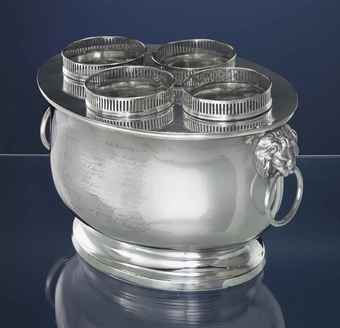
Upon leaving office in August of 1797, Washington gifted Hamilton and other cabinet members unique wine coolers that he had had commissioned for entertaining at the presidential residence.

Image from Christie’s

The wine cooler was one of several that George Washington had commissioned after his election as the first president of the United States.  In an October 1789 letter to Gouverneur Morris asking him to have these wine coolers made, Washington described his vision in detail, stating:

Of plated ware may be made I conceive handsome and useful Coolers for wine at and after dinner.  Those I am in need of viz. eight double ones (for Madeira and claret the wines usually drank at dinner) each of the apertures to be sufficient to contain a pint decanter, with an allowance in the depth of it for ice at bottom so as to raise the neck of the decanter above the cooler; between the apertures a handle is to be placed by which these double coolers may with convenience be removed from one part of the table to the other.  For the wine after dinner four quadruple coolers will be necessary. . . . The reason why I prefer an aperture for every decanter or bottle to coolers that would contain two and four is that whether full or empty the bottles will always stand upright and never be at variance with each other.

The inscription on the cooler, which copies a letter from Washington to Hamilton accompanying the gift states:

Mount Vernon, Aug. 21, 1797

My dear Sir.
Not for any intrinsic value the thing possesses, but as a token of my sincere regard and friendship for you, and as a remembrance of me, I pray you to accept a wine cooler for four bottles, which Colonel Biddle is directed to forward from Philadelphia, (where with other articles it was left,) together with this letter to your address. It is one of four which I imported in the early part of my late administration of the Government, two only of which were ever used.

I pray you to present my best wishes, in which Mrs. Washington joins me to Mrs. Hamilton, and the family, and that you would be persuaded that with every sentiment of the highest regard,

I remain your sincere friend,
and affectionate humble servant:
Geo. Washington.

A week late, Hamilton responded to Washington’s letter on August 28, 1797:

My Dear Sir:
The receipt two days since of your letter of the 21st inst., gave me sincere pleasure. The token of your regard which it announces, is very precious to me, and will always be remembered as it ought to be.

Mrs. Hamilton has lately added another boy to our stock; she and the child are both well.  she desires to be affectionately remembered to Mrs. Washington and yourself….”

Interestingly, this gift exchange took place as Hamilton was in the middle of publishing and dealing with the backlash of publicly confessing his affair with Maria Reynolds and entering into a major sex scandal.

The wine cooler was ultimately sold for $782,500 on January 19, 2012 to a collector named Gary Hendershott.  Hendershott’s website lists the wine cooler as one of several items related to George Washington that have been sold by his company to other collectors.

You may not be able to view the original wine cooler, but you can always see a replica of the wine cooler in the dining room at Hamilton Grange National Memorial.  A brochure created by the National Park Service staff at Hamilton Grange and available online describes the wine cooler:

There is another item in this room that is not an original item, but a reproduction, and it is the wine cooler. This wine cooler speaks volumes of the relationship between George Washington and Hamilton.

The dining room features a replica of a
Image from AMNY


If you happen to be in DC, you can also see another of the wine coolers, which Washington had presented to Secretary of State Timothy Pickering (before he was dismissed from John Adams’ administration) ironically in the John Quincy Adams State Drawing Room at the White House.

Hamil-Burrns: A Twisted Tale

I’ve written before about how John Adams maintained a lifelong hatred of Hamilton, even after Hamilton’s death.  Hamilton also distrusted Adams and had an integral role in ensuring his loss in the Election of 1800 by drafting a letter “Concerning the Public Conduct and Character of John Adams, Esq. President of the United States.”  A few months before Hamilton’s letter was released, he criticized Adams and his administration in a private July 1, 1800 letter to Maryland politician Charles Carroll.  Hamilton said of Adams:

“That this gentleman ought not to be the object of the federal wish, is, with me, reduced to demonstration. His administration has already very materially disgraced and sunk the government. There are defects in his character which must inevitably continue to do this more and more. And if he is supported by the federal party, his party must in the issue fall with him. Every other calculation will, in my judgment, prove illusory.

Doctor Franklin, a sagacious observer of human nature, drew this portrait of Mr. Adams:—“He is always honest, sometimes great, but often mad.” I subscribe to the justness of this picture, adding as to the first trait of it this qualification—“as far as a man excessively vain and jealous, and ignobly attached to place can be.”

Hamilton’s reference was to a July 1783 letter from Ben Franklin that has an interesting and twisted history of its own.

On July 22, 1783, Franklin wrote to Robert Livingston complaining of Adams’ persistent and public hostility to the French and warning that his attitude could have grave political consequences:

“I ought not however to conceal from You, that one of my Collegues is of a very different Opinion from me in these Matters. He thinks the french Minister one of the greatest Enemies of our Country; that he would have straitned our Boundaries to prevent the Growth of our people; contracted our Fishery to obstruct the Increase of our Seamen; and retained the Royalists amongst Us to keep us divided—that he privately opposes all our Negotiations with foreign Courts, and afforded us during the War the Assistance We received, only to keep it alive that We might be so much the more weakened by it. That to think of Gratitude to France, is the greatest of Follies, and that to be influenced by it, would ruin us. He makes no Secret of his having these opinions, expresses them publickly, sometimes in presence of the english Minister, and speaks of hundreds of Instances which he could produce in proof of them. None however have yet appeard to me, unless the Conversation and Letter above mentioned are reckoned such. If I were not convinced of the real Inability of the Court to furnish the farther Supplies We asked, I should suspect these Discourses of a person in his station, might have influenced the Refusal; but I think they have gone no farther than to occasion a Suspicion that We have a considerable party of Antigalicans in America, who are not Tories, and consequently to produce some Doubts of the Continuance of our Friendship. As such Doubts may hereafter have a bad Effect, I think We cannot take too much Care to remove them: and it is therefore I write this to put you on your Guard (beleiving it to be my Duty, tho I know that I hazzard by it a mortal Enmity) and to caution You respecting the Insinuations of this Gentleman against the Court, and the Instances he supposes of their Ill Will to us, which I take to be as imaginary as I know his Fancies to be that the Count de V[ergennes] and myself are continually plotting against him, and employing the News writers of Europe to depreciate his Character &c., but as Shakespear says “Trifles light as Air” &c.  Persuaded however that he means well for his Country, is always an honest Man, often a Wise one, but sometimes and in somethings absolutely out of his Senses.”

Robert Livingston then sneakily provided Franklin’s confidential letter to Abigail Adams via Elbridge Gerry in order to keep her informed about what Franklin was saying about her husband.  (This proves that you don’t need email or social media to get in trouble  about indiscreet past correspondence).  In his letter to Mrs. Adams, Gerry wrote:

Inclosed is an Extract of an official Letter from Doctor F—to Mr. Livingston Secretary of foreign affairs dated July 22d., which is calculated to give a private Stab to the Reputation of our Friend; at least it appears so to me. By the Doctors Observation that by writing the Letter “he hazzarded a mortal Enmity,” I think it evident, he did not intend the Letter should be seen by Mr. Adams’s particular Friends, but that Mr. Livingston should make a prudent Use of it to multiply Mr. Adams’ Enemies. Mr. L. could easily do this, by not communicating to Congress the paragraph: but being now out of Office,the Doctor’s Craft is apparent. You will please to keep the Matter a profound Secret, excepting to Mr. Adams, General Warren and Lady; and let the Channel of Communication be likewise a secret.

Of course, Abigail then sent the letter to John Adams in December of 1783, adding a scathing criticism that Franklin was one of many fools accidentally placed in a position of stature in public opinion of which he was unworthy:

“A Friend of yours in Congress some months ago, sent me an extract of a Letter, requesting me to conceal his Name, as he would not chuse to have it known by what means he procured the Coppy. From all your Letters I discoverd that the treatment you had received, and the suspence You was in, was sufficiently irritating without any thing further to add to Your vexation. I therefore surpresst the extract; as I knew the author was fully known to you: but seeing a letter from G[e]n. W[arre]n to you, in which this extract is alluded to; and finding by your late Letters, that your situation is less embarrassing, I inclose it; least you should think it much worse than it really is: at the same time I cannot help adding an observation which appears pertinant to me; that there is an ingredient necessary in a Mans composition towards happiness, which people of feeling would do well to acquire—a certain respect for the follies of Mankind. For there are so many fools whom the opinion of the world entittles to regard; whom accident has placed in heights of which they are unworthy, that he who cannot restrain, his contempt or indignation at the sight, will be too, often Quarrelling with the disposal of things to realish that Share, which is allotted to himself.” And here my paper obliges me to close the subject—without room to say adieu.”

Hamil-Burrn: Hamilton on Gen. Charles Lee and the Battle of Monmouth

Hamilton was not one to mince words, and his vitriol was especially sharp when it was directed to the forces undermining General Washington and the American forces during the Revolution.  One target with whom Hamilton had significant history and distrust was General Charles Lee.

In a July 5, 1778 letter to Elias Boudinot describing the Battle of Monmouth, Hamilton described Washington’s distinguished war council as a group of babies because of their desire to avoid direct confrontation with the British forces and wrote:

“When we came to Hopewell Township, The General unluckily called a council of war, the results of which would have done honor to the most honorable society of midwives, and to them only”

In a 1789 eulogy of Major General Nathanael Greene, Hamilton again exorciated the failed leadership of the war council before the Battle of Monmouth, describing it as “impotent” for allowing the British to retreat without pursuit.

It would be an unpleasing task and therefore I forbear to lift the veil from off those impotent Councils, which by a formal vote had decreed an undisturbed passage to an enemy retiring from the fairest fruits of his victories to seek an asylum from impending danger, disheartened by retreat, dispirited by desertion, broken by fatigue, retiring through woods defiles and morasses in which his discipline was useless, in the face of an army superior in numbers, elated by pursuit and ardent to signalise their courage.

Speaking directly about General Lee in his July 1778 letter to Boudinot, Hamilton wrote:

“Indeed, I can hardly persuade myself to be in good humour with success so far inferior to what we, in all probability should have had, had not the finest opportunity America ever possessed been fooled away by a man, in whom she has placed a large share of the most ill judged confidence.  You will have heard enough to know, that I mean General Lee.  This man is either a driveler in the business of soldiership or something much worse.”

Hamilton went on to describe General Lee’s cowardly performance at the Battle of Monmouth, noting that his leadership had led to troops retreating from the British forces, and that General Washington single-handedly brought order to the troops and rallied them to victory.

Seattle Panel Appearance at GeekGirlCon

On October 9, 2016, I’ll be speaking on a Hamilton panel at GeekGirlCon in Seattle!  Come check it out if you’re in the area!  Panel description is below and it is scheduled for October 9 at 3 pm:

Over the last year, Lin-Manuel Miranda’s musical Hamilton has become a Broadway and nationwide phenomenon, selling out tickets for performances over a year from now. We’ll explore the impact Hamilton has had in the theater world and beyond, from the fandom it’s inspired to the attention it’s brought to the women in Alexander Hamilton’s life. Come discuss a variety of topics related to the hit musical and the “founding father without a father” who inspired it.

LA Nerd Nite: Manhattan Well Murder Talk Tomorrow Night

On August 11, 2016, I’ll be giving a talk entitled “Murder in Manhattan!: Alexander Hamilton, Aaron Burr, and America’s first recorded murder trial.”  Tickets are available here and a description of my talk is below!

In March of 1800, the nation was transfixed by a high profile murder trial involving the death of a young woman found in the Manhattan Well. The defendant, Levi Weeks, was represented by a legal dream team of Alexander Hamilton, Aaron Burr, and Brockholst Livingston (less than four years before Burr would kill Hamilton in a duel). Pooja Nair will delve into the trial, which is the first recorded murder trial in American history, offering us unique insight into the workings of the criminal justice system of the era.

I’ve been focusing on research and on preparing talks for the past few months, but will be updating this blog more frequently and have some exciting posts scheduled for the end of August!